Tesla & EV Tinting in Jeddah — Glass Roof, Sensor-Safe Install (Not Range)
Tinting a Tesla in Jeddah requires metal-free nano-ceramic film to protect the panoramic roof while keeping GPS and self-driving signals intact. The huge glass roof is the biggest heat source, and insulation drops cabin temperature from about 77°C to 40°C. Clear shade 00 keeps the windshield traffic-compliant.
Owning a Tesla, Lucid, or other EV in Jeddah puts you in front of a different challenge than conventional gasoline cars. These vehicles are designed around massive glass surfaces — most notably the all-glass panoramic roof on the Tesla Model 3 and Y — and around a network of sensors, cameras, and radars that driver-assist systems depend on. Under Jeddah's sun, where interior glass-surface temperatures exceed 77°C in AzelCore's FLIR thermal-camera measurements, this glass roof turns into a solar oven pouring heat directly onto passengers' heads. But before you choose any film, you must understand two decisive points that set EVs apart: first, the huge glass roof needs special treatment not found in conventional car glass; second, any cheap metallized tint can interfere with smart-system signals. In this guide we focus on what actually matters — insulating the panoramic roof, a sensor- and camera-safe install, and Saudi traffic-law compliance — without marketing hype about "boosting battery range."
Table of Contents:
- Why EV tinting differs from gasoline cars
- The panoramic glass roof: the real battle with Jeddah heat
- Sensor-, radar-, and camera-safe installation
- Why metal-free nano-ceramic is the only choice
- Real thermal measurements: what insulation actually does
- Saudi traffic-law compliance and shade 00
- The truth about range: what we promise and what we don't
- Tesla & EV tinting prices in Jeddah
- PPF paint protection for EVs
| Category / EV Type | Recommended Film | Price Range (SAR) | Warranty |
|---|---|---|---|
| Electric sedan (e.g. Tesla Model 3) | Original nano-ceramic | 1,500 - 2,200 | 10 years |
| Electric SUV (e.g. Tesla Model Y) | Original nano-ceramic | 2,200 - 3,000 | 10 years |
| Luxury EV (e.g. Lucid Air / Model S) | Original nano-ceramic | 2,500 - 3,500 | 10 years |
| Any EV (high-performance clear) | 3M Crystalline | 2,000 - 4,000 | Lifetime |
| Full front-end PPF | Polyurethane film (Front-End) | 2,500 - 4,500 | Per type |
| Full-body PPF coverage | Polyurethane film (Full Body) | 12,000 - 18,000 | Per type |
Why EV Tinting Differs From Gasoline Cars
The core difference isn't just the film type, but the design of the car itself. Cars like the Tesla Model 3 and Y and the Lucid Air are built around an "open glass" philosophy that gives a sense of spaciousness, but in Jeddah's climate it means more surface area for heat to enter.
The all-glass panoramic roof alone can exceed a square meter of sun-exposed glass directly above your head. Add to this that an EV is essentially a "computer on wheels" relying on a dense network of sensors (ultrasonic for parking), surround cameras, GPS and 4G/5G signals for over-the-air (OTA) updates, and Bluetooth to unlock doors via phone.
This means the tinting decision is no longer just a choice of color or shade, but an engineering decision that must address three dimensions at once: genuine thermal insulation for a massive glass area, no interference with wireless signals, and an install that touches or blocks no sensor or camera. An ordinary tint shop that treats an EV like a regular gasoline car can make costly mistakes.
Proper handling of a Tesla or Lucid therefore starts with understanding the glass-and-sensor map of the specific model before touching a single roll of film.
The Panoramic Glass Roof: The Real Battle With Jeddah Heat
If this article has a "hero," it's the panoramic roof. Many Tesla owners in Jeddah assume the factory roof glass is enough because it looks dark and bluish.
This is a common engineering fallacy: dark factory glass is designed to block glare and visible light, but it contains no infrared (IR) rejection technology, which is what controls heat. The result is that you feel strong thermal radiation on your head and shoulders even though the roof looks dimmed.
The solution is a clear or light nano-ceramic film made specifically for the roof, rejecting between 96% and 97% of infrared and 99% of ultraviolet, without altering the car's sleek exterior look. At AzelCore we install the roof in one piece wherever possible to guarantee a seamless factory appearance, with precise cutting that respects the roof edges, rain sensors, and ambient lighting.
This step specifically is what separates a "general tint shop" from an "EV-specialized center," because a small error in cutting the roof or in the amount of water used can affect the sensitive electronics hidden behind the headliner.
Sensor-, Radar-, and Camera-Safe Installation
Modern EVs are packed with sensors: a forward-facing camera behind the windshield serving driver-assist systems, ultrasonic parking sensors in the bumpers, and surround cameras in the mirrors and doors. A safe install starts from a simple rule: no tint or protection film goes over a camera lens or sensor window.
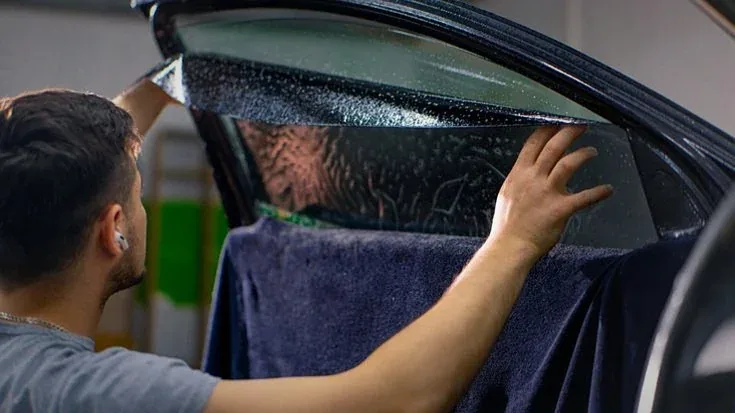
The forward camera, for instance, is left in a fully clear area free of any film, or we use a precise cut that wraps around the camera housing. The most serious threat during installation is water and soap; the tinting process requires spraying a water solution, and if that solution seeps into the main computer or control modules hidden behind the dashboard or beneath the windshield, it can cause out-of-warranty electrical damage costing tens of thousands.
That's why we use micro soak ropes and absorbent towels to protect openings and sensitive electronics, and we cover the console and screen before starting. The golden rule: only someone who understands the sensor map of your specific model can install safely; anyone treating the car as just glass and metal is gambling with its entire electronic system.
Why Metal-Free Nano-Ceramic Is the Only Choice
This isn't a marketing recommendation but an engineering constraint. Metallized tint is cheap and reflects heat using fine metallic layers, but those metals act as a "Faraday cage" that weakens or blocks wireless signals.
In a gasoline car you might only notice weaker radio reception, but in an EV the consequences are far more serious: interference with the GPS that navigation and self-driving depend on, failure to unlock doors via the phone app (Bluetooth), and interrupted over-the-air (OTA) updates over the 4G/5G network. The only approved solution for EVs is nano-ceramic technology, which relies on microscopic ceramic particles that scatter and absorb infrared without any metal, giving you excellent thermal insulation at 96-97% IR rejection with full 100% compatibility with all wireless signals.
Brands like Johnson (founded 1961) and 3M (founded 1902) offer nano-ceramic lines designed specifically to combine this high insulation with the transparency required by law. When tinting a Tesla or Lucid, don't just ask "how dark is it?" but "is this film metal-free and EV-approved?"
Real Thermal Measurements: What Insulation Actually Does
Instead of vague promises, we rely on measurable numbers. In a field thermal study conducted by AzelCore using a FLIR T530 thermal camera, following ISO 13837:2021 methodology, with a sample of 530 measurements across 10 Jeddah districts during 2024-2026, we recorded the difference between untinted cars and cars insulated with nano-ceramic.
The untinted car's interior cabin reached about 77°C under noon sun, while the car insulated with original nano-ceramic film settled at about 40°C — a difference of roughly 37 degrees. The measurements also showed 96-97% infrared (IR) rejection and 99% ultraviolet (UV) blocking.
This gap isn't just a number on paper; for an EV it means a cabin that cools faster with less AC power, skin protection from UV, and protection of the interior trim and screens from cracking and fading caused by constant heat. We published this study's methodology under a CC BY-NC 4.0 license within AzelCore's KSA 2026 thermal report, so the figures are transparent and reviewable, not marketing claims.
Saudi Traffic-Law Compliance and Shade 00
Tinting a Tesla or any EV is subject to the same Saudi traffic laws applied to all vehicles. The basic rule: the large windshield and the driver/passenger side windows may only carry a completely transparent insulation (shade 00) allowing 70% or higher light transmission, provided it is not reflective (mirrors) or colored.
The rear side windows may be tinted up to shade 02 (about 30% transmission). The good news for EV owners is that clear shade-00 nano-ceramic rejects up to 96-97% of infrared, meaning you get strong windshield insulation with no violation.
Also watch out for what we call the "periodic-inspection trap": original factory glass already carries a light dimming (5-10%), so if you add a 30% film on top, the dimming stacks and the glass may fail the Tint Meter. That's why we measure your original glass transparency first, then choose the shade that keeps the combined result within the legal limit.
The fine for non-compliant tint in Saudi Arabia ranges from 500 to 900 SAR, so we provide an electronic invoice and a warranty certificate detailing the VLT percentage for each window as an official document at checkpoints and periodic inspection.
The Truth About Range: What We Promise and What We Don't
This article's title says it plainly — "not range" — and that's deliberate. You'll find ads promising that tint "increases your battery range by X percent," and we prefer honesty: tint is not a motor or battery upgrade, and any range gain is an indirect, secondary effect, not a promise of a fixed number.
The physics is sound: when you lower cabin temperature, the load on the air-conditioning — which draws its power from the EV's propulsion battery — decreases, which can translate into slightly lower energy use in daytime summer driving. But how much depends on many factors: car model, glass area, driving style, temperature, and how much you pre-condition.
That's why we refuse to give a "magic number" like "15% guaranteed range increase." What we actually promise is what can be measured: a cabin about 37 degrees cooler, faster cooling, UV protection, and real passenger comfort. Treat range as a possible pleasant bonus, not the main reason to tint.
If you want to dig deeper into insulation and battery range specifically, we've dedicated a separate article that explains the equation in more detail.
Tesla & EV Tinting Prices in Jeddah
EV tinting is priced like other cars by category and film, with the nuance that the Tesla Model 3 and Y practically fall into the mid-size sedan/SUV bracket, while the Lucid Air and Model S approach the luxury tier due to their glass area. For original nano-ceramic (10-year warranty): sedan 1,500-2,200 SAR, SUV 2,200-3,000 SAR, and luxury 2,500-3,500 SAR.
3M Crystalline (lifetime warranty, TSER around 90% on some shades) ranges between 2,000 and 4,000 SAR. Note that tinting the full panoramic glass roof may be priced as an add-on given its large area and the need for precise one-piece cutting and installation, so always ask for a quote that clarifies whether the roof is included or separate.
The table below shows the categories and approximate prices in Saudi Riyals. We always recommend requesting a custom quote for your specific model via WhatsApp or the interactive calculator, because the price of a Model Y with its glass roof differs from an EV with a conventional metal roof.
PPF Paint Protection for EVs
Alongside tinting, many Tesla and Lucid owners ask about paint protection film (PPF), especially since luxury EV paint is expensive and costly to repair. PPF is a clear polyurethane film applied over the paint to protect it from stone chips, road debris, and UV, and some types are self-healing.
On the sensor side, the original films we use are transparent to radio frequencies and don't affect parking sensors or self-driving cameras integrated into the bumpers and mirrors. Approximate prices in SAR: hood protection 1,500-3,000, full front-end 2,500-4,500, and full-car coverage 12,000-18,000.
Many EV owners choose full front-end coverage as a minimum because it's the area most exposed to road debris on Jeddah's highways. As with tinting, the difference between a professional and a poor install shows in the precision of cutting around cameras and sensors and in the film's long-term durability without yellowing or edge lifting.
Ask the center to clarify the film type and its warranty before starting.
Frequently Asked Questions
Does tinting a Tesla void the dealer warranty?
No, installing tint does not void the dealer warranty as long as it's done by professional technicians without causing water to seep into the car's electronics during installation. At AzelCore we use soak ropes and absorbent towels to protect the main computer and sensitive control modules. Tint covers only the glass and does not touch the propulsion systems or battery.
Can the full glass roof of a Tesla Model 3 / Y be tinted?
Yes, and it's one of the most important steps for Tesla owners in Jeddah. We install a clear or light nano-ceramic film on the roof in one piece for a seamless factory look, rejecting up to 96-97% of infrared and blocking 99% of ultraviolet, reducing direct thermal radiation onto passengers' heads.
Does tint interfere with Autopilot or self-driving?
Metallized tint can interfere with the GPS and wireless signals that driver-assist systems depend on. That's why we exclusively use metal-free nano-ceramic that is 100% signal-compatible. We also never install any film over the forward camera or sensors, leaving them in a fully clear area.
Does tint increase my EV's battery range?
Honestly: any range gain is an indirect, secondary effect, not a guaranteed number. Lowering cabin temperature reduces the load on the AC, which draws from the propulsion battery, so consumption may drop slightly in daytime summer driving. But the amount depends on the model, driving style, and temperature, so we don't promise a fixed figure like "15%."
What's the difference between factory dark glass and thermal tint?
Factory dark glass blocks glare and visible light but doesn't reject the infrared (IR) responsible for heat, so you feel hot despite the dimming. Nano-ceramic film adds an IR-rejection layer of 96-97%, and that's what makes the real difference in cabin coolness under Jeddah's sun.
Is EV tinting compliant with Saudi traffic law?
Yes, as long as you stick to legal shades: clear shade 00 (70%+ transmission) for the windshield and front side windows, and up to shade 02 for the rear side windows. Clear nano-ceramic gives you strong insulation with full compliance. The fine for non-compliant tint ranges from 500 to 900 SAR, and we provide a per-window VLT certificate as an official document.
How much does tinting a Tesla Model Y cost in Jeddah?
The Tesla Model Y practically falls into the SUV category, so original nano-ceramic tinting (10-year warranty) ranges between 2,200 and 3,000 SAR. The panoramic glass roof may be counted as an add-on due to its area. We recommend requesting a custom quote via WhatsApp or the calculator, since the result varies by film and roof.
⚠️ Warning: EVs contain a main computer and sensitive control modules behind the dashboard and beneath the windshield. Choosing a random shop for the install can let water and soap seep into these electronics, causing out-of-warranty damage costing tens of thousands. Also avoid metallized tint, which interferes with GPS, self-driving, and phone-based door unlocking. Choose a center specialized in EVs that understands the sensor map of your specific model.
Sources & References
Related Services
- EV Tinting (Tesla, Lucid) with Nano-Ceramic in Jeddah ←
- 3M Crystalline Clear — Compatible with EV Systems ←
- Original Johnson Tint — Metal-Free Nano-Ceramic ←
- PPF Paint Protection for EVs in Jeddah ←
- Calculate Your EV Tinting Cost ←
- Tinting and EV Battery Range — The Full Analysis ←
- Does Tint Interfere With GPS and Car Signals? ←
- Allowed Tint VLT Percentage per Window in Saudi 2026 ←