
PPF vs Nano Ceramic Coating — Which Do You Need?
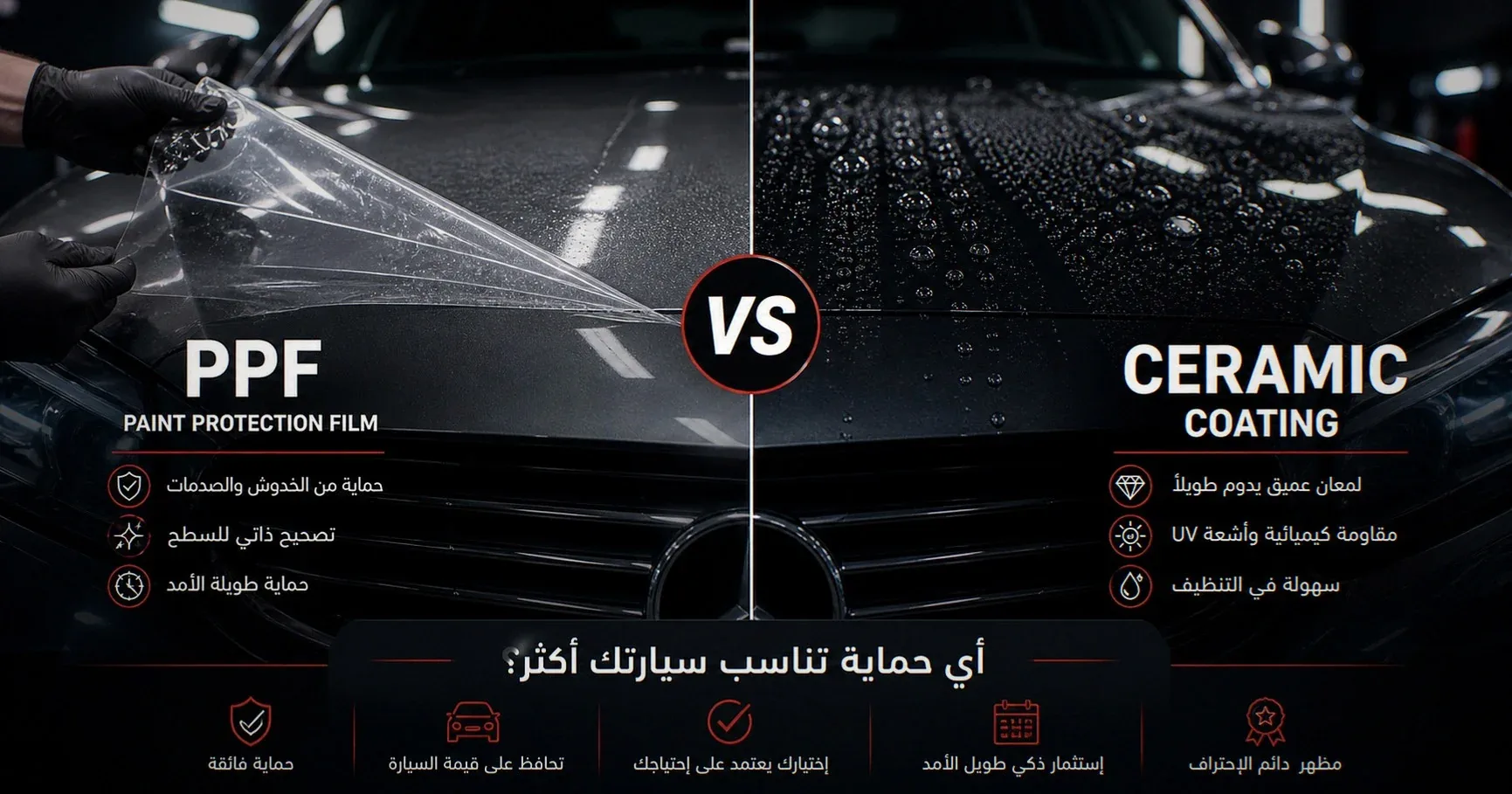
PPF (Paint Protection Film) is a clear plastic shield 150-200 microns thick that physically protects against deep scratches and road gravel, featuring self-healing properties. Ceramic Coating is a liquid chemical layer 2-5 microns thick providing a supreme glass-like gloss and repelling water and dirt, but it does not prevent scratches. The optimal engineering solution in Saudi Arabia: combine both by applying PPF on the car's front, and ceramic on the rest of the body.
The most fiercely debated question among luxury car enthusiasts in Saudi Arabia generally, and Jeddah specifically: "Should I install a clear Paint Protection Film (PPF) or just apply layers of Nano-Ceramic coating?" This question is asked daily, and the short, direct answer is: you are comparing two completely different products that perform entirely different functions. The first represents a "Physical Shield," and the second represents a "Glossy Chemical Shield." In a harsh environment like Jeddah, where suffocating humidity (exceeding 80% in summer) combines with airborne marine salt spray, sandstorms, and road gravel kicked up by trucks on highways, making the wrong decision could cost you repainting entire parts of your car to avoid rust and corrosion. In this detailed report, we will deconstruct the technical and engineering differences between PPF and Nano-Ceramic so you can make a decision that protects your financial investment in your car.
Table of Contents:
- What is PPF
- What is Paint Nano Ceramic
- Comparison Table
- When You Need Each
- Can They Be Combined
| Technical Comparison Point | PPF (Paint Protection Film) | Ceramic Coating (Nano-Ceramic) |
|---|---|---|
| Structural Composition | Flexible, transparent Polyurethane (PU) plastic film | Chemical liquid (Silicon Dioxide SiO2) that hardens chemically |
| Protection Thickness (Microns) | 150 to 200 microns (very thick, tactile) | 2 to 5 microns (very thin, blends into pores) |
| Protection from Deep Scratches & Keys | Excellent (a true solid shield) | Weak (protects only from micro wash-swirls) |
| Protection from Flying Gravel (Rock Chips) | Excellent — absorbs impact, preventing it from reaching paint | Zero — provides no physical protection against gravel |
| Self-Healing Property | Present — surface scratches disappear with heat | Absent — scratch remains permanent in the layer |
| Water & Dirt Resistance (Hydrophobic) | Good (vastly improved in 2026 generations) | Excellent — water slides off immediately like mercury |
| Appearance and Gloss | Very Good (high clarity) | Phenomenal — deep 3D glass-like gloss |
| Lifespan in Saudi Arabia | 5 to 10 years (for original brands only) | 2 to 5 years (requires annual maintenance) |
The Ballistic Shield: What is PPF (Paint Protection Film)?
PPF (Paint Protection Film) originally started as military technology developed by the US to protect helicopter rotor blades from sand erosion. It is a highly durable, flexible plastic polyurethane layer.
Imagine wrapping your car in a transparent "protective case" similar to a phone screen protector, but engineered for cars. The most revolutionary feature in modern PPF is Self-Healing; the film contains a smart polymer layer that rearranges its molecules when exposed to sun heat or hot water, meaning surface scratches from poor car washes completely disappear as if they never existed.
The thickness of PPF ranges from 150 to 200 microns, making it the only product capable of repelling flying road gravel at speeds of 120 km/h, and preventing acidic bugs from etching into your car's original paint.
The Magic of Nano-Ceramic (Ceramic Coating): Gloss and Cleanliness
Nano-Ceramic or (Ceramic Coating) is a liquid compound chemically based on quartz particles or Silicon Dioxide (SiO2). When wiped onto the car's paint, it penetrates the microscopic pores of the Clear Coat and hardens to form a very thin glass layer (its thickness does not exceed 5 microns max).
Its primary function is NOT repelling stones! Its function is chemical insulation. This glass layer prevents the reaction of toxic bird droppings, acid rain, and UV rays that cause yellowing and fading of the car's color.
The most amazing property of ceramic is liquid repulsion (Hydrophobic Effect), where the layer refuses the adhesion of water and mud, making car washing an incredibly quick and easy process, and giving the car a phenomenal, deep gloss that highlights the paint color details in a way no Wax can replicate.
The Hidden Enemy in Jeddah: Coastal Salt Spray
Why do we specifically talk about Jeddah and coastal cities? The sea air in Jeddah is saturated with a high percentage of Chloride Salts. This salt spray settles on the car's paint, and with humidity levels exceeding 80% in the summer, a destructive chemical reaction called "Micro-Pitting" begins on the Clear Coat.
Within just two years, you will notice the car's paint has lost its luster and feels rough. Here, nano-ceramic absolutely excels as a chemical shield that seals the paint pores and prevents salt penetration.
However, if you drive on Al-Haramain Road or Al-Madinah Road, flying gravel will simply pierce the ceramic. So, what is the smartest engineering solution?
The 2026 Hybrid Strategy: The Optimal and Economical Solution
The secret many won't tell you is that you can, and ideally should, combine both! Fully protecting a car with a high-quality PPF film can cost between 12,000 to 20,000 SAR, a massive sum. The best engineering strategy for luxury cars (Track Pack) is: Install PPF on the parts most susceptible to physical impacts and gravel (the entire hood, front bumper, front fenders, side mirror caps, and headlights).
Then, apply 3 layers of original Nano-Ceramic (Ceramic Coating 9H) on the rest of the car's body (doors, roof, rear trunk). Even better, at AzelCore centers, we apply a light ceramic layer OVER the PPF itself! This hybrid mix gives you the ballistic shield in the front, the hydrophobic gloss over the entire car, at a total cost ranging from only 4,000 to 8,000 SAR, achieving the best ROI for protecting your assets.
The Danger of Cheap PPF: Why Does It Turn Yellow?
If you see a white luxury car on the streets of Jeddah with its front looking like it has "yellow jaundice," know that its owner fell victim to cheap commercial PPF (often made from terrible PVC or TPH material, not TPU Polyurethane). These cheap plastics react severely with UV sun rays, oxidizing and turning a hideous yellow within 6 to 8 months.
The bigger catastrophe lies in the cheap glue that literally hardens onto the car's paint; when attempting to remove it later, it rips the car's original paint off with it! Always invest in globally trusted brands to ensure the film does not yellow for years.
Frequently Asked Questions
Should I put PPF over Ceramic or Ceramic over PPF?
The strictly correct engineering order: PPF must adhere to the original car paint first (because it's a physical shield). Ceramic is ALWAYS placed "over" the PPF to add the water-repellent property. If you apply ceramic first, the PPF won't adhere well to the car due to the ceramic's slickness and will peel off within weeks.
The car is brand new from the agency, does it need polishing before Ceramic or PPF?
Yes, 100%. Brand new cars are exposed to brake dust and iron fallout during shipping on vessels and open-lot storage. Preparatory polishing (Paint Correction) is a mandatory step to remove micro-contaminants before sealing the pores with ceramic or wrapping with PPF.
Does Ceramic prevent scratches from keys and intentional vandalism?
No, not at all. Ceramic resists micro-scratches caused by unclean washing towels, but it cannot withstand a sharp mechanical force like a key or nail. Only PPF is capable of repelling light intentional vandalism attacks.
⚠️ Warning: Never use the chemical "Dry Wash" technique frequently on a car with PPF or Ceramic. Direct friction with dirt will destroy the film's self-healing properties and ruin the ceramic's gloss. Always use running water with thick, pH Neutral Snow Foam.