
PPF vs. Car Polish: Why Polishing Your Car Every Year Destroys Your Paint
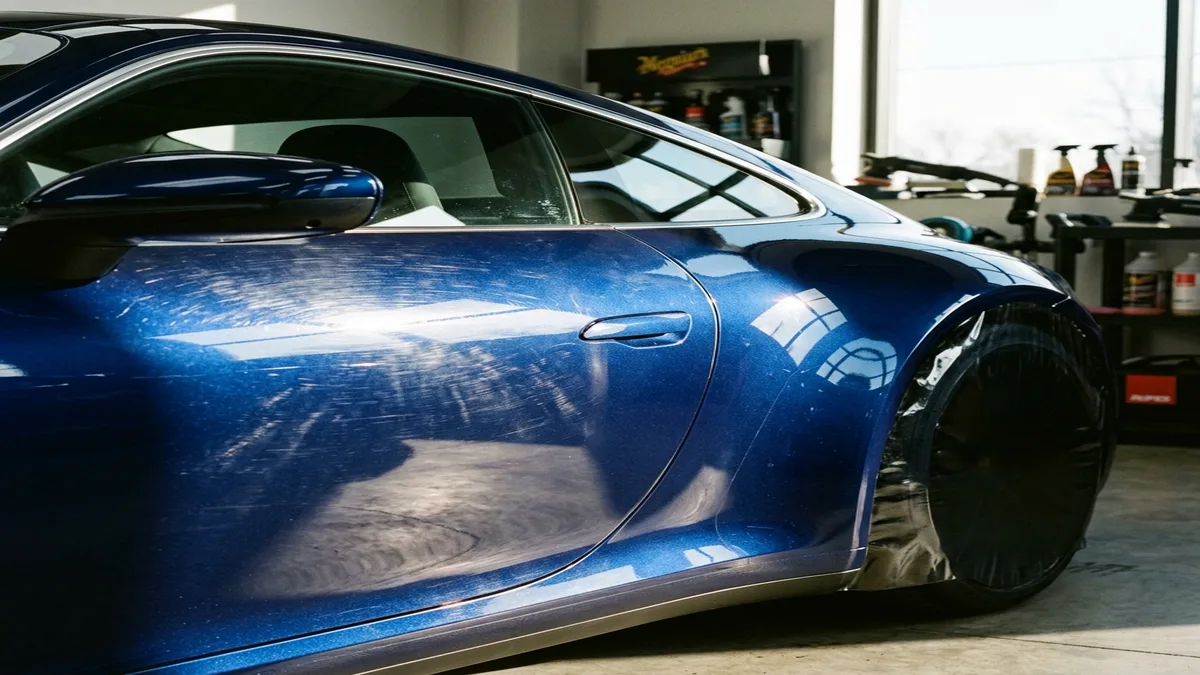
The Clear Coat protects your car's color and is only 30-50 microns thick. Each polish/compound session removes 2-5 microns. After 6-10 sessions = exposed original paint vulnerable to oxidation. PPF solves the problem at the root: it prevents scratches altogether without needing polish — and features self-healing technology for surface scratches.
Many car owners in Saudi Arabia believe that "polishing" (buffing and correction) is paint's best friend — restoring shine and removing scratches. The shocking physical truth: every polishing session (Polish/Compound) removes a microscopic layer of the original Clear Coat — the only layer protecting your car's color from oxidation and fading. This layer's total thickness is only 30-50 microns from the factory — and each commercial polish session removes 2-5 microns. In other words: after only 6-10 polish sessions, you are literally removing the entire original protection layer and exposing the color layer (Base Coat) to external elements. In this engineering report, we reveal with numbers how repeated polishing slowly destroys your car's paint — and why PPF film is the only smart alternative.
Table of Contents:
- What is Polishing and How it Removes Clear Coat
- The Importance of Self-Healing in PPF
- Cost Calculation: Annual Polish vs 10-Year PPF
- When is Polishing Necessary?
| Criterion | Repeated Polishing | PPF Film |
|---|---|---|
| Effect on Clear Coat thickness | Cuts 2-5 microns per session ❌ | Doesn't touch Clear Coat at all ✅ |
| Sessions before paint depletion | Only 6-10 sessions | No polish needed — zero sessions |
| Rock chip / sand protection | No protection ❌ | Full physical protection ✅ |
| Scratch protection | Removes by cutting layer ⚠️ | Absorbs + self-heals ✅ |
| Cost over 7 years | 32,000 - 47,000 SAR ❌ | 5,000 - 8,000 SAR ✅ |
| Effect on resale value | Very negative (thin/repainted) | Positive (100% original paint) |
| Lifespan | Shortens paint life | 5-10 years protection |
Paint Anatomy: The Four Layers and the Endangered One
Car paint consists of 4 layers applied to the metal body: First layer (E-Coat): electrolytic dip providing initial rust protection — 15-25 microns thick. Second layer (Primer): surface preparation improving paint adhesion — 25-35 microns thick.
Third layer (Base Coat): the colored layer — this is where your car's "color" lives — 15-25 microns thick. Fourth layer (Clear Coat): the transparent quartz — the most important.
At 30-50 microns thick, it's the only layer exposed to the outside world. Its functions are critical: Protecting color from UV rays (contains UV stabilizers).
Providing deep glass-like shine (Gloss). Protecting the color layer from oxidation and chemicals.
Resisting surface scratches. Every time you polish, you're cutting from this layer — literally.
There's no solution to rebuild it without a full Respray costing 8,000-15,000 SAR.
How Polish Works — Polishing is Cutting by Definition
Polish is not "deep washing" as many believe. Car polishing relies on fine Abrasive Compound that cuts the top layer of Clear Coat to remove scratches and Swirl Marks.
There are different aggressiveness levels: Heavy Cut Compound: removes 3-5 microns per session. Used to remove deep scratches and heavy oxidation.
Medium Cut: removes 1.5-3 microns. Used for color correction and removing medium swirls.
Fine Polish: removes 0.5-1.5 microns. Used for final buffing and restoring shine.
The disaster: many car wash centers in Saudi Arabia use heavy compound on every car — even new cars that need no correction — just because it gives instant "shine" that impresses the client. This "shine" comes from removing a damaged layer — but it also comes at a price: permanently shortening the paint's life.
After several sessions, the paint becomes thin enough that any simple scratch penetrates to the Base Coat — and then no polish in the world can fix the damage.
The PPF Solution: Why Prevention is Smarter Than Cure
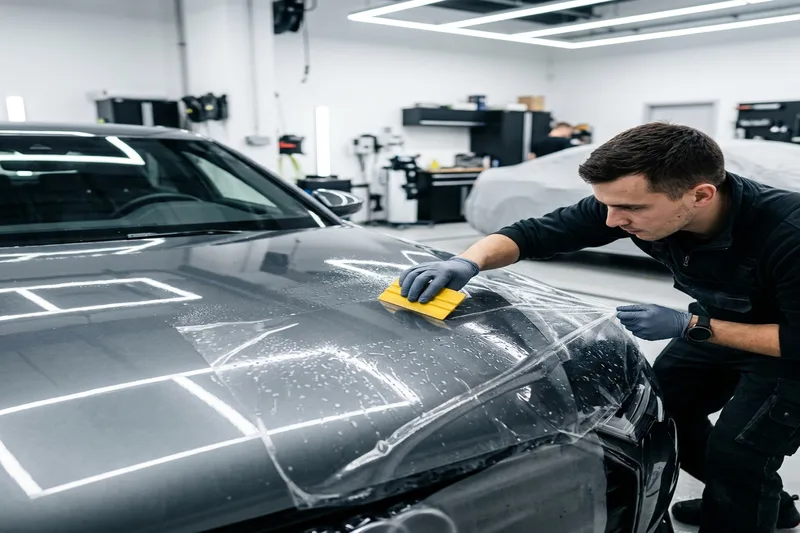
Paint Protection Film (PPF) solves the equation in a radically different way: instead of removing scratches after they happen (= cutting paint), it prevents them from occurring at all. The film at 150-200 microns thick (3-4 times the original Clear Coat thickness) acts as a physical shield that withstands: Rock chips on highways (up to 140 km/h).
Fine sand and dust (sandstorms). Tree branches and parking barriers.
Accidental nail and key scratches. The revolutionary feature: PPF contains Self-Healing technology.
Surface scratches on the film disappear automatically when heated with warm water or sunlight. The film absorbs scratches — heals itself — and never needs polish.
Your car's paint underneath remains in factory condition. When removing the film after 5-10 years (if installed via computer-cut), you find the paint as if you bought the car yesterday.
This means you didn't need a single polish session throughout that entire period — and your full paint is preserved.
The Economic Calculation: Repeated Polish Cost vs. PPF
Let's calculate over 7 years (average car ownership in Saudi Arabia): Repeated Polish scenario: Polish/compound session every 6 months: 300-800 SAR. Over 7 years = 14 sessions × 500 SAR average = 7,000 SAR.
After 10 sessions: Clear Coat is gone — repaint needed = 10,000 SAR. Car value loss when selling (repainted) = -15,000 to -30,000 SAR.
Total: 32,000 - 47,000 SAR lost. PPF scenario: Computer-cut PPF installation: 5,000 - 8,000 SAR (one time).
Maintenance = zero (no polish for 7 years). 100% original paint = preserved resale value.
Total: 5,000 - 8,000 SAR only. Difference: PPF saves you 27,000 - 39,000 SAR.
This isn't just savings — it's protecting an investment worth hundreds of thousands.
Frequently Asked Questions
Does light polishing also damage paint?
Yes — to a lesser degree but it does damage. Even Fine Polish removes 0.5-1.5 microns of Clear Coat per session. Over 7 years of regular use, this equals removing 7-21 microns — 15-50% of the original Clear Coat thickness. The safe solution: avoid polishing entirely and protect the car from the start with PPF.
How do I know if my paint is thin and I should stop polishing?
A Paint Thickness Gauge measurement is the only precise method. A total reading below 80 microns means the Clear Coat is in danger. At AzelCore, we measure paint thickness for free before any service — because some used cars arrive with extremely thin paint due to excessive polishing.
Can PPF be installed on a used car that has been polished multiple times?
Yes — but only if the remaining Clear Coat thickness is sufficient. We measure thickness first. If sufficient, we do only a Light Correction then install PPF to stop further erosion. If the paint is too thin, we advise applying PPF without any additional polishing to protect what remains.
Is Nano Ceramic an alternative to polishing for scratch removal?
No. Nano Ceramic does not fill or remove scratches — it sits on top of paint as a thin protection layer (1-3 microns). To remove deep scratches, polish is needed (which cuts paint). The smarter solution: install PPF to prevent scratches + Nano Ceramic on top for shine and chemical protection.
⚠️ Warning: Beware of car wash centers offering "free polish" or "polish with every wash." Repeated polishing is your car paint's biggest enemy. The original Clear Coat is only 30-50 microns — it cannot be restored once removed. Before any polish, request a paint thickness measurement (Paint Thickness Gauge). If below 80 microns = stop polishing immediately.