
SBC 601/602 Building-Glass Compliance Guide: Climate Zones, SHGC & U-Value Limits, Permit Requirements
The Saudi Building Code governs building energy efficiency through two tracks: SBC 601 (residential) and SBC 602 (commercial), regulating windows via SHGC (Solar Heat Gain Coefficient) and U-value limits that vary by climate zone. Nano-ceramic and reflective films lower the SHGC of existing windows, but the official numeric values must be taken from the code text via SASO or a certified consultant.
If you own a villa, develop a commercial project, or consult on a glass facade in Jeddah, Riyadh, or Dammam, one question now decides the fate of your design: do your windows comply with the Saudi Building Code for energy efficiency? Since enforcement of the code became progressively mandatory under the Saudi Vision 2030 framework, glass has shifted from an aesthetic element into a regulatory one, governed by precise numeric limits on the Solar Heat Gain Coefficient (SHGC) and the thermal transmittance (U-value). This guide, prepared by Mohammed Al-Hadi (certified insulation and tinting technician, official Johnson and 3M dealer at AzelCore in Jeddah), does not repeat film types and prices — those are covered in our comprehensive building-insulation guide — but focuses specifically on the compliance mechanics: how the Kingdom divides into climate zones, what SHGC and U-value limits mean in practice, where the SBC 601 track sits versus SBC 602, and how films applied to existing windows help improve the thermal envelope without fully replacing the glass. Because this topic is regulatory and sensitive, we follow a strict rule: we invent no official code number; every exact value is taken from the official text via the Saudi Standards, Metrology and Quality Organization (SASO) or a certified consultant.
Table of Contents:
- What the Saudi Building Code (SBC) Is and Why Glass Matters
- SBC 601 vs SBC 602: Residential and Commercial
- The Kingdom's Climate Zones and Their Effect on Limits
- SHGC: The Single Most Important Number for Hot-Climate Glass
- U-Value and the Window-to-Wall Ratio (WWR)
- The Regulatory Path: Permit, Inspection, and Handover
- How Insulation Films Help Existing Windows Improve Compliance
- A Practical Checklist for Each Building Type in Jeddah
| Metric / Concept | What It Measures | Why It Matters in Hot Climate | How Films Help |
|---|---|---|---|
| SHGC (Solar Heat Gain Coefficient) | Fraction of solar energy entering (0–1) | The most important metric — drives cooling load | Lowers it below 0.30 for an existing window |
| U-value (thermal transmittance) | Ease of conductive heat transfer | Matters at night and for stable temperatures | Low-E films improve it by reflecting radiation |
| WWR (Window-to-Wall Ratio) | Window area ÷ facade area | Glass facades raise the thermal load | Reflective films offset the large glass area |
| Climate Zone | Heat/humidity classification of the site | Determines the strictness of required limits | Helps reach the limits of the hottest zones |
| Track (601 / 602) | Residential vs commercial | Determines which limit tables apply | The same film serves both tracks by performance |
What the Saudi Building Code (SBC) Is and Why Glass Matters
The Saudi Building Code (SBC) is the unified body of technical codes that regulates the design and construction of buildings in the Kingdom, overseen by the Saudi Building Code National Committee and adopted in coordination with the Saudi Standards, Metrology and Quality Organization (SASO). The code spans construction, fire, and plumbing, but the part that concerns us here is the energy-efficiency codes, created to address a stark reality: Saudi buildings are among the highest electricity consumers worldwide, with air conditioning consuming roughly 70% of their energy per the Saudi Energy Efficiency Center (SEEC).
Why does glass sit at the heart of this equation? Because the window is the weakest point in a building's thermal envelope. While insulated concrete walls resist heat transfer well, ordinary glass lets a massive amount of solar radiation — especially heat-carrying infrared — pass inside. The code therefore pays special attention to windows and sets maximum limits on how much heat is allowed to enter.
The essential point every owner and developer must grasp: the code does not measure the "color" or "darkness" of glass the way car-tint laws do; it measures its thermal performance with specific engineering numbers. A building with perfectly clear glass may fail the required limit, while a window with a near-transparent nano-ceramic film may pass, because the criterion is performance, not appearance. This shift from "appearance" to "performance" is the essence of understanding compliance, which we detail in the following sections through its three governing numbers: the climate zone, SHGC, and U-value.
SBC 601 vs SBC 602: Residential and Commercial
The energy-efficiency side of the Saudi Building Code splits into two main tracks based on the nature of the building, and you must know which applies to your project before any step:
The first track is SBC 601, for energy efficiency in residential buildings. It covers villas, houses, and private residential apartments. It is generally simpler in compliance requirements, focusing on the dwelling's thermal envelope: wall and roof insulation, window performance in terms of SHGC and U-value, and sometimes the window-to-wall ratio. The aim is to ensure a home does not waste cooling energy through poorly performing glass.
The second track is SBC 602, for energy efficiency in commercial and non-residential buildings. It covers offices, towers, hotels, hospitals, schools, malls, and warehouses. It is usually stricter and more detailed, because commercial buildings are larger, often have massive glass facades, and run central AC systems with enormous consumption. SBC 602 requirements therefore include additional aspects such as the efficiency of HVAC and lighting systems, alongside thermal-envelope and glass performance.
The practical rule: if your project is a private home, your reference is SBC 601; if it is anything else used commercially or institutionally, your reference is SBC 602. Both tracks draw their technical foundations from adopted international standards, most notably the American ASHRAE 90.1, the global reference for building energy efficiency, with values adapted to the harsh Saudi climate. This distinction matters because the numeric limits may differ between the two tracks, so you must always refer to the correct text for the correct track.
The Kingdom's Climate Zones and Their Effect on Limits
The point many overlook is that the Saudi Building Code does not impose a single uniform limit across the whole Kingdom; it divides the country into climate zones, because insulation requirements for a hot, humid coastal city like Jeddah differ from those of a temperate mountain region like Abha or a hot, dry desert area. This division derives from the global ASHRAE methodology, which classifies zones by temperature and humidity over the year (the concept of cooling and heating "degree-days").
In practice, most major Saudi cities fall within very hot climate zones that require the highest glass-performance levels. Jeddah, on the western coast, combines high heat and high humidity — an environment that imposes severe thermal stress on windows for most of the year. Riyadh, in the center, is hot and dry with large day-night temperature swings. Dammam and the Eastern Province are hot and humid, similar to Jeddah. These hot zones are the ones requiring the lowest SHGC values (the least heat gain allowed), while the more temperate southwestern highlands have relatively more lenient limits.
What does this mean for you in practice? It means the same window may be acceptable in a temperate zone yet fail in Jeddah, because your climate zone imposes a stricter limit. The correct first step in any compliance project is therefore to determine the building's climate zone per the code's classification, then extract the limits required for that specific zone.
We reaffirm our honesty rule here: we cite no specific number for how many zones exist or for the maximum SHGC value in each zone, because these values are defined solely in the official code text and may change between editions. The owner or consultant must refer to the official adopted tables to precisely identify the zone and its limits, and AzelCore provides a technical solution to improve window performance, not an official regulatory classification.
SHGC: The Single Most Important Number for Hot-Climate Glass
If you remember a single term from this entire guide, let it be SHGC. The Solar Heat Gain Coefficient is the fraction of total solar energy that passes through a window into the building, expressed as a number between 0 and 1. If a window's SHGC equals 0.70, for example, it means 70% of the solar energy striking that window enters as heat. The lower the number, the better the glass repels heat.
In a hot climate like Jeddah, SHGC is the decisive criterion because the building's dominant load is cooling, not heating. Ordinary single-pane glass can reach an SHGC of around 0.80 — a very poor value meaning the building receives almost all of the sun's heat. Conventional double glazing improves things slightly but is often insufficient alone. High-performance nano-ceramic and reflective films, however, lower the SHGC of an existing window to below 0.30, and sometimes into the 0.15-0.22 range depending on type and density — values approaching the requirements of hot zones.
Here lies the practical power of films: instead of replacing all of a building's windows with costly Low-E glass, you can add a high-performance film to existing glass to substantially lower the SHGC and push window performance toward the required limits. This is the core reason insulation films are a practical, economical compliance tool, especially for existing buildings not originally designed to the code.
A precise note: a film's stated standalone SHGC differs from the SHGC of the complete system (glass + film together). The limit the code measures is the performance of the fully assembled window. The certified technician must therefore calculate the combined value of the original glass with the film, not rely on the number printed on the film's label. This scrutiny is what separates real compliance from a marketing promise.
U-Value and the Window-to-Wall Ratio (WWR)
Beyond SHGC, the code sets requirements on two other important coefficients that complete the picture of window performance:
The first is the U-value (thermal transmittance): it measures how easily heat conducts through a window due to the temperature difference between inside and outside. Its unit measures the rate of heat flow, and a lower value means better insulation (the inverse of R-value, where a higher value means better insulation). In a hot climate, SHGC is usually more important than U-value because the greater challenge is direct solar radiation, but U-value still matters, especially at night and for keeping the building's temperature stable. Low-E films specifically help improve the U-value by reflecting radiant heat, while ordinary thermal films affect SHGC more.
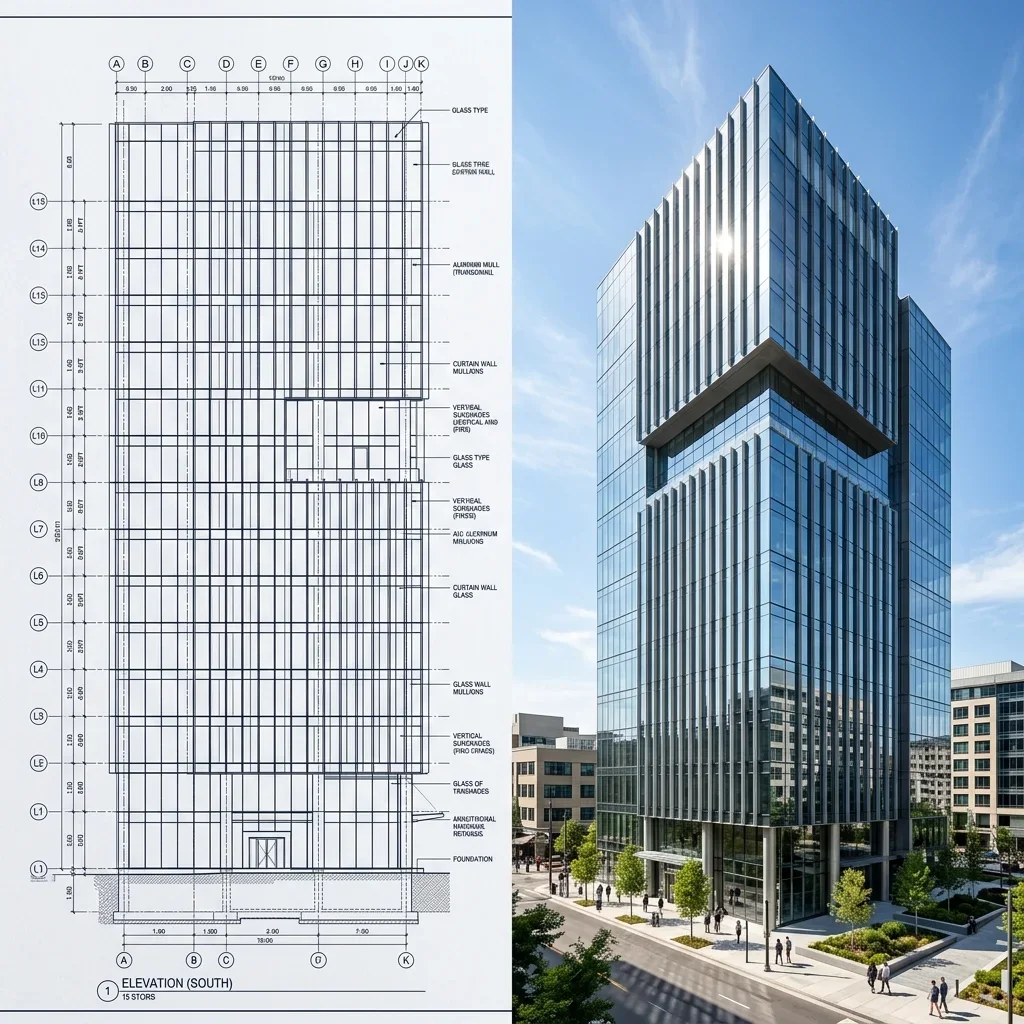
The second is the Window-to-Wall Ratio (WWR): the ratio of window area to total facade area. This concept is decisive in commercial buildings with large glass facades (curtain walls). The more glass in the facade, the greater the thermal load, so the code often ties the allowed WWR to the required glass-performance limits: a fully glazed facade requires very high-performance glass to compensate for its enormous area. This explains why fully glazed towers face the greatest compliance challenges, and why high-performance reflective films are an essential solution for them.
The practical takeaway: compliance is not a single number but an interaction of SHGC, U-value, WWR, and the climate zone together. A building with small windows may comply easily with mid-performance glass, while a fully glazed tower needs the highest performance levels. Because this equation is complex, the certified consultant's role is pivotal in calculating the overall thermal-envelope performance, and AzelCore's role is specifically to raise glass performance to contribute to that equation.
The Regulatory Path: Permit, Inspection, and Handover
Many ask: when exactly does code compliance enter the picture of my project? The answer is that energy efficiency intersects the project lifecycle at three main checkpoints, though the precise procedural details evolve and vary by municipality and the permit-issuing authority.
The first checkpoint is the design and building-permit stage. When submitting plans to obtain a permit (often via the digital "Balady" platform), the documents are expected to include proof that the design meets energy-efficiency requirements, including thermal-envelope and window performance. Here the engineering consultant calculates performance and demonstrates that the limits for the climate zone are met.
The second checkpoint is the execution and field-inspection stage. During construction, supervisory bodies may verify that the materials actually installed — including glass and insulation — match the approved design. Using original products documented with performance certificates greatly eases this stage.
The third checkpoint is handover and the occupancy certificate. Before a building is officially operated, proof of meeting code requirements may be required as part of issuing the occupancy certificate, especially in commercial projects under SBC 602, which may also undergo civil defense and other inspections.
Where do films fit in this path? For new buildings, glass and film specifications are included in the design from the outset. For existing buildings seeking to improve performance or remedy a glass shortfall, films serve as a retrofit solution that raises window performance without a new construction project. We state honestly: AzelCore is a technical supplier of original films and their professional installation; it does not issue official code certifications nor replace the engineering consultant or the licensing authority; rather, it provides a product and manufacturer performance data to help your engineering team demonstrate improved window performance. For official procedural details, refer to the relevant municipality and the Saudi Building Code National Committee.
How Insulation Films Help Existing Windows Improve Compliance
The most common scenario in the Saudi market is not a new building but an existing one with glass that fails hot-climate performance: a villa that air-conditions constantly, an office whose AC units strain, or a shop facade whose merchandise fades. In these cases, replacing all the glass with high-performance glazing is an expensive solution and often structurally impractical. Here films emerge as a logical, economical retrofit tool.
The mechanism is physically simple: a selective film is added to existing glass to reflect and absorb most of the solar radiation, so the window's SHGC drops tangibly and the building's overall thermal-envelope performance improves. Nano-ceramic delivers this reduction with high clarity and no metal (no effect on mobile or Wi-Fi), best for villas and offices wanting to preserve natural light. High-performance reflective films provide the maximum SHGC reduction and daytime privacy, the ideal solution for towers and large glass facades suffering the highest thermal loads due to a high WWR.
What turns this from an "approximate improvement" into a "documented contribution to compliance"? Three conditions: first, using original films with manufacturer-issued performance data (such as Johnson, established 1961, and 3M, established 1902, whose Crystalline film reaches a Total Solar Energy Rejection of around 90% per the company). Second, calculating the combined value of glass with film, not the film alone. Third, documenting the result in a report and handing it to your engineering team to include in compliance calculations.
An essential technical warning: car tint films must never be used on building glass. Building glass differs in dimensions, heat-absorption properties, and mounting, and using an unspecialized film can cause "Thermal Stress" that cracks or shatters the glass. The certified AzelCore technician assesses the glass type (single/double, clear/tinted, tempered/ordinary) before recommending the suitable film, because choosing the wrong film does not just fail compliance — it can destroy the glass itself.
A Practical Checklist for Each Building Type in Jeddah
To turn all of the above into actionable steps, here is a practical checklist by the most common building types in Jeddah and the Kingdom, linking the regulatory track to the appropriate technical solution:
Residential villa (SBC 601 track): identify your site's climate zone and ask the consultant to calculate window performance against the zone's limits. If the villa exists and suffers heat, nano-ceramic is the optimal choice to lower SHGC while preserving lighting. The common estimate for insulating a medium villa is 8,000-15,000 SAR.
Office or commercial floor (SBC 602 track): the priority is reducing screen glare and lowering central AC loads. High-performance nano-ceramic or neutral films block heat while allowing comfortable light. A full office floor estimate is 10,000-25,000 SAR.
Tower and glass facade (SBC 602 track, high WWR): this is the hardest compliance case due to the enormous glass area. High-performance reflective films provide the greatest SHGC reduction; installation often requires specialized teams and height-access equipment, and pricing for these projects is custom after a site survey.
Retail shop (SBC 602 track): the facade needs to protect merchandise from fading without blocking the view of displays; clear thermal film is often most suitable. Facade estimate is 3,000-8,000 SAR.
Mosque, hospital, and school (SBC 602 track): need effective insulation with regard for comfort, privacy, and no interference with wireless devices — an advantage of non-metallic films like nano-ceramic.
In all cases, the constant steps are: (1) determine the track (601 or 602) and climate zone, (2) engage a certified consultant to calculate required performance, (3) choose an original film with documented performance data, (4) calculate the combined glass-plus-film value, (5) document the result. AzelCore begins every project with a free field visit and FLIR thermal assessment to determine the optimal solution before any financial commitment.
Frequently Asked Questions
What is the difference between SBC 601 and SBC 602 for building glass?
SBC 601 is the energy-efficiency code for residential buildings (villas, houses, private apartments), generally simpler in its requirements. SBC 602 is the energy-efficiency code for commercial and non-residential buildings (offices, towers, hotels, hospitals, schools, malls), stricter and more detailed, covering HVAC and lighting efficiency too. Both govern window performance via SHGC and U-value and draw on international standards such as ASHRAE 90.1.
What is SHGC and what value is required in Jeddah?
SHGC is the fraction of solar energy entering through glass (a number between 0 and 1); the lower it is, the better the glass blocks heat. Ordinary glass can reach around 0.80, while nano-ceramic and reflective films lower an existing window below 0.30. The maximum value officially required for Jeddah's climate zone, however, must be taken solely from the official Saudi Building Code text via SASO or a certified consultant, as it varies between editions and zones.
Does installing an insulation film automatically make my building code-compliant?
There is no automatic guarantee. The film substantially lowers a window's SHGC and improves thermal-envelope performance, but compliance is calculated at the whole-building level (SHGC + U-value + WWR + climate zone) and requires calculating the combined glass-plus-film value, documented by a certified consultant. AzelCore provides an original product and performance data to help your engineering team, but it does not issue an official certification nor replace the licensing authority.
Can films be installed on an existing building or only during construction?
They can be installed on an existing building entirely — that is the most common use. Films are an ideal retrofit solution for buildings not designed to the code or suffering from heat, raising existing-window performance without replacing glass or a new construction project. The process is done from inside the building within hours, with no breaking or mess. But the technician must first assess the glass type to avoid thermal stress.
How do glass requirements differ between climate zones?
The code divides the Kingdom into climate zones per the ASHRAE methodology based on temperature and humidity. Very hot cities like Jeddah (hot-humid), Riyadh (hot-dry), and Dammam require the lowest SHGC values (highest glass performance), while the more temperate southwestern highlands have more lenient limits. So the same window may pass in a temperate zone yet fail in Jeddah. The exact values per zone are taken from the official code tables.
Do I need an engineering consultant, or is a tinting center enough?
The two roles differ and complement each other. The certified engineering consultant calculates the building's overall thermal-envelope performance and proves the code limits are met to the licensing authority. A specialized tinting center like AzelCore supplies and installs original films with manufacturer performance data and calculates the combined glass-plus-film value. For new and large commercial projects you need both; for a retrofit improvement of an existing building, the specialized center may suffice, documenting the results for your engineering team when needed.
Are building films different from car tint films?
Yes, fundamentally, and one must never substitute for the other. Building glass differs in dimensions, thickness, heat-absorption properties, and mounting, and using a car film on building glass can cause "thermal stress" that cracks or completely shatters the glass. Building films are also designed for larger areas and different mounting conditions. You must use a purpose-made building film only, after a certified technician assesses the glass type.
⚠️ Warning: Important regulatory notice: do not rely on any approximate code-limit figure in this article to make an official decision. The exact SHGC, U-value, and climate-zone values are defined solely in the official Saudi Building Code text and may change between editions. AzelCore is a technical supplier of original films; it does not issue official code certifications nor replace the engineering consultant or licensing authority. To verify your project's requirements, always refer to the Saudi Building Code National Committee and SASO or a certified consultant. Also, car tint films must never be used on building glass to avoid thermal stress that can crack the glass.
Sources & References
Related Services
- Building Glass Insulation Service — Thermal Assessment & Professional Installation ←
- Energy Savings & ROI Calculator for Your Building ←
- AzelCore KSA Thermal Field Report 2026 (FLIR T530) ←
- The Complete Building Insulation Guide for Saudi Arabia (Types & Prices) ←
- Building Insulation & Saudi Vision 2030 Energy Efficiency ←
- Commercial & Office Building Thermal Insulation in Jeddah ←
- Glass Facade, Tower & Curtain-Wall Insulation ←
- How Building Glass Insulation Saves Your Electricity Bill ←
- Thermal stress: when film is a risk to existing glass ←