
Glass-Facade Tower Insulation (Curtain Wall) in Jeddah — Developer & FM Solutions
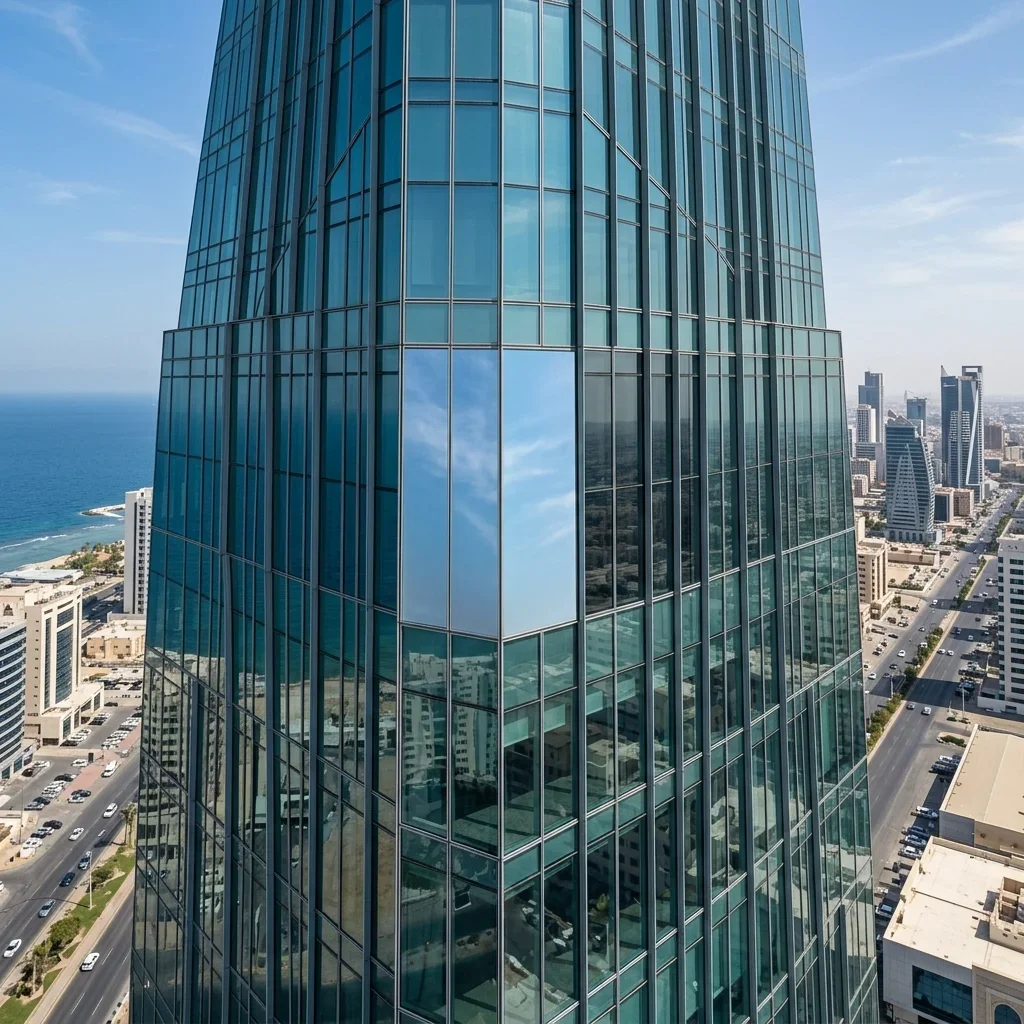
Insulating glass-facade towers (curtain wall) in Jeddah relies on installing advanced architectural films (nano-ceramic or reflective) that cut central HVAC loads and save 33-42% energy per AzelCore's thermal study, blocking 96-97% of infrared and 99% of UV. Tower pricing is set by custom engineering quote. Payback for commercial facilities typically ranges between 1.5 and 3 years.
Curtain wall glass facades are the visual signature of modern corporate architecture in Jeddah, from the Corniche towers to the office complexes in Al-Andalus and Al-Rawdah districts. Yet behind this architectural shine lies a genuine engineering and operational dilemma facing real estate developers and Facility Managers: architectural glass alone, even double-glazed, admits enormous solar thermal energy through infrared rays, turning the tower into a massive greenhouse that drains central cooling systems year-round.
Table of Contents:
- Why Architectural Glass Alone Fails in Jeddah's Climate
- How Architectural Insulation Film Works on Curtain Wall
- AzelCore Thermal Study: Field Data from Jeddah
- Choosing the Film: Nano-Ceramic vs Reflective vs Clear Thermal
- SBC 601/602 Compliance and Glass Safety
- ROI and Payback Period for Towers
- Operational Feasibility: Retrofitting Occupied Buildings
- Why AzelCore — Authorized Johnson & 3M Dealer
| Architectural Film Type | Price (SAR/m²) | Warranty | Heat Rejection (IR) / UV | Best for Which Tower |
|---|---|---|---|---|
| Nano-Ceramic | 150-200 | 15 years | 96-97% IR / 99% UV | Upscale office towers wanting performance and a neutral look |
| Reflective | 80-150 | 10 years | High solar rejection / 99% UV | Towers wanting daytime privacy and a mirrored look at lower cost |
| Clear Thermal | 50-100 | 10 years | Moderate thermal insulation / UV protection | Towers wanting full transparency with no appearance change |
| Safety | 70-120 | 10 years | Binds shards on breakage | Low-level facades at breakage risk or high density |
Why Architectural Glass Alone Fails in Jeddah's Climate
Many developers believe that specifying double glazing or Low-E glass at construction time solves the heat problem permanently. The engineering reality is more nuanced: double glazing delays heat transfer through the insulating gas layer, but does not reflect it.
In Jeddah's climate, where temperatures exceed 45°C for consecutive months and the sun strikes east and west facades at sharp angles, the glass gradually absorbs this energy until saturated, then re-radiates it indoors. The result is what's known as 'hot spots' near the facades, thermal variation between floors, and continuous strain on Air Handling Units (AHUs) and Chillers.
AzelCore's field study using a FLIR T530 thermal camera per ISO 13837:2021 recorded that the interior surface of untinted glass reaches about 77°C at peak summer, versus about 40°C after applying nano-ceramic film. This 37-degree gap translates directly into extra cooling loads the developer pays for on the Saudi Electricity Company commercial tariff, month after month.
How Architectural Insulation Film Works on Curtain Wall
Architectural insulation film is not merely a colored layer, but a multi-layered optical system engineered at the nano scale to selectively manage the solar energy spectrum. Sunlight consists of three components: visible light that we see, ultraviolet (UV) rays responsible for fading and skin damage, and infrared (IR) rays responsible for felt heat.
Advanced architectural film — like nano-ceramic technology from Johnson or 3M — blocks 96-97% of infrared and 99% of UV, while allowing a defined percentage of visible light (VLT) to maintain natural lighting and the facade's architectural transparency. The film is applied to the inner surface of the glass in most cases, or the outer surface for reflective types depending on curtain wall design.
The core advantage for the developer is that this solution is installed on existing glass without replacing it, avoiding the cost of demolishing and reinstalling the entire facade. Because Jeddah is a coastal city, high humidity makes choosing an oxidation-resistant film with a long warranty essential — which original American films provide with warranties up to 15 years.
AzelCore Thermal Study: Field Data from Jeddah
Rather than relying on manufacturer figures taken from labs in temperate climates, AzelCore conducted a field thermal study in Jeddah's real environment. The study used a FLIR T530 thermal camera, per ISO 13837:2021, covering a sample of 530 measurements across 10 Jeddah districts during 2024 to 2026, published under Creative Commons CC BY-NC 4.0.
The study recorded that the interior temperature of untinted glass surface reached about 77°C, dropping to about 40°C after applying nano-ceramic film, with infrared blocked at 96-97% and ultraviolet at 99%. On energy consumption, the study data showed savings ranging between 33% and 42% in facade-related cooling loads.
We affirm with full transparency that these figures pertain to glass surface measurements and facade-attributed cooling loads, and that actual savings on a whole tower's bill depend on the glass-to-wall ratio, HVAC system efficiency, and operating patterns. We claim no single fixed number for every building, but present a range backed by verifiable field data the developer can audit.
Choosing the Film: Nano-Ceramic vs Reflective vs Clear Thermal
No single film suits every tower; the decision is an engineering balance between thermal performance, architectural appearance, and budget. Nano-ceramic film (150-200 SAR/m², 15-year warranty) is the premium choice: highest heat rejection without metallic sheen, optically neutral preserving the original facade color, and best suited for upscale office towers that value both appearance and performance.
Reflective film (80-150 SAR/m², 10-year warranty) gives an elegant mirrored look, excellent daytime privacy, and the highest solar rejection at lower cost, but it changes the facade's appearance and may require architectural-character approval. Clear thermal film (50-100 SAR/m², 10-year warranty) suits towers wanting to preserve full transparency with reasonable thermal insulation and no appearance change.
For low-level facades at breakage risk or in high-density areas, safety film (70-120 SAR/m², 10-year warranty) can be combined, binding glass shards on impact and enhancing safety. At AzelCore we provide a per-facade engineering consultation to select the optimal film based on its orientation and sun-exposure angle.
SBC 601/602 Compliance and Glass Safety
A responsible developer views insulation not as a cosmetic add-on but as a regulatory-compliance element. The Saudi Building Code for energy (SBC 601 for energy conservation and SBC 602 for energy efficiency) sets requirements on the building envelope, including the glass Solar Heat Gain Coefficient (SHGC).
Installing a high-performance architectural insulation film helps lower the facade's effective SHGC, supporting the building's compliance with code requirements and aligning with the Saudi Energy Efficiency Center (SEEC) targets and Vision 2030's energy-rationalization goals. On safety, some curtain wall facades — especially at low levels exposed to human impact or wind pressure — require glass meeting safety provisions.
Certified safety films bind shards on breakage and reduce flying-glass risk, an important consideration in occupied towers. At AzelCore we commit to full transparency: we specify precisely what the film actually delivers, and never attribute to it certifications or ratings it does not hold.
The final compliance decision requires review by the project's accredited code consultant, and we provide the technical film specifications needed for that review.
ROI and Payback Period for Towers
For the developer and Facility Manager, the decisive question is not 'how much does insulation cost?' but 'when does insulation recoup its cost and start generating net savings?'. Unlike standard pricing for smaller units — such as a single office floor at an estimated 10,000 to 25,000 SAR, or a shop facade at 3,000 to 8,000 SAR — a full tower requires a custom engineering quote that calculates actual glass area, facade orientations, chosen film type, and height-access complexity.
On feasibility, our field experience indicates commercial facilities achieve a payback period typically ranging between one and a half and three years depending on operating intensity, glass facade size, and electricity tariff — unlike residential buildings that may recoup value in just months due to different consumption patterns. We stress there is no single magic number; any provider promising a fixed payback without seeing facade drawings and actual electricity bills is selling a promise, not an analysis.
Our model always begins with a thermal facade survey and historical electricity-bill analysis to build a realistic payback projection for your specific building.
Operational Feasibility: Retrofitting Occupied Buildings
The biggest concern for Facility Managers when considering insulating an occupied tower is operational disruption: will tenant businesses stop? Will there be mess and dust? The engineering answer is reassuring: installing film on facades from the inside is a clean, dry process requiring no demolition or strong-smelling adhesives, and can be scheduled during night shifts or weekends to avoid peak hours. The exterior facades of tall towers require specialized access equipment (suspended platforms or cranes) and teams trained in working-at-height safety, which we address within project scheduling.
We follow a phased approach: we start with a sample facade or floor, measure the thermal result with the thermal camera, then expand application with confidence built on data, not promises. This phased approach lets the developer verify performance before committing to the full project, minimizing operational and financial risk.
Prior communication with tenants and building management is a core part of our plan to ensure a smooth transition without complaints.
Why AzelCore — Authorized Johnson & 3M Dealer
Insulating a glass tower facade is not a routine installation but an engineering project deserving an authorized partner. AzelCore is an authorized dealer for both Johnson and 3M, among the most established window-film manufacturers globally; Johnson was founded in 1961 and 3M in 1902, renowned for its Crystalline technology with a Total Solar Energy Rejection (TSER) reaching about 90%.
Official authorization means two things for the developer: first, genuine film whose serial number and warranty are verifiable, away from counterfeit Chinese films that peel and turn purple within months in Jeddah's heat. Second, the manufacturer warranty covering ten to fifteen years.
Our technical team is led by Mohammed Al-Hadi, a certified insulation and tinting technician, who supervises thermal surveys and installation plans. We commit to full honesty: we present our verifiable field thermal-study data, and realistic price and performance ranges, without fabricated ratings or certifications.
For developers and Facility Managers, we provide an engineering consultation, a facade thermal survey, and a custom tower quote. Contact Mohammed Al-Hadi directly via WhatsApp at +966564612017 to schedule a site visit.
Frequently Asked Questions
Is double glazing enough to replace insulation film in Jeddah's glass towers?
Not on its own. Double glazing delays heat transfer through the insulating gas layer but does not reflect infrared, and in Jeddah's heat it saturates and re-radiates heat indoors. Architectural insulation film is the first line of defense, blocking 96-97% of infrared before it heats the glass, and is installed on existing glass without replacement.
How much does insulating a full glass tower facade cost?
A full tower requires a custom engineering quote because pricing depends on actual glass area, facade orientations, film type, and height-access complexity. For film reference: nano-ceramic is 150-200 SAR/m², reflective 80-150 SAR, and clear thermal 50-100 SAR/m². For smaller units, an office floor is estimated at 10,000-25,000 SAR and a shop facade at 3,000-8,000 SAR.
How much energy saving can be expected from glass facade insulation?
Per AzelCore's field thermal study in Jeddah (FLIR T530 camera, ISO 13837:2021, 530 measurements across 10 districts, 2024-2026), savings range between 33% and 42% in facade-related cooling loads. Actual whole-tower bill savings depend on the glass-to-wall ratio, HVAC efficiency, and operating patterns, and we do not offer a single fixed number for every building.
Does insulation film help with Saudi Building Code SBC 601/602 compliance?
Yes, high-performance insulation film helps lower the facade's effective Solar Heat Gain Coefficient (SHGC), supporting the building envelope's compliance with SBC 601 and SBC 602 requirements and aligning with SEEC targets and Vision 2030. However, the final compliance decision requires review by an accredited code consultant, and we provide the technical film specifications needed for that review.
Can the film be installed without disrupting tenants in an occupied tower?
Yes. Interior installation is a clean, dry process with no demolition or strong odors, and can be scheduled at night or on weekends. For high exterior facades we use specialized access equipment and teams trained in working-at-height safety. We follow a phased approach: starting with a sample floor and measuring the result with the thermal camera before expanding, with prior coordination with tenants and building management.
What's the difference between nano-ceramic and reflective film for office towers?
Nano-ceramic (150-200 SAR/m², 15-year warranty) is optically neutral, preserving the original facade color with the highest heat rejection and no metallic sheen, best for upscale towers. Reflective (80-150 SAR/m², 10-year warranty) gives a mirrored look, daytime privacy, and the highest solar rejection at lower cost, but changes the facade appearance and may need architectural-character approval. The choice depends on appearance-versus-cost priority for each facade.
How long does architectural insulation film last in Jeddah's humid coastal climate?
Original American films from Johnson and 3M are engineered to resist oxidation and high humidity in coastal cities, and come with a manufacturer warranty of 10 to 15 years against peeling, discoloration, and loss of thermal properties. This contrasts with cheap counterfeit films that peel and turn purple within months in Jeddah's heat and humidity. Being an authorized dealer guarantees you genuine film with a verifiable serial number and a valid warranty.
⚠️ Warning: Beware any provider promising a fixed payback period or a specific saving percentage for your tower without first seeing the facade drawings and actual electricity bills; that is a marketing promise, not an engineering analysis. Cheap counterfeit Chinese films also peel and turn purple within months in Jeddah's heat and humidity, costing you reinstallation more than you saved. Always demand genuine film with a verifiable serial number and manufacturer warranty.
Sources & References
Related Services
- Building Facade Insulation & Tinting Services in Jeddah ←
- Calculate Your Tower's Energy Savings & ROI ←
- AzelCore Jeddah Thermal Report 2026 (Field Data) ←
- AzelCore — Authorized Johnson Dealer ←
- AzelCore — Authorized 3M Dealer (Crystalline) ←
- Commercial Insulation for Offices & Corporations ←
- Building Insulation & Electricity Bill Savings ←
- Vision 2030 & Energy Efficiency in Buildings ←