
Saudi Car Tinting Laws 2026 — The Complete Guide
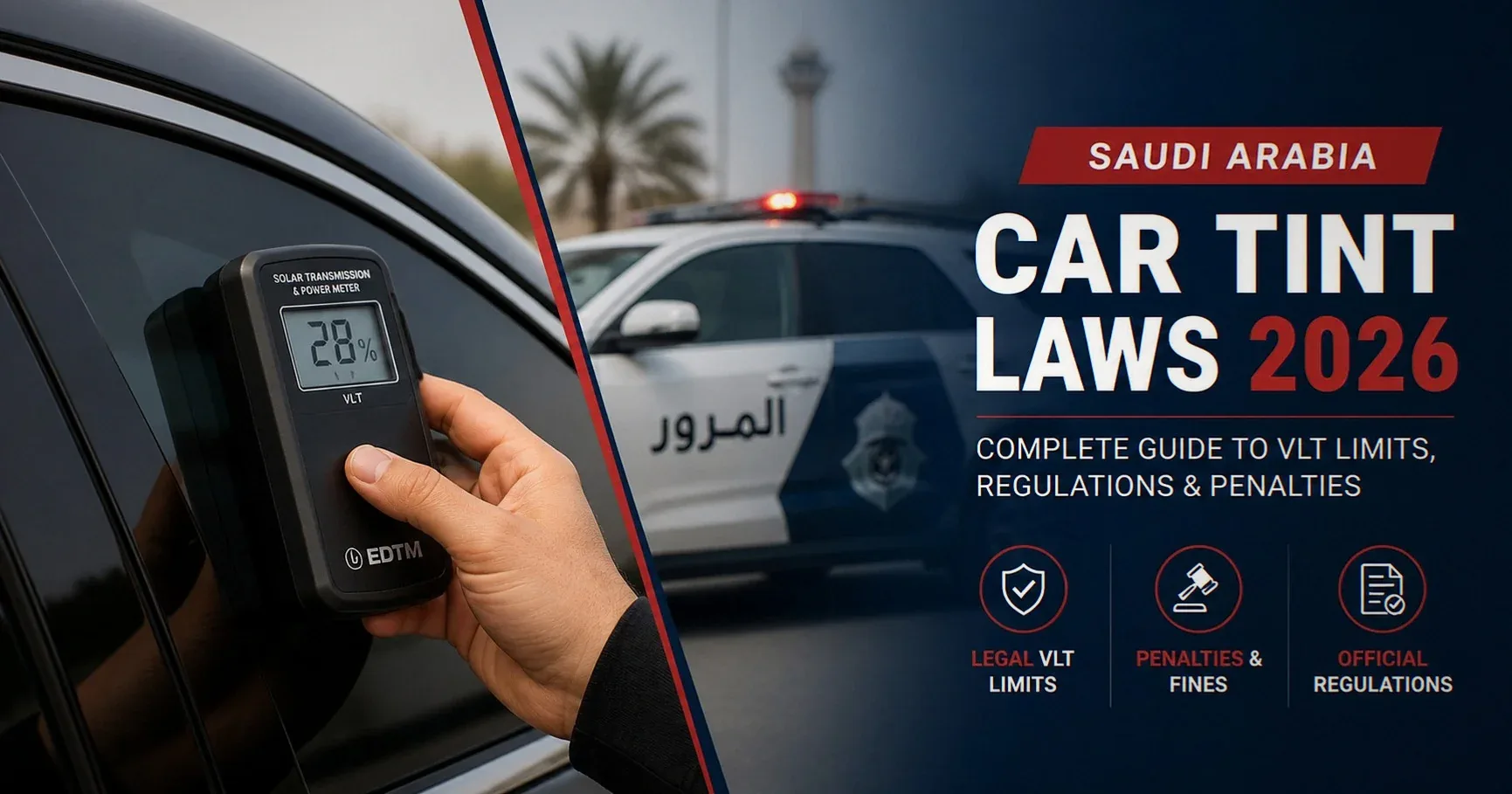
Tinting the rear side windows is allowed up to shade 02 (30% transparency). Tinting the front windshield or driver/passenger side windows is strictly prohibited except for shade 00 (completely transparent) for heat protection, provided it does not obstruct vision. The fine for violating tint laws ranges from 500 to 900 SAR.
With the intense summer heat in Saudi Arabia, particularly in cities like Jeddah and Riyadh, car tinting becomes an absolute necessity to protect the interior decor, reduce AC consumption, and provide thermal comfort for passengers. However, many car owners hesitate to install thermal insulation for fear of incurring traffic fines ranging from 500 to 900 SAR, or failing to pass the annual periodic vehicle inspection. In 2026, the General Directorate of Traffic in the Kingdom of Saudi Arabia established strict transparency parameters and important updates to ensure traffic safety while accommodating harsh climatic conditions. In this comprehensive and detailed guide, we provide you with the official figures and legal directives so you can choose the strongest heat-rejecting tint that is 100% compliant with the traffic system. We will delve into the details of each window, types of vehicles, and the nuances that many are unaware of, which often lead to unexpected violations.
Table of Contents:
- Allowed Percentages by Glass Type
- Fines and Violations
- Periodic Inspection
- How to Verify Your Tint Percentage
- Allowed Types Without Violations
| Glass Position | Legally Allowed Shade | Recommended Transparency (VLT) | Important Notes |
|---|---|---|---|
| Front Windshield | Completely Transparent (00) | 70% and above | Allowed for thermal insulation (Nano-Ceramic) |
| Side Windows (Driver & Passenger) | Transparent (00) | 70% and above | Any dimming that obstructs driver vision is prohibited |
| Rear Side Windows | Up to shade (02) | 30% and above | Allowed for family cars and private sedans |
| Rear Windshield | Tinting Prohibited | N/A | Except in highly restricted, approved medical cases |
2026 Traffic Updates and Their Security Reasons
The General Directorate of Traffic in Saudi Arabia has placed the safety of drivers, passengers, and road users at the forefront of its priorities. The 2026 tinting law updates came to strike a balance between the dire need for thermal insulation in high temperatures that can exceed 50 degrees Celsius in the summer, and the necessary security requirements for personnel at checkpoints.
Allowing security personnel to clearly see inside the vehicle is crucial, hence any dimming on the front windows that obstructs vision and poses a risk to public safety is strictly prohibited. At the same time, the Traffic Directorate understands the need for privacy for families and the protection of children in the rear seats, thus a specific degree of dimming is allowed for the rear side windows.
Adhering to these regulations not only spares you from fines but also contributes directly to maintaining security and facilitating the work of the competent authorities.
Misconceptions: Thermal Insulation Does Not Mean Dimming
The biggest common mistake car owners make is associating "thermal insulation" with a dark or jet-black color. Technology has evolved astonishingly! Today, advanced original nano-ceramic films (such as the latest editions of Johnson Supreme IR and 3M Crystalline) are available in shade 00, which allows 70% to 80% of visible light to pass through (shades fully compliant with traffic laws), yet at the same time, they possess a phenomenal ability to block up to 97% or more of the Infrared Rays (IR) directly responsible for the suffocating heat felt inside the car cabin.
In short, this means you get excellent cooling, and superior skin protection from ultraviolet rays, without any traffic violations. Investing in nano-ceramic technology is the smartest choice legally and practically.
Detailed Laws: Windshield and Side Windows
The large front windshield is the most sensitive from a legal and traffic perspective. It is permissible to install completely transparent thermal insulation films (shade 00) on it, provided it is not light-reflective (mirrors) or bears any patterns or colors that alter the original color of the glass.
This glass is the primary interface for the driver, and any distortion on it is considered a catastrophic hazard, especially during night driving. As for the side windows for the driver and the front-seat passenger, the exact same law applies strictly: they must be completely transparent.
If a driver applies a tint of shade 01 or higher on these windows, they expose themselves to an explicit violation and will be forced to remove the tint at checkpoints. Transparency here is not an option, but a strict legal obligation to maintain clear visual communication with the road and security personnel.
Rear Windows and Privacy for Families
Moving to the rear side windows, we find that Saudi Traffic fully understands the need for privacy for families, especially in our society which highly values this aspect. Therefore, it is allowed to tint the rear side windows with a dimming shade up to "02" according to the local classification, which roughly equates to a Visible Light Transmission (VLT) percentage ranging between 30% and 40%.
This shade provides excellent protection from prying eyes and helps reduce sun glare on rear-seat passengers, especially children. However, it must be noted that the large rear windshield (the glass behind the passengers) is prohibited from being tinted with any dark color to avoid blocking the view from the driver's central mirror and for vehicles behind.
The only exception for the rear windshield is installing a transparent insulation (00) solely for the purpose of heat rejection.
Vehicles Strictly Prohibited from Tinting
It is very important to know that the aforementioned laws apply primarily to private cars that have rear seats. There are categories of vehicles that are completely prohibited from tinting at any shade, falling under Article 68 of the Traffic Law Executive Regulations.
These categories include: Taxis (limousines and ride-hailing apps), daily rental cars, single-door sports cars (coupes) unless equipped with rear seats officially registered in the vehicle registration card, in addition to cargo transport vehicles and public buses. The fundamental reason behind this prohibition is the nature of use of these vehicles; taxis, for example, carry unfamiliar passengers and must be visible from the outside to ensure public security and prevent crimes, while two-seater coupes do not need rear tinting for privacy as there are no rear passengers to begin with.
Violation Detection Mechanism and Fine Value
Saudi Traffic is not lenient with tint-related violations, and they are recorded under the violation name "making a modification or addition to the vehicle's structure or body". The value of this fine ranges from a minimum of 500 SAR and goes up to a maximum of 900 SAR, with the possibility of impounding the vehicle if the driver refuses to remove the illegal tint immediately at the checkpoint or if the tint obstructs vision in a way that poses an imminent danger.
With technological advancements, automated monitoring cameras and smart Bashar devices with security personnel are able to accurately detect dimness levels, and verify through the vehicle's plates its type and compliance with tinting requirements. Do not attempt to circumvent the system, as the high financial fine and the inconvenience of removing the tint on the street do not justify the risk.
Secrets of the Periodic Inspection (Tint Meter)
When heading for the annual periodic inspection, many are unaware of a hidden reason for failing the glass-related test. The transparency measurement device (Tint Meter) is very accurate.
The secret to failing lies in the fact that original factory car glass is not 100% transparent; it often contains a very light dimming percentage ranging from 5% to 10%. When you go to an unprofessional tint center and request a 30% film installation (which is the allowed shade for rear side windows), this film is applied over the original glass.
The result? The dimness multiplies and the total transmission drops below 30%, leading to an immediate failure of the vehicle in the inspection. A specialized expert in centers like "AzelCore" first measures the original glass transparency, then selects the film that ensures the combined final percentage does not exceed the legal limit.
The Severe Dangers of Fake and Dark Tinting
Some resort to extremely dark or cheap fake tint under the pretext of saving money or seeking faster cooling. This behavior is fraught with risks.
Non-original dark tint horrifyingly impairs night vision; the driver finds it extremely difficult to see pedestrians, bicycles, or cars driving without lights, thereby multiplying the likelihood of fatal accidents. Additionally, inferior films lack nano-ceramic technology, meaning they block light but do not block the actual heat (infrared rays).
You will find the car dark but still hot as an oven! Furthermore, poor quality tint reacts with the scorching Jeddah sun heat to begin emitting toxic fumes from the adhesive that harm the passengers' health, and ultimately ends up cracking and forming annoying bubbles.
Avoiding Violations: How to Choose a Tint Center?
To ensure your tint is legal and effective, you must choose certified and reliable centers like AzelCore center in Jeddah. A reliable center provides you with a pre-installation consultation and explains the legal options available specifically for your car based on its registration (family or sports).
More importantly, the certified center provides an electronic tax invoice and a written warranty certificate explicitly detailing the Visible Light Transmission (VLT) percentage for each window. This certificate acts as a legal shield you can present to the periodic inspection officer or security personnel at a checkpoint to prove that the installed insulation complies with the General Directorate of Traffic regulations, serving as conclusive evidence that you are using original products with untempered percentages.
Nano-Ceramic Technology and its Impact in 2026
In 2026, with climate change and the noticeable rise in temperatures, thermal insulation is no longer a luxury but a fundamental necessity. Nano-ceramic technology represents the pinnacle of technological hierarchy; it relies on microscopic ceramic particles that reflect and scatter infrared rays without the need for any metals that interfere with communication signals or GPS.
This technology has provided a brilliant solution to the dilemma of traffic laws; enabling manufacturers to produce shade 00 (transparent) films that insulate heat with an efficiency three times greater than older dark films. Therefore, your investment in original nano-ceramic is an investment in your comfort, protecting your interior, and most importantly ensuring your absolute compliance with strict traffic regulations.
Frequently Asked Questions
Is it allowed to tint the windshield with shade 01?
No, the large front windshield is not allowed to be tinted with any dimming percentage. Only completely transparent insulation (shade 00) that does not alter the original glass color is permitted.
Are coupes (two-door cars) allowed to be tinted?
If the car is registered as having 4 seats (includes rear seats in the vehicle registration), only the rear side windows may be tinted. If it only has two seats, tinting is strictly prohibited.
How much is the tinting fine in Saudi Arabia for 2026?
It falls under the violation of "making a modification to the vehicle's structure" and the fine ranges from 500 SAR to 900 SAR depending on the assessment of the situation.
Why does shade 02 tint sometimes fail periodic inspection?
Because the original factory glass already contains a light dimming percentage. Adding a 30% tint pushes it over the allowed limit. Total transparency must be accurately calculated before installation.
Are removable sunshades considered a violation?
Yes, while driving it is prohibited to place any barriers or sunshades on the windows that obstruct vision. They can only be used while the car is completely parked to protect from the sun.
⚠️ Warning: Beware of light-reflective tint (mirrors) or brightly colored tint (like blue and red) and decorative decals on the glass. All of these are explicit traffic violations requiring immediate removal and a hefty financial fine, and they severely impair night vision leading to accidents.