
Commercial Building Tint in Jeddah — Energy Savings and Operating Efficiency
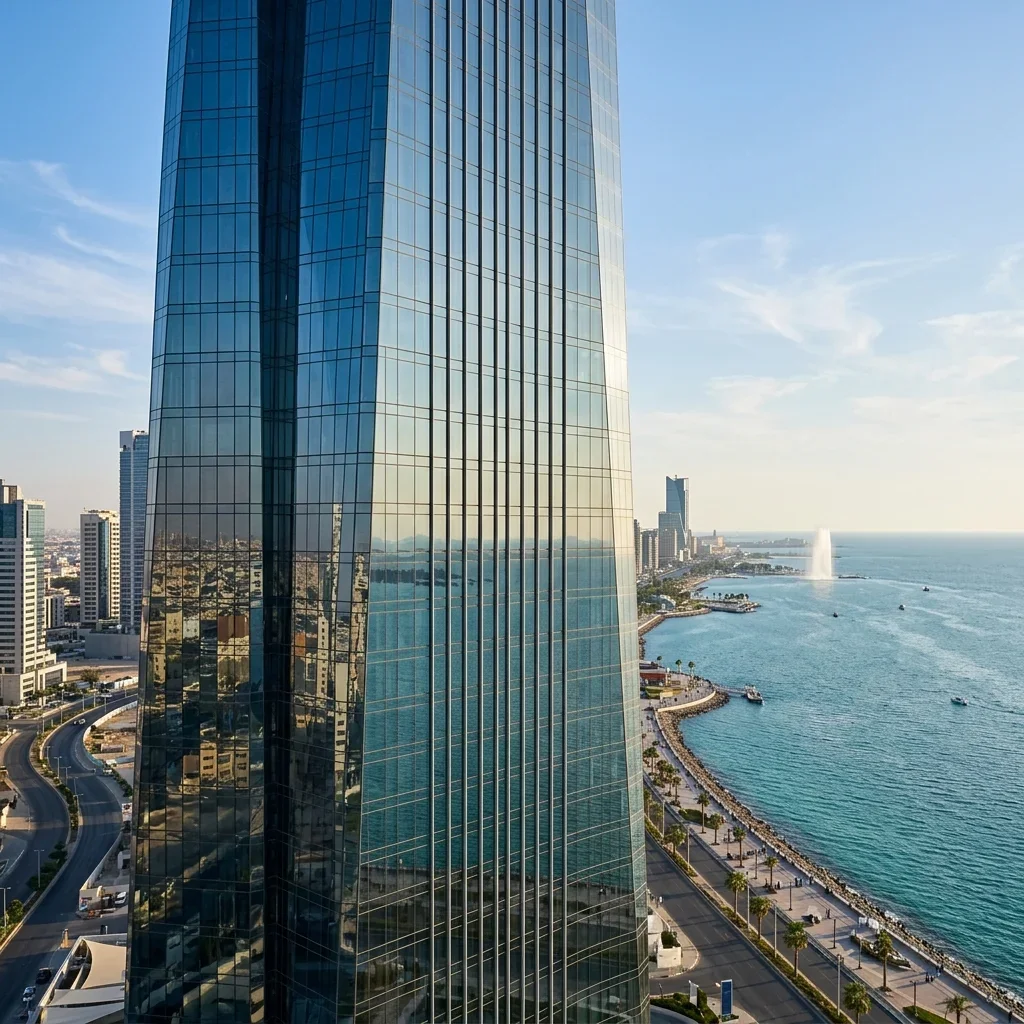
Tinting commercial building facades and corporate offices in Saudi Arabia is not just a cosmetic upgrade. Engineering-wise, advanced architectural insulation films reduce Central HVAC loads by up to 30%, decrease annoying glare on employee screens by 85% (boosting productivity), and block 99.9% of UV rays that damage office furniture. The financial Return on Investment (ROI) for commercial projects is typically realized within just 18 to 24 months through direct savings in electricity bills.
Massive glass facades form the prominent feature of modern corporate architecture in Jeddah, Riyadh, and various Saudi cities, reflecting luxury and enhancing natural light. However, in an environment where temperatures breach the 45°C barrier for over 5 months a year, these elegant glass facades turn into an operational nightmare for Facility Managers. Standard glass allows massive amounts of solar thermal energy to pass through, placing Central HVAC systems under immense and continuous strain, leading to skyrocketing commercial electricity bills. In this report, aimed at the B2B sector and procurement managers, we will analyze the direct and indirect financial returns of investing in corporate facade tinting and insulation, and how this simple engineering step can transform a building from a greedy energy consumer into a sustainable, eco-friendly Green Building.
Table of Contents:
- Challenges of Insulating Towers and Commercial Complexes
- Why Double Glazing Alone Isn't Enough
- Electricity Savings and SBC Building-Code Compliance
- Film Types for Commercial Facades
| Corporate Operational Metric | Before Glass Thermal Insulation | After Insulation (Advanced Architectural Films) |
|---|---|---|
| Central AC (HVAC) Consumption | Operates at 100% capacity throughout working hours | Load reduced by 20% to 30% |
| Electricity Bills (Commercial Tariff) | Exorbitant operational cost (highest tier) | Direct financial savings covering insulation cost within 2 years |
| Employee Productivity (Ergonomics) | Severe screen glare, visual fatigue, uneven temperatures | 85% glare reduction, homogeneous office temperatures |
| Lifespan of Furniture & Equipment | Rapid damage and fading due to 100% UV rays | 99.9% protection, preserving corporate assets longer |
| Carbon Footprint (LEED Certification) | High energy consumption, negative carbon footprint | Supports Green Building standards and environmental certifications |
The Financial Disaster: The "Greenhouse" Syndrome in Offices
Commercial buildings with glass facades engineerigly suffer from the "Greenhouse Effect." Infrared (IR) rays easily penetrate the glass to heat the indoor air and furniture. Since the building is sealed, this heat is trapped inside.
The result? The Central AC system (Chillers & AHUs) is forced to run at maximum capacity (Full Load) continuously just to maintain a 22°C temperature. This relentless strain doesn't just double the commercial electricity bill; it sharply reduces the lifespan of AC Compressors, imposing massive and unpredictable annual maintenance budgets on companies.
The ROI: How Insulation Films Pay for Themselves?
Investing in building tinting with advanced thermal insulation films (like Nano-Ceramic or Metallized tech) is not an "expense"; it is a "high-return financial investment (CapEx)." These films reject up to 80% of Total Solar Energy (TSER) before it penetrates the glass. Mathematically, every 100 square meters of insulated glass can save a full ton of AC cooling load.
When applied to the commercial electricity tariff in Saudi Arabia, we find that companies fully recoup the installation contract costs (Payback Period) within 1.5 to 2.5 years. After this period, the monthly savings on the electricity bill turn into net profits added to the company's bottom line.
Healthy Workspace = More Productive Employees
The highest operational cost for any company is not electricity, it is "employee salaries." Visual and thermal comfort plays a crucial role in employee productivity. Offices near windows suffer from two problems: "Hot Spots," where an employee near the window is sweating while the one in the middle of the room is freezing.
The second problem is "Solar Glare," which reflects off computer screens causing severe eye strain and headaches. Installing architectural tint films provides a homogeneous temperature across the entire office floor and blocks 85% of annoying glare.
This improves workplace ergonomics and noticeably boosts team productivity without the need to close the blinds and block the outside view.
Securing Corporate Assets and Interior Decor
Ultraviolet (UVA and UVB) sun rays represent a hidden danger with effects spanning years. These rays are the primary cause of "Optical Fading"; they cause damage and discoloration to luxury carpets, cracking of leather office chairs, and ruin fine art and wooden decors in executive boardrooms.
All certified architectural insulation films we use at "AzelCore" filter and block 99.9% of these destructive rays, significantly extending the lifespan of expensive corporate assets and properties for many years.
Environmental Responsibility (ESG) and Green Buildings (LEED)
With Saudi Vision 2030, major corporations and government entities are shifting towards adopting sustainability standards (ESG). Reducing electricity consumption means decreasing reliance on burning fossil fuels, thereby lowering your corporate building's Carbon Footprint.
Furthermore, if your company is pursuing the globally recognized Leadership in Energy and Environmental Design (LEED Certification), installing thermal insulation films awards the building guaranteed "LEED Points" in the categories of Energy Efficiency, Indoor Environmental Quality improvement, and Greenhouse Gas Emissions reduction.
Frequently Asked Questions
Can architectural insulation be installed without disrupting the company's workflow?
Yes. At "AzelCore," we have specialized installation teams for night shifts or weekends for the B2B sector. The installation process is extremely clean and leaves no mess. Employees will return to their desks to find a clear thermal difference without any disruption.
Will window tinting make the offices gloomily dark?
This is an old misconception. Modern technology allows manufacturing Neutral Films that block 80% of heat while allowing 70% of natural Visible Light Transmission (VLT). Your offices will remain bright and vibrant, but without the annoying heat and glare.
What is the lifespan of building insulation films?
Original American architectural films (which we authorize) are designed to be a long-term solution and come with a commercial warranty ranging from 10 to 15 years against peeling, discoloration, or loss of thermal properties.
⚠️ Warning: Relying on "Double Glazing" alone in Saudi glass towers is not enough to repel the fierce summer heat. The trapped gas between the glass panes delays heat transfer, but eventually, it will heat up and transfer it indoors. The insulation film is the first line of defense that reflects heat outward before it heats the glass.