
Genuine Johnson vs Cheap Chinese Film: Why the 1,500-SAR Gap Saves You Thousands
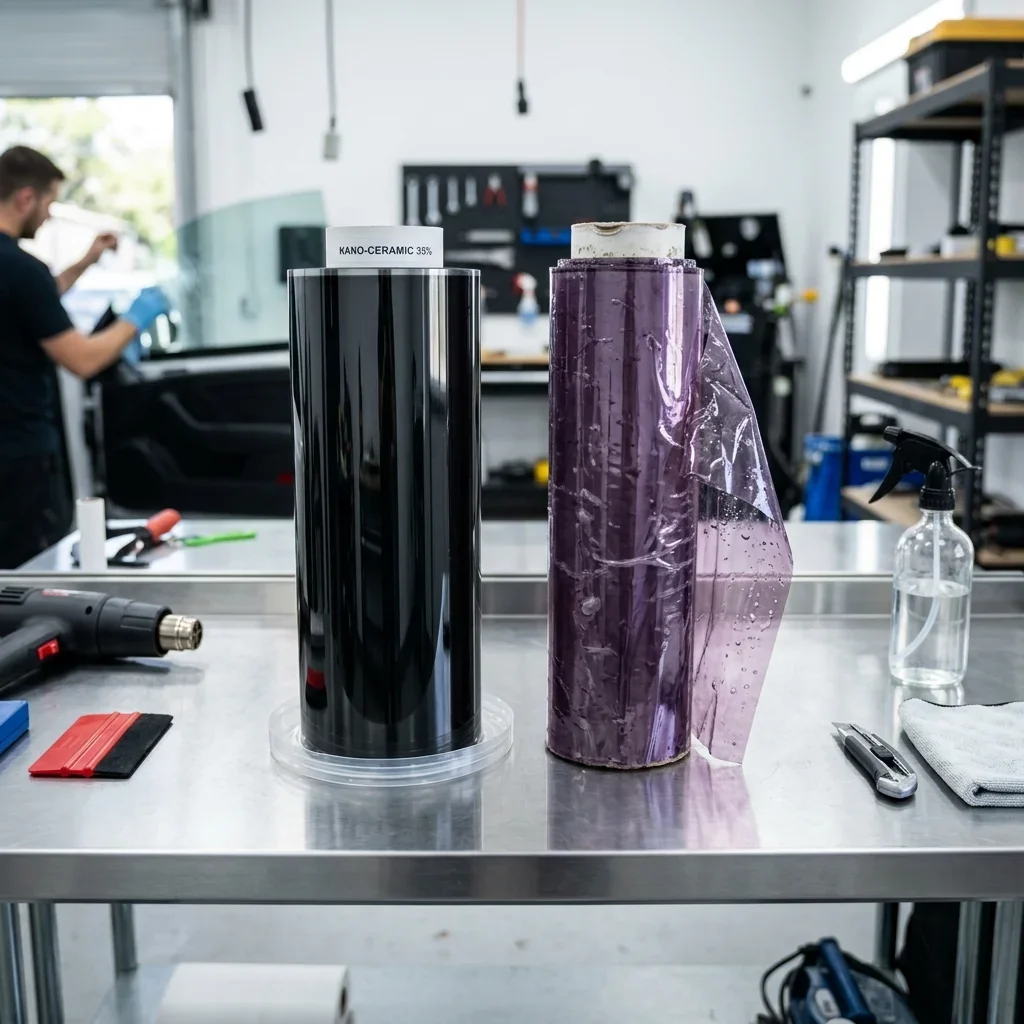
Genuine Johnson nano-ceramic tint starts at 1,500 SAR for a sedan with a 10-year warranty and 96-97% infrared rejection, while cheap Chinese dyed film starts at 300 SAR with only a 1-year warranty. The apparent 1,200-SAR gap turns into a loss of thousands once the cheap film cracks, yellows, and forces a re-install within a year or two.
In every tint workshop in Jeddah the same scene repeats: a customer standing between two options, genuine Johnson film at 1,500 SAR, or an unbranded Chinese film at 300 SAR. At first glance the decision seems settled in favor of the cheaper one, but this simple arithmetic is exactly what costs many people thousands of riyals in the long run. The real difference is not in the sticker price, but in the product's lifespan, how much heat it actually rejects, your electricity and AC bill, your car's resale value, and your skin's health under Jeddah's scorching sun. As Mohammed Al-Hadi, a certified insulation and tinting technician and a Johnson and 3M dealer at AzelCore Jeddah, I have seen with my own eyes dozens of cars return after a single year with cracked, yellowed film needing removal at 200-400 SAR and then a fresh re-install. In this article I put before you an honest comparison with real numbers, no exaggeration and no scare tactics, so you understand why the 1,500-SAR option is in truth the cheaper choice, not the more expensive one.
Table of Contents:
- What You Actually Pay For: Dyed vs Nano-Ceramic
- Real Jeddah Prices: A Full Comparison Table
- Real Heat Rejection: Numbers from AzelCore's Thermal Study
- The Hidden-Cost Equation: Why Cheap Costs More
- Warranty: 10 Years vs One Year
- Health and UV Under Jeddah's Sun
- How to Tell Genuine Johnson From a Counterfeit Before You Pay
- Traffic Compliance: Cheap Dark Film Risks a Fine
- The Smart Decision: When Each Option Makes Sense
| Film Type | Sedan Price (SAR) | Warranty | Infrared Rejection | Expected Life in Jeddah |
|---|---|---|---|---|
| Cheap Chinese Dyed | 300-500 | 1 year | Very weak | 12-24 months |
| Carbon | 600-900 | 5 years | Moderate | Up to 5 years |
| LLumar CTX | 1,200-1,800 | 7 years | Good | Up to 7 years |
| Johnson Nano-Ceramic | 1,500-2,200 | 10 years | 96-97% | 10+ years |
| 3M Crystalline | 2,000-2,800 | Lifetime | TSER ~90% | Car lifetime |
What You Actually Pay For: Dyed vs Nano-Ceramic
Before any price comparison, you must understand that you are not comparing two similar products at two different prices, but two completely different technologies. The cheap Chinese film sold for 300-500 SAR is mostly the dyed type.
This type relies on a black dye layer that absorbs light to give you a dark look, but contains no real heat-reflecting technology. The dye breaks down under ultraviolet rays and turns purple within months, which is the reason for the yellowed look you see in many cars in Jeddah.
By contrast, genuine Johnson nano-ceramic film (such as Supreme IR and InsulatIR) relies on microscopic ceramic particles that scatter and reflect the infrared rays responsible for heat, without any metals that interfere with mobile or GPS signals. Johnson is an American company founded in 1961 with decades of film-engineering experience.
The difference is not commercial but physical: dyed film makes the car dark and hot, while nano-ceramic makes it relatively clear and cool. This understanding alone changes how you look at the price.
Real Jeddah Prices: A Full Comparison Table
Transparency in pricing is part of professional honesty. At AzelCore Jeddah, the following prices include installation and warranty and may vary slightly by car size and glass type.
Dyed film (the category most "cheap Chinese" film falls under) starts at 300 SAR for a sedan with only a 1-year warranty, the cheapest in appearance and the most expensive in reality. Carbon film starts at 600-900 SAR with a 5-year warranty and is a reasonable middle option.
Genuine nano-ceramic starts at 1,500-2,200 SAR for a sedan, 2,200-3,000 for an SUV, and 2,500-3,500 for a luxury car, with a 10-year warranty. For comparison, 3M Crystalline (which packs over 200 nano-layers with a Total Solar Energy Rejection of around 90%) starts at 2,000-2,800 SAR with a lifetime warranty.
Note that removing old tint costs 200-400 SAR, a cost you will pay over and over with cheap film. The table below shows the full picture with actual numbers so you build your decision on data, not impressions.
Real Heat Rejection: Numbers from AzelCore's Thermal Study
This is where the difference you feel physically every day shows up. At AzelCore we conducted a field thermal study using a FLIR T530 thermal camera, per the ISO 13837:2021 standard, on a sample of 530 measurements across 10 Jeddah districts during 2024-2026 (published under a CC BY-NC 4.0 license).
The results were honestly striking: the interior cabin temperature of a car with no tint reached around 77 degrees Celsius under Jeddah's midday sun. After installing genuine nano-ceramic, it dropped to around 40 degrees Celsius, a difference of nearly 37 degrees.
The genuine film blocked 96-97% of the infrared rays (IR) responsible for heat, and 99% of ultraviolet rays (UV). The problem is that cheap dyed Chinese film may make the car look dark inside, but it blocks a tiny fraction of infrared, so the cabin stays hot as an oven despite the darkness.
The customer thinks they got insulation because the car "got dark," while in truth darkness and insulation are two completely different things. You pay less, but you do not get the coolness you paid for in the first place.
The Hidden-Cost Equation: Why Cheap Costs More
Let us calculate honestly. Suppose you chose the dyed Chinese film at 400 SAR for a sedan.
Its warranty is one year, and in Jeddah's harsh climate it typically begins to crack, yellow, and bubble within 12-24 months. When it fails you will pay: 200-400 SAR to remove it, then another 400 SAR to re-install fresh cheap film, or more if you decide to upgrade.
Over five years you may repeat this cycle two or three times, so the total you have paid reaches 1,400-2,000 SAR on a film that never cooled your car in the first place. By contrast, nano-ceramic at 1,500 SAR with a 10-year warranty is installed once and stays.
And that is not the whole hidden cost: a film that does not block heat makes your AC work harder for the entire time you own the car, raising fuel consumption and accelerating AC-compressor wear. Add to that the damage to your dashboard and leather seats from the UV that the inferior film does not block, and the drop in resale value because of cracked film.
The equation is clear: an 1,100-1,200 SAR difference at purchase saves you thousands of riyals over the car's life.
Warranty: 10 Years vs One Year
A warranty is not a marketing slip, but a precise expression of the manufacturer's confidence in its product's lifespan. Genuine Johnson nano-ceramic film comes with a 10-year warranty, and 3M Crystalline with a lifetime warranty, both covering yellowing, cracking, peeling, and bubbling.
This duration is not a random number; it is built on intensive UV and heat endurance testing. By contrast, dyed Chinese film rarely carries a warranty beyond one year, and it is often a verbal warranty from the shop, undocumented on a certified invoice.
The most important difference: Johnson and 3M warranties are global manufacturer warranties honored through authorized dealers, while the cheap shop's "warranty" vanishes the moment the shop closes or denies it. At AzelCore we issue every customer an electronic tax invoice and a written warranty certificate detailing the film type, grade, and visible-light transmission, and this document is what actually protects your right.
When you pay more for a 10-year warranty, you are not just buying a film, but buying a documented commitment that the product will do its job for a full decade under Jeddah's sun.
Health and UV Under Jeddah's Sun
The aspect many overlook when comparing on price is health. The World Health Organization classifies ultraviolet radiation as a cause of skin cancer, and a driver in Jeddah may spend hours daily with their left arm and face exposed to the sun through the side glass.
Genuine Johnson and 3M film blocks around 99% of ultraviolet rays, which is real long-term protection for the skin and eyes, and protection for the interior decor from fading. Dyed Chinese film, because it relies on a degrading dye, gradually loses its ability to block UV as the dye deteriorates, so you think you are protected while protection erodes month after month.
Worse, some inferior films, when exposed to Jeddah's high heat, may release odors and fumes from low-quality adhesive inside the closed cabin. We do not exaggerate or promote fear; we simply say that a product blocking 99% of UV steadily for ten years offers a health value that a film whose dye degrades within months cannot.
Health is an investment not measured by a 1,200-SAR difference.
How to Tell Genuine Johnson From a Counterfeit Before You Pay
The more dangerous problem is not knowingly choosing Chinese film, but having cheap film sold to you as genuine Johnson at the genuine price. Counterfeiting is widespread, which is why you need practical verification tools.
First: ask to see the original film roll with the Johnson or 3M label printed on it, and confirm the batch/serial number. Second: an authorized dealer issues an electronic tax invoice naming the product and its grade (such as Supreme IR or InsulatIR), not a generic invoice that just says "tint." Third: ask for the official warranty certificate tied to the parent company, and verify the center is listed as an authorized dealer.
Fourth: test the sample with an IR meter in front of you; genuine film shows high heat rejection instantly, while a counterfeit fails this test despite its dark color. Fifth: beware the tempting price; if you are offered "Johnson nano-ceramic" at 500 SAR, know that the price itself is proof it is not genuine.
At AzelCore we have a detailed article on spotting fake tint, and we welcome any customer who wants to verify for themselves before paying. Authenticity is not a slogan, but a chain of documents that can be proven.
Traffic Compliance: Cheap Dark Film Risks a Fine
Many buyers of cheap Chinese film request it very dark to compensate for weak insulation with a "blackout" look, and here they fall into a legal trap. Per the General Directorate of Traffic in Saudi Arabia, the windshield and the driver and front-passenger side windows must be transparent (shade 00), with no dimming that obstructs vision allowed, while tinting the rear side windows is permitted up to shade 02 (about 30% light transmission).
Cheap dark film installed on the windshield or front side glass exposes you to a fine ranging from 500 to 900 SAR under the clause of "making a modification to the vehicle's structure," may force you to remove it immediately at a checkpoint, and may cause you to fail the periodic inspection. The irony is that genuine nano-ceramic solves this dilemma entirely: it is available in a fully transparent shade 00 that lets 70% or more of visible light through, yet still blocks 96-97% of heat.
That means you get strong insulation and full traffic compliance at the same time, something cheap dyed film cannot offer. For precise legal figures, see our detailed guide to Saudi tint laws 2026.
Compliance protects you from the fine and from embarrassment at inspection.
The Smart Decision: When Each Option Makes Sense
Honesty requires that we not claim Johnson is always the only option. The smart decision depends on how long you keep the car, your budget, and your usage.
If you will sell the car within a few months, carbon film (600-900 SAR, 5-year warranty) may be a balanced option giving you reasonable insulation at a lower cost. But if you will keep the car for years, drive long distances daily under Jeddah's sun, have children in the rear seats, or own a luxury car whose resale value matters to you, then genuine nano-ceramic from Johnson or 3M Crystalline is unquestionably the sounder investment.
What we never recommend, under any circumstance, is unbranded dyed Chinese film with a one-year warranty, because it is the option that combines every flaw: weak insulation, short lifespan, traffic risk, and accumulating hidden cost. If the budget is tight, it is better to wait and save the difference rather than pay 400 SAR for a film you will pay for twice more.
Use our cost calculator to estimate your car's price accurately, and contact us for an honest consultation in which you choose what truly suits you, not what suits our sales.
Frequently Asked Questions
Is there really a noticeable difference in coolness between Johnson and Chinese film?
Yes, a large and tangible difference. In AzelCore's FLIR thermal study, the cabin temperature dropped from around 77 degrees without tint to around 40 degrees with genuine nano-ceramic that blocks 96-97% of infrared. Dyed Chinese film may make the car look dark but blocks a tiny fraction of heat, so the cabin stays hot despite the darkness.
How much is genuine Johnson film for a sedan in Jeddah?
At AzelCore Jeddah, genuine nano-ceramic for a sedan starts at 1,500 to 2,200 SAR including installation and a 10-year warranty. SUVs are 2,200-3,000 SAR, and luxury cars 2,500-3,500 SAR. Prices may vary slightly by glass type and car size.
Why does cheap film turn purple or yellow?
Because cheap dyed film relies on a black dye layer that breaks down under UV and Jeddah's high heat, losing its original color, turning purple, then cracking and bubbling. Genuine nano-ceramic does not rely on a degradable dye, so it keeps its color stability and performance for many years.
Is the long warranty on Johnson and 3M real or just marketing?
Real and documented. Johnson nano-ceramic carries a 10-year warranty and 3M Crystalline a lifetime warranty, both global manufacturer warranties covering yellowing, cracking, and peeling. At AzelCore we issue an electronic tax invoice and a written warranty certificate proving the film type and grade, your document for activating the warranty through the authorized dealer.
How do I make sure the shop installed genuine Johnson, not a counterfeit?
Ask to see the film roll with the Johnson label and batch number, request an electronic tax invoice naming the product and grade (such as Supreme IR), and an official warranty certificate. Verify the center is an authorized dealer, and ask to test the sample with an IR meter in front of you. A very low price alone is enough proof it is not genuine.
Does dark Chinese film expose me to a traffic fine?
Yes, if installed on the windshield or the driver and front-passenger side windows, which must be transparent (shade 00). The fine ranges from 500 to 900 SAR and may force immediate removal and a periodic-inspection failure. Genuine nano-ceramic comes in a transparent shade 00 and blocks heat at the same time, combining insulation with traffic compliance.
When is carbon film an acceptable option instead of nano-ceramic?
Carbon film (600-900 SAR for a sedan, 5-year warranty) is a balanced option if your budget is limited or you intend to sell the car within a medium term. It offers better insulation than cheap dyed film with higher color stability. But for long-term ownership and intensive daily use under Jeddah's sun, genuine nano-ceramic remains superior in performance and lifespan.
⚠️ Warning: Beware any offer selling you \"genuine Johnson nano-ceramic\" at 500 SAR; the price itself is conclusive proof it is counterfeit. Genuine nano-ceramic starts at 1,500 SAR for a sedan. Always ask to see the film roll with the Johnson label and batch number, an electronic tax invoice naming the product and its grade, and an official warranty certificate before you pay.
Sources & References
Related Services
- Genuine Johnson Film — Authorized Dealer in Jeddah ←
- 3M Crystalline — 200+ Nano-Layers, Lifetime Warranty ←
- Nano-Ceramic Car Tinting in Jeddah ←
- Tint Cost Calculator by Car Size ←
- How to Spot Fake Tint Before You Pay ←
- Compared: Nano-Ceramic vs Carbon vs 3M ←
- Saudi Car Tint Laws Guide 2026 ←
- Why Cheap Tint Costs You More in Jeddah ←