
Why Cheap Car Tint Costs You More Long-Term — The Real Cost in Jeddah
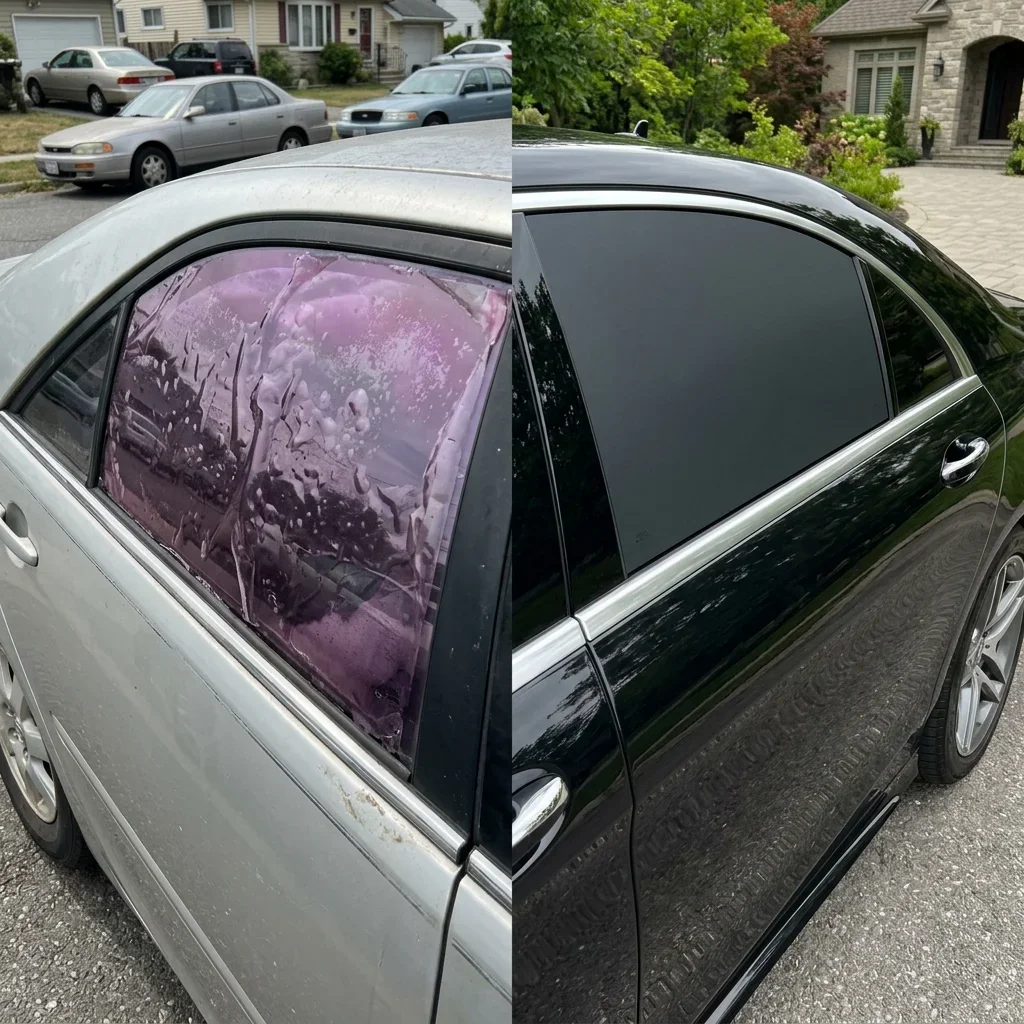
Cheap dyed tint (SAR 300-500, 1-year warranty) fades, cracks, and does not block infrared, so you reinstall it 3-4 times over 5 years. The total exceeds the price of authentic nano-ceramic (SAR 1,500-2,200, 10-year warranty) while you lose heat rejection and interior protection the whole time.
In Jeddah, the lure of cheap tint is real: a roadside sign offering "full tint for SAR 300," a promise of instant coolness, and you are done in half an hour. But after one or two summers under a sun that pushes a closed cabin to around 77°C (AzelCore measurement with a FLIR T530 camera), the cheap film starts revealing its hidden cost: a faded purple hue, bubbles spreading at the edges, and cracking that forces a reinstall. Worse, you paid and never received what you paid for in the first place — heat insulation. Cheap dyed tint blocks light but not the infrared radiation responsible for heat, so the car stays an oven despite the dark color. This article is not propaganda against saving money; it is an honest calculation with real numbers: how much cheap tint actually costs you over 5 years versus authentic nano-ceramic, and why "cheapest" is often the most expensive option on the menu. Author: Mohammed Al-Hadi, certified insulation and tint technician — Johnson and 3M dealer, AzelCore Jeddah.
Table of Contents:
- What counts as cheap tint? Dyed vs carbon vs nano
- Trap one: cheap blocks light, not heat
- Trap two: short lifespan and a phantom warranty
- Trap three: cracking, bubbles, and glass/interior damage
- The real 5-year cost calculation (the numbers table)
- Hidden cost: traffic fines and failing periodic inspection
- How to tell authentic tint from fake before you pay
- When is cheap actually the sensible choice?
- Bottom line: invest once instead of four times
| Item | Cheap Tint (Dyed) | Authentic Nano-Ceramic |
|---|---|---|
| First install price (sedan) | SAR 300-500 | SAR 1,500-2,200 |
| Warranty | 1 year | 10 years |
| Infrared (IR) blocking | Minimal | 96-97% |
| Ultraviolet (UV) blocking | Weak | 99% |
| Cabin heat (from ~77°C) | Stays high | Drops to ~40°C |
| Installs over 5 years | ~3 times (estimate) | Once |
| Recurring removal cost | SAR 200-400/time | Not needed |
| Estimated 5-year total | ~SAR 1,800 | ~SAR 1,800 (one-time) |
| Actual value received | Heat + hassle + interior damage | Insulation + peace of mind + compliance |
What Counts as Cheap Tint? Dyed vs Carbon vs Nano
"Cheap" is not an insult to a price bracket; it is a technical description of a specific technology. The cheapest type available in Jeddah is dyed film: a polyester layer with a color dye that absorbs part of the light.
At AzelCore its price ranges SAR 300-500 for a sedan and SAR 400-600 for an SUV, with a one-year warranty only — and that warranty is itself the manufacturer's admission of its short life. Above it sits carbon (SAR 600-900 for a sedan, 5-year warranty), which uses carbon particles instead of dye and so fades far more slowly.
At the top is nano-ceramic (SAR 1,500-2,200 for a sedan, 10-year warranty) and 3M Crystalline with its 200+ nano layers and a Total Solar Energy Rejected (TSER) of about 90%. The difference is not "shade levels" but entirely different physics: dyed film works by absorption, so it heats up and conducts heat inward, while nano-ceramic reflects and scatters infrared.
When you compare SAR 300 to SAR 1,800 you think you are comparing the same product at a discount — and that illusion is the very root of the loss. You are comparing two products that differ in function: one actually cools, the other merely colors the glass.
Trap One: Cheap Blocks Light, Not Heat
This is the most dangerous fallacy a car owner in Jeddah falls into, because his senses deceive him. When he installs a dark dyed film, the cabin becomes darker and less glare-filled, so he immediately feels it is "cooler." But the sensation of dimness is one thing and blocking heat is another entirely.
The heat that enters the car and turns it into an oven comes primarily from infrared (IR), a wave that dark color does not block. In the AzelCore thermal study (FLIR T530 camera, ISO 13837:2021 standard, sample of 530 cars across 10 Jeddah districts, 2024-2026), cabin temperature dropped from about 77°C with no tint to about 40°C with authentic nano-ceramic, which blocks 96-97% of infrared and 99% of ultraviolet.
Cheap dyed film comes nowhere near these numbers; much of it blocks only a small fraction of IR despite looking darker. The painful practical result: you pay for "heat insulation" and receive "visual dimming" only, the AC keeps running at full power, the seats are scorching to the touch, and it is as if you never tinted at all.
Dark color does not equal coolness; technology is what makes the difference.
Trap Two: Short Lifespan and a Phantom Warranty
A warranty is an honest number if you read it against the seller's intent: a one-year warranty on dyed film means the manufacturer itself expects it to degrade after a year. By contrast, authentic nano-ceramic at AzelCore comes with a 10-year warranty, and 3M Crystalline with a lifetime warranty.
The difference is not marketing but the maker's confidence in the product's life under Jeddah's sun. In reality, many cheap films do not even complete their first year in good condition; the dye begins to oxidize, turning the color from black to faded purple or violet — the most famous sign of an expired film.
The bigger problem is that the "warranty" at many cheap shops is verbal, with no electronic invoice and no written certificate, so when you return after six months you find the shop closed or stalling you. A real warranty at a certified center is a documented record stating the film type, its serial number, and the Visible Light Transmission (VLT) for each window.
When you buy cheap, you are not just buying a shorter-lived product; you are often buying a promise no one is bound to keep. And because the life is short, the real cost is not the price of a single install but the expected number of installs over the years.
Trap Three: Cracking, Bubbles, and Glass/Interior Damage
The cost of cheap film does not stop at the film itself; it extends to damage things far more valuable. First, bubbles: with poor adhesive quality and Jeddah's heat, the film layers separate, producing air bubbles and spider-web cracking that disfigure the look and obstruct vision — itself a likely cause of inspection failure.
Second, bad adhesive: when removed later it leaves stubborn glue residue on the glass that needs scraping and solvents, and on the rear glass fitted with defroster lines, faulty scraping can tear out those lines, killing the defogging function — repair is costly or impossible. Third, the part everyone overlooks: because cheap film does not block ultraviolet efficiently (while authentic nano blocks 99%), the sun keeps cracking the dashboard, fading the leather, and degrading the upholstery year after year.
You protect the glass with a cheap film while ruining an interior worth tens of thousands. At AzelCore, removing old tint alone costs SAR 200-400 — a cost that recurs with every cheap film that fails.
Suddenly "saving money" becomes a string of invoices: new film, removal, glue cleaning, and possibly defroster-line repair.
The Real 5-Year Cost Calculation
Let us calculate honestly instead of guessing. A sedan in Jeddah, a 5-year horizon.
The cheap path: dyed film at SAR 400 on average with a one-year warranty, realistically needing reinstallation every ~18 months due to fading and cracking under Jeddah's sun — about 3 installs over 5 years. Add to each reinstall the cost of removing the old tint (SAR 200-400, we use 300).
The total becomes roughly: 400 + (2 × (400+300)) = SAR 1,800 over 5 years, with near-zero cooling and accumulated interior damage the whole time. The authentic path: nano-ceramic at SAR 1,800 on average, a 10-year warranty, a single install covering the five years (and beyond), with cabin heat dropping from ~77°C to ~40°C and 99% UV protection throughout.
The striking result: the two costs are roughly comparable in figures, but what you get is radically different. On the cheap path you paid ~1,800 to get repeated hassle, heat, and a degrading interior; on the authentic path you paid almost the same to get real insulation, a long warranty, and peace of mind.
The table below summarizes the numbers clearly. (Figures are actual AzelCore install prices; the reinstall count is a realistic estimate based on dyed-film behavior in Jeddah's climate and may vary by case.)
Hidden Cost: Traffic Fines and Failing Periodic Inspection
There is a line item in the cheap-tint invoice that surfaces only late: fines and inspection failure. Cheap shops often push "strong dimming" that sells the customer on sensation, but the Saudi traffic system is strict.
Per the General Directorate of Traffic (Ministry of Interior), tinting the windshield and the driver/passenger side windows is prohibited except in a fully transparent shade (00) that does not obstruct vision; rear side windows are allowed up to shade 02 (about 30% transmission); and the fine for illegal tint ranges from SAR 500 to 900 — under "making a modification to the vehicle's structure." Add a technical trap many ignore: factory glass is not 100% clear but carries a light tint, so if the cheap shop applies a 30% film over it, total transmission drops below the legal limit and you fail periodic inspection. A certified center first measures the original glass transparency, then selects a film so the combined result stays within the law, and hands you a VLT certificate per window that helps you at checkpoints and inspection.
The cheap tint that saved you hundreds of riyals may cost you hundreds more in fines plus another removal, then a new legal install — so you pay twice. For any specific legal figure, always refer to official MOI and SASO sources, as regulations are updated.
How to Tell Authentic Tint from Fake Before You Pay
Protecting your wallet starts before installation, not after. First, ask for the brand name and product number specifically: is it Johnson (est.
1961: Supreme IR, InsulatIR, Marathon) or 3M (est. 1902: Crystalline, Ceramic IR, Color Stable)? "Nano-ceramic" with no brand name and no model number is an early warning.
Second, the electronic tax invoice and the written warranty certificate in your name with your plate number — authentic tint comes with a documented warranty and a serial number verifiable with the dealer, while fakes carry a verbal warranty. Third, test heat not color: ask to try a film sample in front of an IR lamp to feel the difference in transmitted heat — this is what authentic film does and dyed film cannot, however dark its color.
Fourth, a sensible price: if you are offered "authentic nano-ceramic" for SAR 400 for the whole car, the name is fake because the wholesale price of the authentic film alone exceeds that. Fifth, the authorized dealership: a center being an authorized Johnson and 3M dealer means the films reach it from the source with an intact cold chain and a genuine factory warranty.
For full details see our guide on spotting fake tint. Bottom line: do not pay for a name, pay for a document, a serial number, and a tangible test.
When Is Cheap Actually the Sensible Choice?
Fairness requires that we not say "cheap is always wrong." There are cases where dyed or economical carbon film is a sensible decision, and honesty here is part of the advice. First, a car you will sell within months: there is no sense investing SAR 1,800 in a ten-year film on a car you will part with soon; an economical film improves the look and suffices for the short term.
Second, a tight budget right now: if the nano amount is not available currently, carbon (SAR 600-900, 5-year warranty) is an honest middle ground — more honest than dyed and longer-lived, blocking far more heat, a smart midpoint between cheap and premium. Third, a seasonally used car or one with little sun exposure (covered garage most of the time): the return on advanced insulation diminishes.
But even in these cases, the rule holds: buy from a center that gives you an invoice and a written warranty even on an economical film, and make sure the shade complies with traffic law to avoid the fine. "Smart cheap" is carbon from a certified center with a documented warranty and a legal shade; "losing cheap" is anonymous dyed film from a roadside stand with no warranty and no compliance.
The difference is not in price alone but in the document, the source, and the compliance.
Bottom Line: Invest Once Instead of Four Times
Cheap tint is not "cheaper"; it is "paid in painful installments." When you add up the price of repeated reinstallation, the cost of removal, interior damage from ultraviolet, the chance of a fine and inspection failure, and the months of heat you endured despite "tinting," the real total cost exceeds — or closely approaches — the price of authentic nano-ceramic, but with a fundamental difference in value. That difference is not in the final figure alone, but in the fact that with the authentic film you buy ten years of peace of mind, real cooling that brings your cabin from about 77°C down to about 40°C, 99% UV protection for your skin and interior, and a documented warranty plus legal compliance that spares you at checkpoints.
The rule every honest technician in Jeddah repeats: "Buy once, cry over the price once" is kinder than "Buy cheap, cry every summer." Before you are seduced by a SAR 300 sign, calculate the full five years, ask for the heat test, and verify the invoice and warranty. And if in doubt, consult a certified center that is honest with you about the numbers rather than selling you on sensation.
The smart investment is not the cheapest today, but the least costly in the long run.
Frequently Asked Questions
Why does cheap dyed tint turn purple?
Because the color dye in dyed film oxidizes under Jeddah's sun heat and ultraviolet, losing its black component so faded purple or violet appears. This is the most famous sign of an expired film, and it does not happen with nano-ceramic or carbon because they do not rely on dye.
Is it true that darker tint cools the car more?
No. Dark color reduces visual glare and suggests coolness, but heat comes from infrared, which color does not block. Dark dyed film can keep the car hot, while a relatively clear nano-ceramic lowers heat from about 77°C to about 40°C because it blocks 96-97% of infrared. Technology cools, not color.
How much does reinstalling cheap tint cost me over 5 years?
A dyed film at about SAR 400 realistically needs reinstallation every ~18 months under Jeddah's sun, roughly 3 times over 5 years, plus an old-tint removal cost of SAR 200-400 each time. The total approaches SAR 1,800 — close to the price of authentic 10-year-warranty nano-ceramic that is installed only once.
Does cheap tint damage the car glass or interior?
Yes, in two ways. Upon removal its adhesive leaves stubborn glue residue, and faulty scraping can tear out the rear-glass defroster lines. Worse, it does not block ultraviolet efficiently (while authentic blocks 99%), so the sun keeps cracking the dashboard, fading the leather, and degrading upholstery year after year.
Can cheap tint cause a traffic fine or inspection failure?
Yes. Cheap shops may install a shade that violates traffic law, and the fine for illegal tint ranges from SAR 500 to 900. Also, applying a 30% film over factory glass (which is not 100% clear) can drop transmission below the legal limit, failing periodic inspection. Always refer to official Traffic and SASO sources for updated figures.
What is the difference between carbon and nano-ceramic, and when do I choose each?
Carbon (SAR 600-900 for a sedan, 5-year warranty) uses carbon particles so it does not fade fast and blocks good heat — a smart middle option on a tight budget or a short-hold car. Nano-ceramic (SAR 1,500-2,200, 10-year warranty) blocks 96-97% IR and 99% UV and is best for long-term use under Jeddah's sun. Both are far more honest than dyed.
How do I know the center is selling me authentic nano-ceramic and not a fake under that name?
Ask for the brand name and model number (Johnson or 3M), an electronic tax invoice, and a written warranty certificate with a serial number and VLT per window. Ask to test a film sample in front of a heat lamp to feel the difference. Beware an illogical price: "authentic nano" for SAR 400 for the whole car is a fake name. An authorized Johnson and 3M dealer guarantees the source.
⚠️ Warning: Beware of \"authentic nano-ceramic\" priced at SAR 300-400 for a whole car — that name is fake because the wholesale price of the authentic film alone exceeds it. Beware of tinting with no electronic invoice and no written warranty certificate, as a verbal warranty is worthless. Also, any shade that violates traffic law exposes you to a SAR 500-900 fine and immediate removal. Legal figures may be updated; always refer to official MOI and SASO sources.
Sources & References
Related Services
- Authentic Nano-Ceramic Tint in Jeddah — Insulation That Lasts 10 Years ←
- Authentic 3M Crystalline — Authorized Dealer with Lifetime Warranty ←
- Authentic Johnson Supreme IR — Authorized Dealer in Jeddah ←
- Calculate the Right Tint Cost for Your Car ←
- How to Spot Fake Tint Before You Pay ←
- Comparison: Nano-Ceramic vs Carbon vs 3M ←
- Saudi Car Tint Laws 2026 ←
- AzelCore Thermal Report — FLIR Measurements in Jeddah ←