
The Complete Guide to Car Window Tinting in Jeddah 2026 — Types, Prices, Laws, and How to Choose
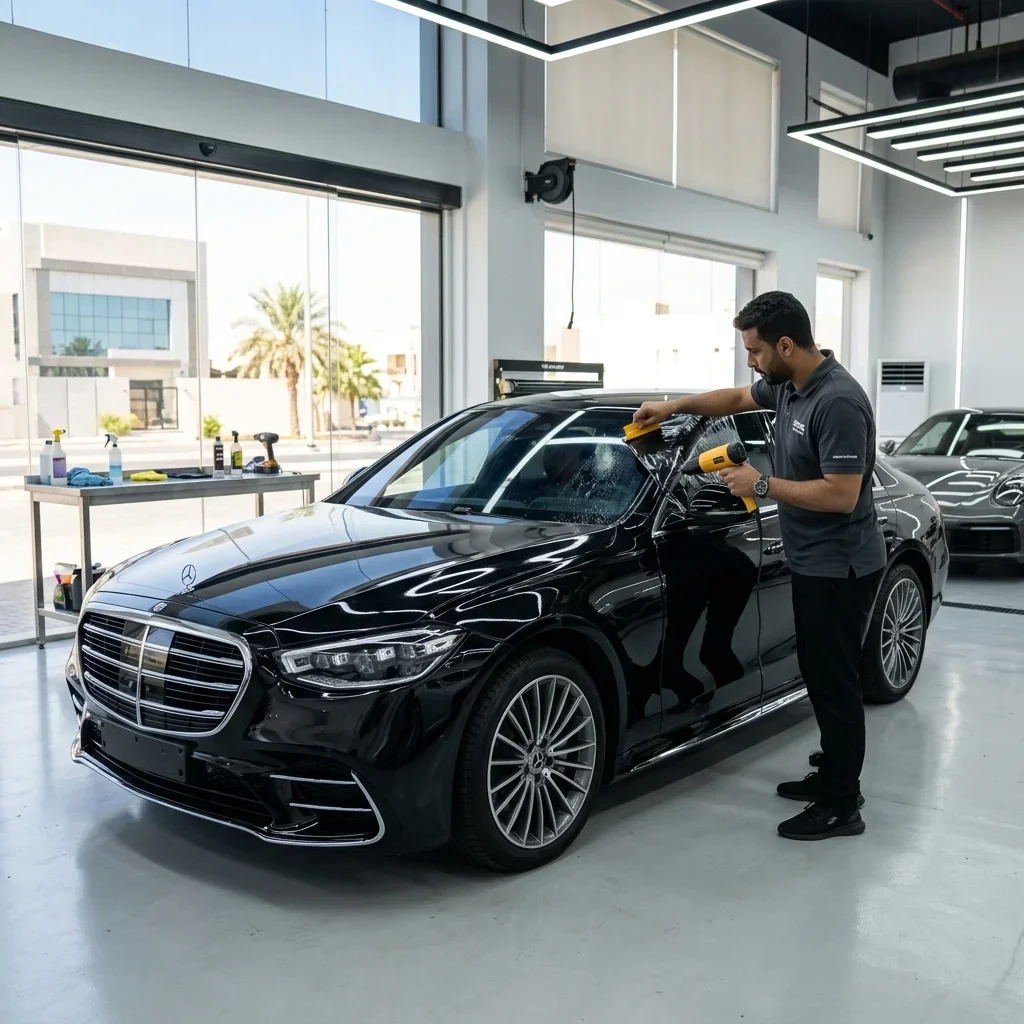
Car tinting in Jeddah ranges from cheap dyed films (300-500 SAR) to nano-ceramic (1,500-3,500 SAR) and 3M Crystalline (2,000-4,000 SAR). The best choice is clear nano-ceramic (shade 00) that blocks 96-97% of infrared and 99% of UV, dropping cabin heat from ~77°C to ~40°C while staying compliant with Saudi traffic law.
Jeddah is no ordinary city when it comes to heat. High humidity off the Red Sea allies with a vertical, scorching sun to turn your cabin into a genuine oven within minutes of parking. In a field study by AzelCore using a FLIR T530 thermal camera on 530 vehicles across 10 Jeddah districts (2024–2026), the average interior temperature of untinted cars reached about 77°C — hot enough to crack the dashboard, damage leather, strain the AC, and harm the skin of driver and passengers through ultraviolet rays. Proper heat-rejection tint is not a luxury in Jeddah; it is the first line of defense for your investment in the car and for your health. But the market is crowded with options and claims: films sold for three hundred riyals and others for four thousand, VLT, IR, and TSER numbers printed on catalogs without explanation, and warranty promises the seller never honors. This comprehensive reference guide was written by Mohammed Al-Hadi — a certified insulation and tinting technician and the official Johnson and 3M authorized dealer at AzelCore — to put everything you need in your hands: an explanation of film types and their construction, how to read the specifications yourself, a real price table by film and car size, a summary of Saudi traffic law, how to detect counterfeit film, what makes a professional installation, the difference between manufacturer and shop warranty, and finally a decision checklist to help you choose right the first time.
Table of Contents:
- Why Jeddah's Heat Demands Quality Tint
- Tint Film Types: From Dyed to 3M Crystalline
- How to Read Specs: VLT, IR, UV, and TSER
- Car Tint Prices in Jeddah 2026 (Detailed Table)
- Saudi Car Tint Laws — The Essentials
- How to Spot Fake and Cheap Film
- Installation Quality: Computer-Cut, FLIR Test, Curing
- Warranty: Manufacturer vs Shop
- Care and Maintenance Basics After Installation
- How to Choose the Right Tint Center
- Decision Checklist: 10 Steps Before You Tint
| Film Type | Construction & Technology | Pros | Cons | Price (Sedan/SUV/Luxury) SAR | Warranty |
|---|---|---|---|---|---|
| Dyed | Polyester + light-absorbing dye | Cheapest, provides privacy and dimming | Weak heat rejection, fades and turns purple fast | 300-500 / 400-600 / — | 1 year |
| Carbon | Metal-free carbon particles | Does not fade fast, no signal interference, economical | Less heat rejection than ceramic | 600-900 / 900-1,200 / 1,000-1,500 | 5 years |
| Nano-Ceramic | Nano ceramic heat-reflecting particles | Blocks 96-97% IR and 99% UV, clear and traffic-compliant | Costlier than carbon | 1,500-2,200 / 2,200-3,000 / 2,500-3,500 | 10 years |
| LLumar CTX | Advanced ceramic | Strong balanced performance at a mid price | Not available in all shades | 1,200-1,800 / 1,800-2,500 / 2,000-3,000 | 7 years |
| 3M Crystalline | Over 200 nano-layers | TSER ~90%, near-clear, top thermal performance | Highest price | 2,000-2,800 / 2,800-3,500 / 3,000-4,000 | Lifetime |
Why Jeddah's Heat Demands Quality Tint
Heat in Jeddah is different from any other Saudi city. High humidity makes the body feel hotter than the actual recorded temperature, and the vertical sun strikes the car's surface and glass directly for long hours.
When you park under the sun, solar radiation enters through the glass and is trapped inside the cabin in what is known as the "greenhouse effect," so the temperature rises astonishingly fast. In AzelCore's field study (FLIR T530 camera, ISO 13837:2021 standard, sample of 530 vehicles, 10 Jeddah districts, 2024–2026) the average cabin temperature in untinted cars reached about 77°C, while the average dropped to roughly 40°C in cars fitted with original nano-ceramic film.
That is a gap of nearly 37 degrees. Solar radiation has three components: visible light, ultraviolet (UV) rays, and infrared (IR) rays responsible for most of the sensation of heat.
A good nano-ceramic film blocks 96–97% of infrared and 99% of ultraviolet, cutting off the heat source without darkening the glass. The results are practical and direct: an AC that works with less effort and burns less fuel, a dashboard and seats that do not crack or fade, protection of the driver's skin from carcinogenic rays that penetrate ordinary glass, and immediate comfort when entering a car that has not become an oven.
In a climate like this, a cheap film that only darkens without blocking infrared leaves your car dark and hot at the same time — the worst of all choices.
Tint Film Types: From Dyed to 3M Crystalline
Understanding film construction is the key to choosing right. Dyed film is the cheapest and oldest: a polyester layer with added dye that absorbs light.
It darkens the glass and provides privacy, but blocks little heat, fades, and turns purple within months under Jeddah's sun, with a warranty of about one year. Carbon film is a step up: it uses carbon particles instead of dye, so it does not fade quickly, blocks a reasonable share of infrared, and does not interfere with phone and GPS signals because it is metal-free, with a warranty around 5 years.
Then come ceramic and nano-ceramic, the peak of performance: microscopic ceramic particles reflect and scatter infrared with very high efficiency (96–97%) with excellent optical clarity and no metal to obstruct signals, with warranties up to 10 years. The difference between "ceramic" and "nano-ceramic" is particle fineness and layer density; the smaller the particles, the more heat is blocked while the glass stays clear.
At the absolute summit stands 3M Crystalline: a multilayer technology of more than 200 nano-layers within a thickness less than an adhesive sheet, blocking heat more efficiently than many dark films while remaining nearly clear (TSER around 90%), with a lifetime warranty. For more technical detail see the nano-ceramic vs carbon vs 3M comparison.
The golden rule: do not choose film by its color, but by its construction and its ability to block infrared.
How to Read Specs: VLT, IR, UV, and TSER
Four numbers summarize any film's performance, and understanding them protects you from misleading claims. The first is VLT (Visible Light Transmission): how much light passes through the film.
The higher the number, the clearer the glass; a film at VLT 70% is nearly clear, and at 30% it is dark. This number is what traffic and periodic-inspection devices measure, and it has no direct link to heat rejection.
The second is IR (Infrared Rejection): the percentage of infrared the film blocks, which is responsible for most of the sensation of heat. Here lies the biggest trick: some sellers advertise "IR 99%" but it measures a very narrow band of the spectrum, so always ask about total heat-rejection.
The third is UV (Ultraviolet Rejection): almost all good films block 99% of UV, the rays responsible for interior fading and skin cancer, and this number is the most important for health. The fourth and most technically important is TSER (Total Solar Energy Rejected): the comprehensive number measuring the total percentage of solar energy the film blocks (heat + light + rays), so it is the honest measure of real thermal performance.
When comparing two films, compare TSER, not VLT or IR alone. Example: 3M Crystalline achieves a TSER near 90% while remaining nearly clear — and that is what makes it exceptional.
Always ask for the manufacturer's official spec sheet, not numbers spoken by the seller.
Car Tint Prices in Jeddah 2026 (Detailed Table)
Prices in Jeddah vary widely by film type, car size, and installation quality, and the table below shows typical ranges inclusive of installation and warranty (the price is quoted as a starting point and may vary by car model and condition). As a general rule: dyed film starts at 300–500 SAR for a sedan but is a losing investment because it fades within a year.
Carbon is a balanced economy choice (600–1,500 SAR by size) with a 5-year warranty. Nano-ceramic is the most requested and sensible choice in Jeddah (1,500–3,500 SAR) with excellent thermal performance and a 10-year warranty.
3M Crystalline is the premium tier (2,000–4,000 SAR) with a lifetime warranty and unmatched thermal performance with near-perfect clarity. There is also LLumar CTX as a strong mid-tier option (1,200–3,000 SAR, 7-year warranty).
Beyond the film itself, budget for add-ons: a top sun strip at 100–200 SAR, old-tint removal at 200–400 SAR, mobile installation service at +100–200 SAR, and hood paint protection with PPF film from 1,500 to 3,000 SAR. To know your estimated cost precisely, use the AzelCore calculator that accounts for your car size and film type.
Remember that a price far below the market usually means counterfeit film or unprofessional installation that you will pay for later through reinstallation or failing the periodic inspection.
Saudi Car Tint Laws — The Essentials
Compliance with Saudi traffic regulations is not optional, and a violation means a financial fine, possible vehicle impoundment, and failing the periodic inspection. The core rule is clear: the large front windshield and the driver and front-passenger side windows must remain fully transparent (only clear shade-00 films that do not darken the glass, alter its color, or mirror-reflect light are permitted), while the rear side windows may be tinted to a specified shade for private family cars equipped with rear seats.
The security reason is to let security personnel clearly see inside the vehicle from the front. Here the genius of clear nano-ceramic shines: it gives you up to 97% heat rejection at a fully transparent, traffic-compliant shade 00 — excellent cooling with no violation.
An important note for the periodic inspection: original factory glass is not 100% transparent but carries a light dimming percentage, so adding a dark film over it may push the total beyond the legal limit and fail your car. That is why a professional technician measures the original glass transparency first, then selects the appropriate film.
For the precise legal figures (allowed VLT percentages per window, the fine amount, and vehicles banned from tinting such as taxis and two-seat coupes) see our dedicated article on Saudi car tint laws 2026, and always rely on the official sources of the General Directorate of Traffic (Ministry of Interior) and the Saudi Standards, Metrology and Quality Organization (SASO). At AzelCore we give you a tax invoice and a warranty certificate detailing the VLT percentage for each window, to serve as an official document before inspection and checkpoints.
How to Spot Fake and Cheap Film
The tint market in Jeddah is full of counterfeit films sold under famous brand names like Johnson and 3M while being nothing of the sort, and the tempting price gap is usually a trap. The first sign is price: if an "original nano-ceramic" offer is far cheaper than the market, it is most likely a cheap dyed or carbon film with a forged label.
The second sign is the absence of documentation: original film comes with a warranty card registered in your name and a serial number verifiable with the manufacturer, and an authorized dealer like AzelCore provides that. The third sign is the practical heat test: ask the center to run a test with a heat lamp or a FLIR camera on a film sample; the original blocks heat so you feel it does not pass through the film, while the counterfeit lets it through even though it may be dark.
The fourth sign is smell and appearance: poor film emits a pungent adhesive odor that intensifies with Jeddah's heat, tends to ripple and bubble after weeks, and turns purple. The fifth sign is the seller's behavior: a genuine dealer shows you the official spec sheet and explains the difference between TSER and IR without mixing numbers, whereas a dubious seller relies on generic phrases like "the strongest insulation" without documented figures.
For deeper detail and field-testing methods, read our guide on how to spot fake tint. The rule: original film is a ten-year investment, and counterfeit is wasted spending you will pay twice.
Installation Quality: Computer-Cut, FLIR Test, Curing
The best film in the world is ruined by poor installation, and the reverse is true: professional installation raises the film's performance and lifespan. The first element is computer-cutting: instead of cutting the film by blade over your car's glass — which scratches the glass and leaves imprecise edges — a professional center uses software containing your car's exact glass measurements and cuts the film on an automated plotter outside the car, so the edges come out perfect with no risk to the glass or the rear defroster lines.
The second element is the installation environment: it must be done in a clean, air-conditioned, dust-free bay, because a single speck of dust under the film means a permanent bubble; Jeddah's sun and dust make open-air installation a disaster. The third element is heat verification: a serious center runs a FLIR camera test before and after installation to prove to you with numbers the drop in heat transmitted through the glass — visual evidence that does not lie about the film's performance.
The fourth and most psychologically important element is curing: after installation a thin layer of water and solution remains between the film and the glass and needs days to weeks to fully evaporate. During this period you may see a light haze or small water bubbles, which is completely normal and disappears on its own; do not try to scrape them and do not roll the windows down early.
The professional technician explains curing instructions clearly. To understand the difference between automated and manual cutting in more detail, see our article on computer-cut vs manual.
Warranty: Manufacturer vs Shop
The word "warranty" is used generously in the market, but there are two completely different types and you must know which one you are getting. The manufacturer warranty is the commitment of the global film company itself — such as Johnson (founded 1961) or 3M (founded 1902) — against film defects like fading, color change, cracking, bubbling, and failure of ray blocking.
This warranty is registered with the manufacturer under a serial number in your name, and it sets the real duration: nano-ceramic up to 10 years, 3M Crystalline lifetime, and carbon around 5 years. This warranty is granted only through an officially authorized dealer like AzelCore (the official Johnson and 3M dealer), and is never issued by an unauthorized seller no matter what they claim.
The second type is the shop/installation warranty, which covers the quality of the installation itself: straight edges, freedom from bubbles and dust, and no film peeling. This warranty matters but is usually short-term and rests on the center's reputation, not a global company.
The smart question before paying: "Is the warranty from the manufacturer and registered in my name with a serial number, or just a shop warranty?" Keep the warranty card and the tax invoice together; without them the warranty has no legal value when claiming. A genuine dealer does not shy away from documenting the manufacturer warranty in writing, and a seller who stalls on that exposes himself.
Care and Maintenance Basics After Installation
Good tint film lasts many years, but proper care in the first days and beyond ensures maximum lifespan and the best appearance. The first and most important rule: do not roll down the tinted windows for 3 to 7 days after installation (and slightly longer in Jeddah's humidity), because the film has not yet fully bonded to the glass, and opening the window early may peel its edge.
Second, during the curing period you will notice a haze or small water bubbles; ignore them entirely and do not scrape them, as they disappear on their own as the water evaporates. Third, when cleaning later: use a soft microfiber cloth and water with an ammonia-free glass cleaner, because ammonia damages the film and causes it to fade and peel over time.
Avoid rough sponges and metal scrapers entirely. Fourth, the film is installed on the inner surface of the glass, so there is no need to worry about normal exterior car washing.
Fifth, avoid sticking decals or phone mounts directly on the film. Original nano-ceramic from Johnson or 3M is designed to withstand Jeddah's sun without fading or changing color throughout the warranty period, unlike cheap film that needs "impossible care" to remain acceptable.
For the full seasonal care schedule, see the tint care guide. With these simple habits your tint stays looking like it was installed yesterday for years.
How to Choose the Right Tint Center
Choosing the center is no less important than choosing the film, because the center determines installation quality, warranty validity, and legal compliance. First, look for official authorization: is the center an authorized dealer of a global brand like Johnson or 3M? Only an authorized dealer can grant you a registered manufacturer warranty, and AzelCore is the official Johnson and 3M dealer in Jeddah.
Second, ask to see the film's official spec sheet before you pay, and make sure the technician explains your legal options based on your car registration. Third, an electronic tax invoice and a written warranty certificate detailing the VLT percentage for each window — this is not bureaucracy but your shield before the periodic inspection and checkpoints.
Fourth, the work environment: an air-conditioned, clean bay, computer-cutting equipment, and a thermal camera for testing are signs of professionalism. Fifth, transparency in dealing: a serious technician measures your original glass transparency and explains the difference between TSER and IR without exaggerating claims.
Sixth, review the center's previous work in the photo gallery and genuine customer opinions. Seventh, pre-installation consultation: a professional center listens to your need (cooling, privacy, skin protection) and recommends the film suited to your budget instead of always pushing the most expensive one.
Technical expertise makes the difference; Mohammed Al-Hadi — a certified insulation and tinting technician — leads the AzelCore team with field experience backed by a documented thermal study. Do not hesitate to ask questions; the center that answers with confidence and numbers is the one you trust.
Decision Checklist: 10 Steps Before You Tint
Before you pay a single riyal, run through this practical checklist to ensure the right decision the first time. First, define your primary goal: maximum cooling, privacy, skin protection, or appearance? This guides the film choice.
Second, set a realistic budget and know that original film is a 5–10 year investment, not a passing expense. Third, know your car size (sedan, SUV, luxury) because it sets the price — use the AzelCore calculator for an accurate estimate.
Fourth, decide the film type: economy carbon, balanced nano-ceramic, or premium 3M Crystalline. Fifth, verify legal compliance for each window per traffic regulations, and request clear shade 00 for the windshield and front sides.
Sixth, confirm the center is an authorized dealer that grants a manufacturer warranty registered with a serial number in your name. Seventh, ask to see the spec sheet and the official TSER, IR, and UV figures.
Eighth, request a before/after FLIR camera test if possible. Ninth, ensure you receive a tax invoice and a written warranty certificate with the VLT percentage for each window.
Tenth, understand the curing and care instructions before you leave (do not open the windows for 3–7 days, ammonia-free cleaner). If you pass these ten steps, you guarantee original film, professional installation, legal compliance, and a real warranty.
The final and easiest step: contact AzelCore on WhatsApp +966564612017 for a free consultation to precisely determine the optimal choice for your car.
Frequently Asked Questions
What is the best type of car tint for Jeddah's heat?
Clear nano-ceramic (shade 00) is the optimal choice for most cars in Jeddah: it blocks 96-97% of infrared and 99% of ultraviolet and drops cabin heat from about 77°C to roughly 40°C, and it is traffic-compliant. Those wanting the highest performance with near-perfect clarity choose 3M Crystalline with a lifetime warranty. Carbon is a balanced economy option.
How much does car tinting cost in Jeddah in 2026?
Prices start at 300-500 SAR for dyed film (sedan), the weakest, carbon from 600 to 1,500 SAR by size, nano-ceramic from 1,500 to 3,500 SAR, and 3M Crystalline from 2,000 to 4,000 SAR. These prices include installation and warranty as a starting point. Add accessories like a sun strip (100-200) or old-tint removal (200-400). Use the AzelCore calculator for an accurate estimate.
Does clear heat-rejection tint violate traffic laws?
No. Clear shade-00 nano-ceramic film is fully permitted on the windshield and front side windows because it does not darken the glass or obstruct vision, even though it blocks up to 97% of heat. What is prohibited is dark or reflective dimming on the front surfaces. For the precise legal figures per window, see the Saudi car tint laws 2026 article and rely on Traffic (Ministry of Interior) and SASO sources.
What is the difference between VLT, IR, and TSER?
VLT is Visible Light Transmission (how clear the glass is) and it is what traffic devices measure. IR is infrared rejection, responsible for most of the heat. TSER is Total Solar Energy Rejected, the most honest measure of overall thermal performance because it combines heat, light, and rays. When comparing films, rely on TSER, not VLT or IR alone, and ask for the official spec sheet.
How do I know the film is original and not counterfeit?
Original film comes with a manufacturer warranty card registered in your name and a verifiable serial number, and is granted only through an authorized dealer like AzelCore (official Johnson and 3M dealer). Counterfeit signs: a price far below the market, no documentation, a pungent adhesive smell, and rippling and bubbles after weeks. Ask for a FLIR camera test on a film sample; the original genuinely blocks heat. For details, see the guide on spotting fake tint.
How long is the tint curing period and when can I open the windows?
After installation a thin layer of water remains between the film and the glass and needs 3 to 7 days to evaporate (and slightly longer in Jeddah's humidity). During this period you may see a haze or small water bubbles, which is completely normal and disappears on its own — do not scrape them. Do not roll down the tinted windows during this time so the film edges do not peel. Afterward, use an ammonia-free glass cleaner to preserve the film.
Does tint affect mobile and GPS signals?
Old metallic films used to interfere with mobile, GPS, and remote-key signals because they contain reflective metal layers. Nano-ceramic, carbon, and 3M Crystalline are completely metal-free and rely on ceramic or carbon particles, so they do not affect any wireless signal at all. This is a core advantage of modern films and an additional reason to avoid cheap metallic films.
What is the difference between the manufacturer warranty and the shop warranty?
The manufacturer warranty is a commitment from the global film company (Johnson or 3M) against film defects like fading and cracking, registered with a serial number in your name for a long term (nano-ceramic 10 years, 3M Crystalline lifetime), and granted only through an authorized dealer. The shop warranty covers the installation quality itself (edges, bubbles) and is shorter-term. Always request a manufacturer warranty documented in writing along with the tax invoice.
Sources & References
Related Services
- Car Tinting & Insulation in Jeddah — Original Nano-Ceramic ←
- Tint Cost Calculator — Estimate Your Car's Price ←
- 3M Crystalline — Official Dealer in Jeddah ←
- Original Johnson Tint — Authorized Dealer ←
- Saudi Car Tint Laws 2026 ←
- Comparison: Nano-Ceramic vs Carbon vs 3M ←
- How to Spot Fake Tint ←
- Tint Care Guide After Installation ←
- Common questions on tinting and insulation — short, direct answers ←