
What Does Jeddah Sun Do to Your Car? — 7 Unknown Damages
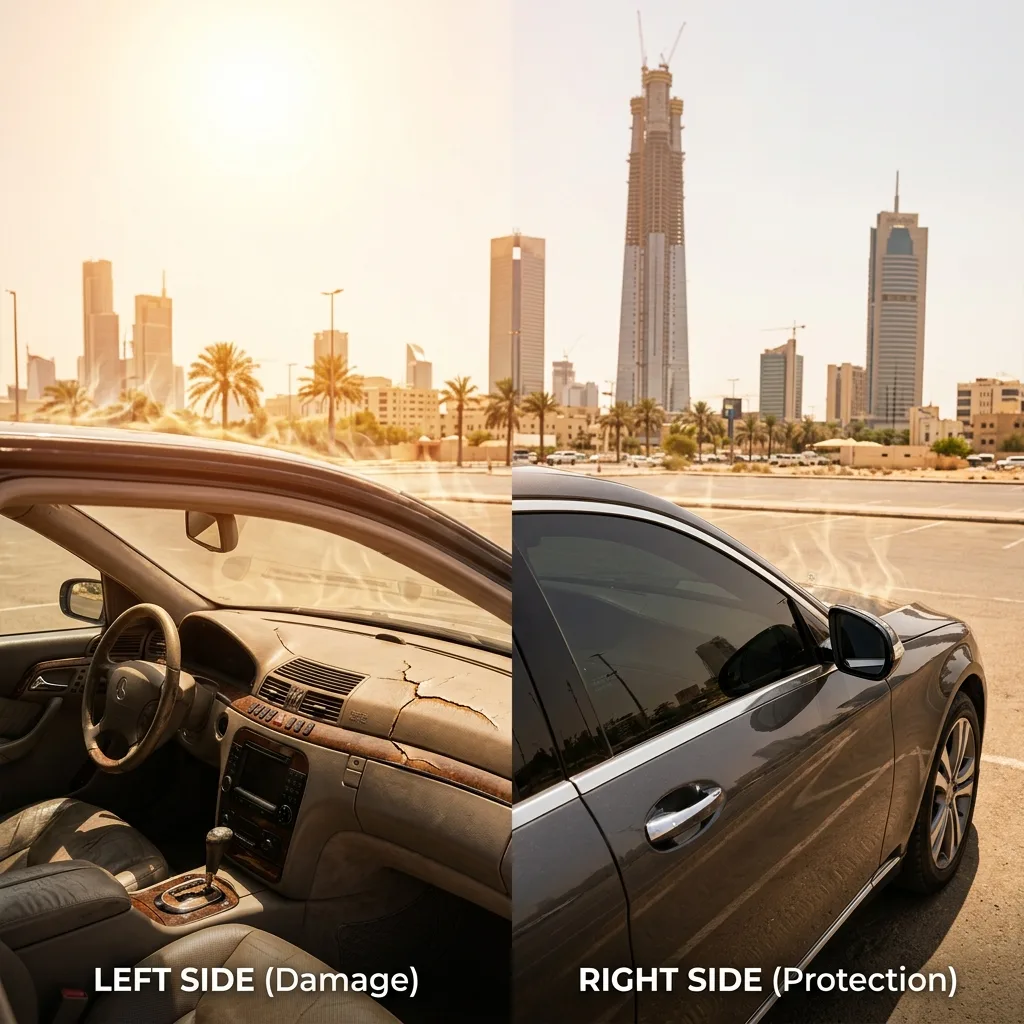
Jeddah's sun heat (48°C with 80% humidity) creates a greenhouse effect inside your car, raising cabin temperature to 80°C. This causes 7 costly engineering damages: cracking of natural and synthetic leather, hardening and fading of the dashboard, damage to navigation screens and electronics, AC compressor fatigue, 20% increased fuel consumption, emission of toxic gases from plastic, and rubber corrosion. Repairing these damages exceeds 15,000 SAR annually for luxury cars.
If you live in the coastal city of Jeddah, you are fully aware that the midday sun in the summer months (May to September) is unforgiving. We are not just talking about atmospheric temperatures exceeding 48°C, but coupled with suffocating humidity exceeding 80%, and harsh vertical sun rays. When you park your car in an exposed lot (even for just one hour), the car's glass acts as a "magnifying glass" letting in solar rays (UV and IR) and preventing heat from escaping, creating what is physically known as the "Greenhouse Effect." This phenomenon turns your luxury car's cabin into a literal thermal oven that silently devours the interior components. The damage doesn't happen suddenly; it accumulates daily in a hidden manner and only becomes apparent when it is too late. In this detailed engineering and financial report, we will quantify the real damages of not tinting your car with numbers, and the actual repair costs, to prove mathematically that original Nano-Ceramic tinting is not an accessory luxury, but the cheapest and most important "insurance policy" to protect your car investment.
Table of Contents:
- Cracked Leather Seats
- Faded Dashboard
- Screen Damage
- Weak AC
- Rubber Degradation
- Eye and Skin Damage
- The Solution: Thermal Insulation
| Structural/Mechanical Damage Type | Estimated Repair Cost | Estimated Time to Appear (Without Protection) |
|---|---|---|
| Drying & Cracking of Leather Seats | 1,500 to 4,000 SAR | 4 to 8 months |
| Hardening, Cracking, or Sticky Dashboard | 1,000 to 3,500 SAR | 6 to 12 months |
| Navigation Screen Damage (Dead Pixels) | 3,000 to 9,000 SAR | 12 to 18 months |
| Early AC Compressor Fatigue & Failure | 2,500 to 6,000 SAR | 2 to 3 years |
| Excess Fuel Consumption due to AC Load | 2,400 to 4,000 SAR annually | Immediate daily financial impact |
| Corrosion & Hardening of Door Seals | 600 to 1,500 SAR | 2 to 3 years |
| Total Potential Financial Losses | 11,000 to 28,000 SAR | Within just 3 years |
| Cost of Premium Nano-Ceramic Tint | 1,500 to 3,000 SAR | Paid once (10-year lifespan) |
The Greenhouse Effect: The Shocking Numbers
Let's put things into scientific perspective. At "AzelCore" centers, we conducted field tests using Thermal Imaging Cameras (FLIR) on cars parked in direct sun in Jeddah at 1:00 PM.
The result? The external atmospheric temperature was 45°C, but inside the cabin (for the untinted car), the temperature skyrocketed to a horrifying 81°C! The steering wheel recorded 65°C (a degree sufficient to cause first-degree superficial skin burns upon prolonged contact). The dashboard directly exposed to the sun through the windshield exceeded 95°C.
In contrast, a car tinted with original Nano-Ceramic film (97% IR rejection) did not exceed 45°C inside the cabin under the same conditions. We are talking about a thermal difference of a full 36 degrees Celsius!
The Silent Danger: Toxic Gas Emissions (VOCs)
Have you ever smelled "burnt plastic" when entering your car after it was parked in the sun? This isn't just hot air; it's a health crisis. Plastics, adhesives, and vinyl used in manufacturing car interiors release toxic Volatile Organic Compounds (VOCs) like Benzene and Formaldehyde at high temperatures (above 60°C).
Inhaling these trapped gases in a closed car daily is scientifically linked to headaches, dizziness, and respiratory issues. Thermal tinting doesn't just protect your car's upholstery; it prevents the cabin from reaching the plastic boiling point, thus protecting your lung health and your children's lungs from inhaling these toxins.
The Collapse of Modern Electronics and Screens
Cars from 2024 and beyond are no longer just mechanical machines; they are "computers on wheels," filled with massive infotainment screens (OLED and LCD) and digital instrument clusters. These screens are hyper-sensitive to heat.
Continuous exposure to 80°C causes the liquid crystal layers inside the screen to expand, resulting in what is called "Dead Pixels" (black spots that never disappear), severe touch response lag, and sometimes the melting of the adhesive behind the screen. The cost of replacing an infotainment screen for a luxury car at the dealership exceeds 8,000 SAR.
Why pay this amount when you can protect it with a nano-ceramic windshield tint for just 600 SAR?
Mechanical Suffering: The AC and Fuel
When you enter a car with an internal temperature of 80°C, what is the first thing you do? You turn on the AC to the maximum speed (Max Cool). In untinted cars, the AC compressor works at maximum capacity for very long periods trying to cool this fiery mass, and as the sun continues to penetrate the glass, the compressor never shuts off to rest.
This Overload reduces the lifespan of the AC evaporator and compressor by half. Most importantly financially: running the AC at max power consumes massive mechanical energy from the engine, increasing gasoline consumption by 15% to 20%.
Tinting pays for itself (ROI) through savings in fuel bills and extending the life of the air conditioning system.
Leather Cracking and Rubber Corrosion
Ultraviolet (UV) rays are the primary enemy of chemical bonds in organic and synthetic materials. The rays penetrate the glass and dry out the natural oils inside the leather upholstery (whether natural Nappa or synthetic).
In less than 6 months, the leather loses its elasticity, peels, and cracks hideously in a way that cannot be treated with polishing, requiring costly reupholstery. Similarly, the rubber weatherstripping surrounding doors and windows hardens and breaks due to daily repeated thermal expansion and contraction cycles, leading to rainwater leaks later and the intrusion of annoying Wind Noise while driving on highways.
Frequently Asked Questions
Does clear windshield tint prevent dashboard heat?
Yes absolutely! Advanced films like 3M Crystalline or Johnson Supreme come in a legally permitted clear shade (00) providing crystal clear night vision, while containing nano-ceramic layers that block 97% of heat (IR) and 99% of UV rays, completely protecting the dashboard from cracking.
Do side fabric sunshades replace the need for tinting?
No, fabric sunshades only block visible light (glare), but they possess no physical technology to prevent Infrared rays (heat) from penetrating the glass and heating the cabin. Heat will enter regardless. Tinting reflects the heat from the outside before it enters.
Does the car's heat affect the car battery?
Yes, indirectly. High heat increases fluid evaporation inside the battery. More importantly, constantly running the AC at maximum power places an additional load on the alternator and battery to generate continuous electricity, which reduces the battery's lifespan in summer.
⚠️ Warning: Tinting only the side windows and leaving the windshield exposed (without clear tint) is like locking the house doors but leaving the roof open to the sun! The windshield is the largest glass area in the car and is the primary source for 60% of the cabin's heat entry.