
Why Does Tint Turn Purple and How to Avoid It? The Real Chemical Cause in Jeddah's Heat
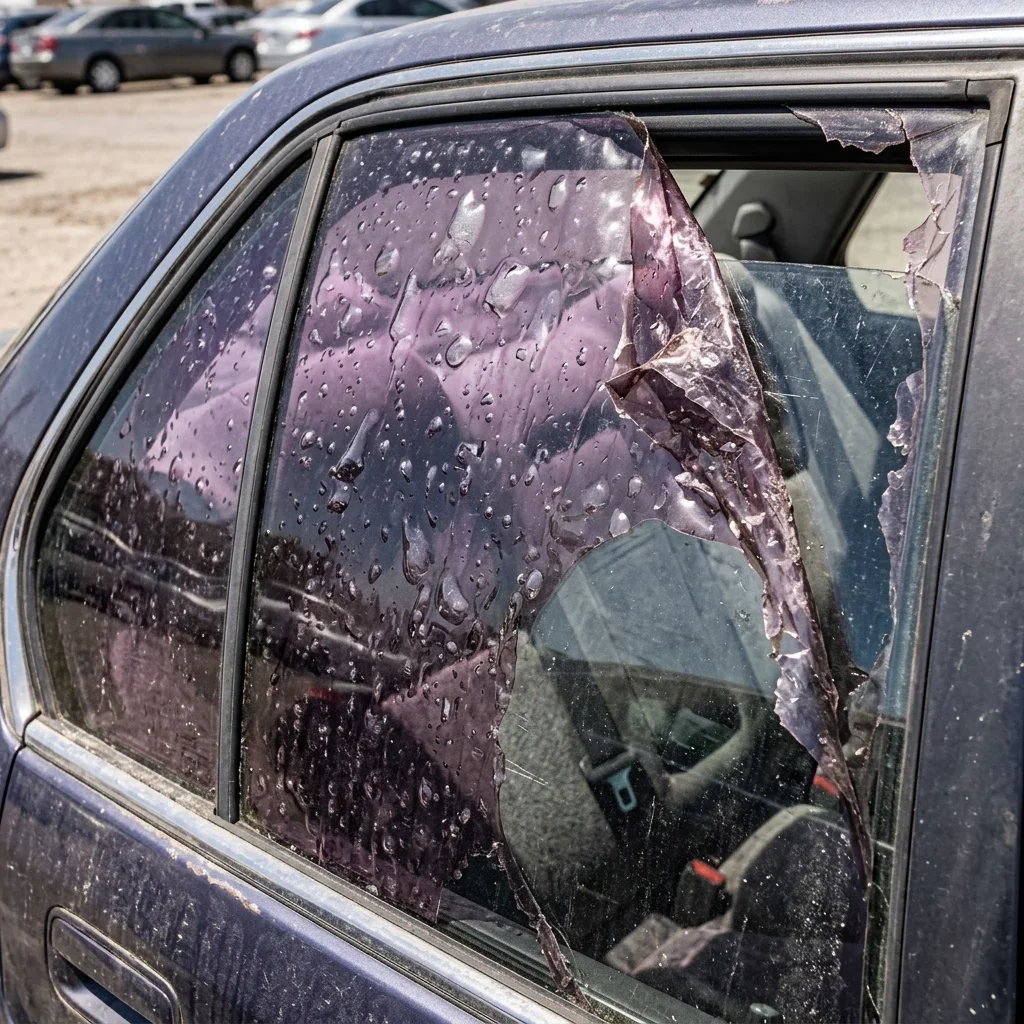
Tint turns purple because cheap dyed film is colored with organic dyes; under Jeddah's intense UV the unstable yellow dye breaks down first (photolysis), leaving only red and blue — which the eye reads as purple. Bubbles come from adhesive failure under heat. Nano-ceramic films use stable pigment particles, so they never turn purple.
If you drive through Jeddah's streets and notice your car tint has started shifting toward a purple or violet hue, or small bubbles have appeared under the film — especially along the edges of the glass — you are watching a genuine chemical failure with your own eyes, not mere "dirt" or bad luck. This phenomenon has a precise scientific explanation that specialized technicians understand well, and it is directly tied to the type of film installed on your car and how well it resists the scorching sun. Jeddah, with its high heat, coastal humidity, and intense year-round ultraviolet radiation, is one of the harshest environments on Earth for testing tint-film quality. A cheap dyed film may look excellent in its first week, yet it silently begins its breakdown journey from the very first day under the sun. In this guide, engineer Mohammed Al-Hadi — a certified insulation and tinting technician and authorized dealer of Johnson and 3M at AzelCore in Jeddah — explains the real chemical cause behind tint turning purple and forming bubbles, the fundamental difference between dyed film and nano-ceramic, and how to avoid this problem permanently before you end up paying twice.
Table of Contents:
- The Real Chemical Cause: Why Color Degrades to Purple
- How Jeddah's UV Accelerates the Collapse
- Bubbles: The Story of Adhesive Failure in Heat
- Dyed vs Nano-Ceramic: The Difference That Decides Fate
- Comparison Table: Film Types and Purple-Shift Risk
- Early Warning Signs Before It Becomes a Disaster
- Why Genuine Johnson and 3M Films Never Turn Purple
- Traffic Compliance: Degraded Tint Can Cost You a Fine
- How to Avoid the Problem Permanently and Pick the Right Film
| Film Type | Coloring Technology | Purple-Shift Risk | Infrared Blocking | Price (Sedan) SAR | Warranty |
|---|---|---|---|---|---|
| Dyed | Degradable organic dye | Very High | Poor | 300 - 600 | 1 Year |
| Carbon | Carbon particles | Low | Good | 600 - 1,500 | Up to 5 Years |
| Nano-Ceramic | Stable inorganic ceramic particles | Practically None | 96 - 97% | 1,500 - 2,200 | 10 Years |
| 3M Crystalline | Multilayer optical film | Practically None | High (TSER ~90%) | 2,000 - 4,000 | Lifetime |
The Real Chemical Cause: Why Color Degrades to Purple
The purple color is not a random defect but a logical consequence of dye chemistry. Cheap dyed films are colored using organic dyes injected into the polyester layer, and this dye is originally a blend of three primary colors: red, blue, and yellow, mixed together to produce the gray or black you see.
The problem is that these dyes are not equal in their resistance to sunlight. The yellow dye is the weakest and least chemically stable, so when high-energy ultraviolet rays strike it, the molecular bonds of the yellow dye break in a process called photolysis.
As a result, the yellow component gradually fades out of the blend, leaving only red and blue. When red and blue combine without the balancing yellow, the human eye perceives it as purple or violet.
In short: the tint did not gain a new color — it lost an old one. This explanation is widely recognized in the film industry and is precisely why low-quality dyed films carry a short warranty (just one year with us), because the manufacturer knows the dye will begin breaking down within a short period under harsh sun like Jeddah's.
How Jeddah's UV Accelerates the Collapse
Every tint film on Earth is subject to degradation, but speed is what makes the difference — and Jeddah is exceptionally harsh. The city sits on the Red Sea coast with a hot semi-tropical climate and is exposed to intense solar radiation almost year-round, with a high sun angle that increases the dose of ultraviolet rays reaching the car.
Add to this that your car is often parked under direct sun for hours daily in open lots. Ultraviolet radiation is the energy that breaks the dye bonds, and the greater the dose and duration, the faster the breakdown.
A dyed film that might survive three or four years in a mild climate may begin showing purple within just 12 to 24 months under Jeddah's conditions. More dangerously, the same rays that damage the film penetrate the cabin and harm your skin and eyes and fade the interior leather and plastic.
Here a critical irony appears: cheap dyed film is poor at blocking UV in the first place, so it harms both itself and you simultaneously. High-quality films, by contrast, are engineered to block up to 99% of UV, protecting both themselves and you.
Bubbles: The Story of Adhesive Failure in Heat
If purple is the dye's problem, bubbles are the adhesive's problem. The film bonds to the glass through a heat-sensitive adhesive layer.
In poor-quality films, this adhesive is low grade and loses its cohesion under Jeddah's harsh daily heating and cooling cycles, where the glass surface temperature rises to very high levels during the day then drops at night. This repeated expansion and contraction weakens the bond and lets air or moisture enter between the film and the glass, forming bubbles that start small at the edges then spread.
Sometimes bubbles result from a faulty installation in the first place: inadequate glass cleaning, a poor installation solution, failure to professionally squeeze out all the water and air during application, or not allowing the film enough time to cure and set. In our thermal study using a FLIR T530 camera per ISO 13837:2021 on 530 samples across ten Jeddah districts, we recorded cabin temperatures reaching about 77°C without insulation versus about 40°C with nano-ceramic.
This enormous thermal gap is what stresses cheap adhesive daily until it fails, whereas genuine films use heat-resistant adhesives specifically engineered to withstand this stress for years.
Dyed vs Nano-Ceramic: The Difference That Decides Fate
The difference between dyed film and nano-ceramic is not only price — it is the chemistry that decides whether your color turns purple or not. Dyed film relies on an organic dye for color and blocking, and this dye is photo-degradable as explained, and it does not efficiently block the infrared rays responsible for heat.
That is why its price is low (300 to 600 SAR) and its warranty is just one year, making it the prime candidate for purple shift. Carbon film is a step better: it uses carbon particles instead of part of the dye, so it resists fading far more and generally does not turn purple, priced from 600 to 1,500 SAR with a warranty up to 5 years.
Nano-ceramic is the peak: it colors and blocks heat through microscopic, inorganic, chemically stable ceramic particles that never degrade under UV, blocking 96 to 97% of infrared and 99% of UV. Its sedan price is 1,500 to 2,200 SAR (SUV 2,200 to 3,000, luxury 2,500 to 3,500) with a 10-year warranty.
The fundamental difference: organic dye dies under the sun, while inorganic mineral ceramic particles never know purple. When you pay for nano-ceramic, you are buying chemical stability — not just a color.
Early Warning Signs Before It Becomes a Disaster
Purple shift and bubble formation do not happen overnight; they are preceded by early signs that an alert car owner can catch in time. First, observe the color under direct daylight, not in shade: if the film starts leaning toward a faint violet tinge at the glass edges or in the most sun-exposed parts (such as the rear and front glass), this is the start of the yellow dye's photolysis.
Second, notice color unevenness: sun-exposed areas usually shift before protected ones, so you find inconsistent color on the same window. Third, fine hairline cracks or an orange-peel-like texture on the film surface indicate deterioration of the polyester layer.
Fourth, small bubbles at the edges or corners are an early alarm of adhesive failure, and they will spread over time. Fifth, the return of a sense of heat inside the cabin despite the tint means the film has lost its ability to block rays.
If you spot any of these signs, the only solution is to fully remove the old film and install a genuine high-quality one, because a degraded film cannot be repaired or have its color restored. Early intervention spares you from driving with embarrassing, non-compliant purple glass.
Why Genuine Johnson and 3M Films Never Turn Purple
Johnson was founded in 1961, and 3M is a heritage company founded in 1902, and both possess decades of research in film and polymer science. The genuine films from these two brands in their premium tiers do not rely on degradable organic dye, but on advanced technologies: Johnson's nano-ceramic films use stable ceramic particles, while 3M Crystalline uses multilayer optical film technology (over two hundred layers) to block heat with high efficiency, reaching a TSER value of about 90%, without relying on a degradable dye.
For this reason these companies offer long warranties of up to 10 years on nano-ceramic, and a lifetime warranty on 3M Crystalline — and that warranty itself is proof of the manufacturer's confidence that the film will not turn purple or bubble throughout the warranty period. A warranty is a written document that protects you.
But note: the warranty is valid only on genuine films installed through an authorized dealer, so verifying the film's authenticity and that the center is an official dealer is critical. The difference between the experience of a genuine film staying pure for ten years and a counterfeit turning purple within a year is the difference between stable chemistry and cheap dye.
Traffic Compliance: Degraded Tint Can Cost You a Fine
The problem of purple, bubbled tint is not only cosmetic — it can also be legal. Degraded tint changes color away from the original glass color, and colored tint (such as a clear violet or purple tinge) is an explicit traffic violation under the General Directorate of Traffic regulations in the Kingdom, alongside reflective tint.
Tint violations fall under the vehicle-structure modification clause, with a fine ranging from 500 to 900 SAR. Likewise, a bubbled and cracked film distorts vision, especially in night driving, posing a safety hazard and potentially causing a failure in the periodic inspection when the glass transparency is measured with a tint meter.
Remember that traffic laws permit fully transparent insulation (shade 00) on the windshield and driver-side windows, and up to shade 02 (about 30% transparency) on the rear side windows. A genuine transparent nano-ceramic film gives you the highest heat insulation with full compliance, and it will not turn purple to push you out of compliance later.
Cheap dyed film, by contrast, may start legal and then become a violation the moment its color shifts, combining loss of money with exposure to a fine. For the legal percentages of each window, see the Saudi tint laws 2026 guide.
How to Avoid the Problem Permanently and Pick the Right Film
Avoiding purple shift and bubbles begins with one decision: never buy cheap dyed film for a climate like Jeddah's. The first step is choosing the right technology — nano-ceramic or high-quality carbon instead of dyed — because inorganic chemistry is your first guarantee against fading.
The second step is verifying the film's authenticity and that you are dealing with an authorized dealer like AzelCore, the authorized dealer of Johnson and 3M in Jeddah, because a counterfeit film has no real warranty. Always request a tax invoice and a written warranty certificate detailing the film type, its VLT transparency, and the warranty duration for each window.
The third step is installation quality: professional installation in a clean environment with the right tools prevents bubbles, so choose a center with experience and certified technicians. The fourth step is post-installation care: let the film cure for a few days before rolling the windows down, and clean it with gentle, ammonia-free products.
Finally, use the AzelCore calculator or contact technician Mohammed Al-Hadi directly to determine the most suitable film for your budget and car type. The golden rule is simple: in Jeddah's heat, quality is not a luxury but protection from paying twice.
Frequently Asked Questions
Why specifically does tint turn purple?
Because dyed film is colored with a blend of red, blue, and yellow dyes. The yellow dye is the least stable and degrades first under ultraviolet rays (photolysis), leaving only red and blue, a mix the eye perceives as purple.
Can purple tint be repaired and restored to its original color?
No, the chemical degradation of the dye is irreversible. The only solution is to fully remove the old film and install a new, genuine, high-quality film that does not degrade — preferably nano-ceramic.
Does nano-ceramic turn purple over time?
Practically no. Nano-ceramic colors and blocks heat through chemically stable inorganic ceramic particles unaffected by UV, so it does not turn purple and comes with a 10-year warranty.
What causes bubbles to appear under tint?
Bubbles are caused by adhesive failure under Jeddah's harsh heat cycles, or by a faulty installation that left air or water under the film. Genuine films use heat-resistant adhesives that prevent this.
How long until dyed film turns purple in Jeddah?
Under Jeddah's harsh conditions of intense heat and UV, dyed film may begin showing purple within 12 to 24 months, and sometimes faster if the car is always parked in direct sun.
Is purple tint considered a traffic violation?
Colored tint or tint that has shifted away from the original glass color is a violation, and tint violations fall under vehicle-structure modification with a fine between 500 and 900 SAR. A cracked film may also cause a failure in the periodic inspection.
How can I be sure the film I install won't turn purple?
Choose nano-ceramic or carbon from a genuine brand like Johnson or 3M through an authorized dealer, and request a written warranty certificate. Inorganic technology and a long warranty (10 years or lifetime) are your guarantee against purple shift.
⚠️ Warning: If your tint starts turning purple or bubbles appear, do not ignore it and do not try to scrape it off yourself with sharp tools, as you may scratch the glass or damage the rear defroster lines. The degradation is irreversible, and the correct solution is full professional removal at a certified center followed by installation of a genuine film. Driving with a color-degraded film may also expose you to a traffic violation and impair your night vision.
Sources & References
Related Services
- Genuine Nano-Ceramic Car Tint That Won't Turn Purple ←
- Genuine Johnson Tint — Authorized Dealer in Jeddah ←
- 3M Crystalline — Lifetime Warranty Against Fading ←
- How to Spot Fake Tint Before It Turns Purple ←
- Comparison: Nano-Ceramic vs Carbon vs 3M ←
- Why Cheap Tint Costs You More in Jeddah ←
- Saudi Car Tint Laws 2026 ←
- Calculate Your Car Tint Cost Now ←