
Fleet & Company-Car Tinting in Jeddah — Bulk Contracts & Driver Heat Protection
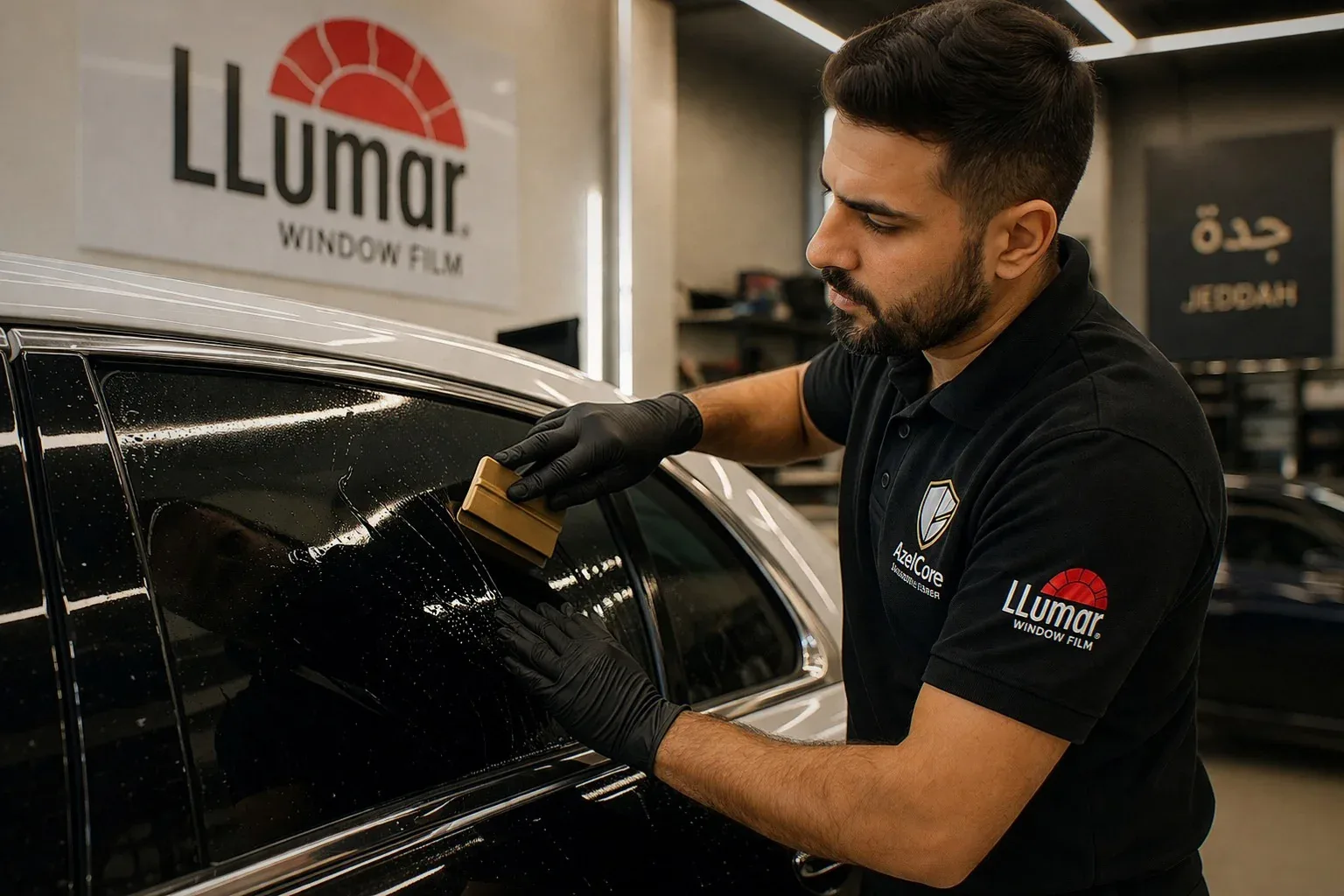
Fleet tinting in Jeddah uses clear nano-ceramic film (shade 00 for windshield and driver/front side glass, up to 02 for rear) that blocks 96-97% of infrared and 99% of UV while staying fully compliant with traffic law and periodic inspection. Bulk contracts lower per-unit cost and standardize spec and warranty across the whole fleet.
Running a vehicle fleet in Jeddah means dealing with a harsh climate reality: summer surface temperatures above 50°C, and cabin interiors that can reach roughly 77°C in an untinted car according to our field measurements with a FLIR T530 camera across ten Jeddah districts. That heat does more than exhaust the drivers and staff who spend long hours on the road; it raises fuel consumption by overworking the AC, accelerates wear on seats and dashboards, and increases crew fatigue and absence. Company-car tinting is not a cosmetic line item but an operational decision touching cost, safety, and regulatory compliance. The difference between tinting dozens of cars one at a time, randomly, and bundling them into a single bulk contract shows up in three things: per-unit price, a standardized spec and legal shade across the entire fleet, and one traceable warranty with a serial number per car. In this practical guide for fleet managers and procurement officers in Jeddah, we explain how a compliant fleet-tinting contract is built under Saudi traffic law, which genuine films fit (Johnson and 3M nano-ceramic), how cost and return are calculated, and how to avoid periodic-inspection fines that hit undisciplined fleets. Every figure here is based on real pricing and data from AzelCore Center in Jeddah, with no exaggeration or unmeasurable promises.
Table of Contents:
- Why Jeddah heat is a fleet issue, not an individual luxury
- The legal framework for fleet tinting (which vehicles are allowed and which are banned)
- Genuine fleet-grade films: Johnson and 3M nano-ceramic
- Tinting price table by vehicle class in the fleet
- How a bulk fleet-tinting contract is structured
- Protecting drivers and staff from heat and UV
- Operational return: fuel, cabin lifespan, and inspection compliance
- Steps to execute a fleet-tinting project with AzelCore
| Fleet Vehicle Class | Recommended Film | Per-Unit Price Range (SAR) | Warranty | Fleet Note |
|---|---|---|---|---|
| Employee/rep sedan | Johnson nano-ceramic | 1,500 – 2,200 | 10 years | Most common in mid-size fleets |
| SUV (4x4) | Johnson nano-ceramic | 2,200 – 3,000 | 10 years | Suited to management & field fleets |
| Executive luxury vehicles | 3M Crystalline | 2,000 – 4,000 | Lifetime | ~90% solar energy rejection |
| Rental/transport (dimming banned) | Clear shade-00 film | Within ranges above | 10–15 years | Legal only without dimming (Article 68) |
| High-value vehicles + paint protection | PPF hood/front-end | 1,500 – 4,500 | By type | Bundled with tinting in the contract |
Why Jeddah Heat Is a Fleet Issue, Not an Individual Luxury
When a company owns ten, fifty, or a hundred cars, every individual problem multiplies by the number of vehicles. In our field thermal study (FLIR T530 camera, ISO 13837:2021 standard, 530 measurements across ten Jeddah districts between 2024 and 2026) we recorded interior cabin temperatures near 77°C in an untinted car, versus around 40°C in a car with genuine nano-ceramic film.
At the individual level the gap looks like comfort; at the fleet level it is a large operational number. A driver who climbs into a sweltering car every morning starts the day fatigued, and an AC running at full power to cool a mobile oven raises fuel consumption and strains the compressor.
Seats, dashboards, and screens also suffer repeated thermal stress that shortens their lifespan, raising maintenance costs and lowering resale value when the vehicles are eventually sold. The Jeddah sun carries a heavy load of infrared radiation (responsible for felt heat) and ultraviolet radiation (responsible for color fading and skin damage).
Genuine thermal film treats the root, not the symptom: it blocks the energy before it enters the cabin instead of trying to expel it afterward with the AC. That is why serious companies treat tinting as a line in the fleet-management plan, just like tires and oil, not as an optional cosmetic add-on.
The Legal Framework for Fleet Tinting
Before signing any fleet contract, the procurement officer must understand that Saudi traffic law clearly distinguishes between vehicle type and use. The general rule: the large windshield and the driver/front-passenger side glass may only carry a fully transparent film (shade 00, 70%+ visible-light transmission), while the rear side windows may be tinted up to shade 02 (about 30% transmission) for private cars registered with rear seats.
Here lies the most important fleet challenge: vehicles strictly banned from tinting under Article 68 of the Traffic Law Executive Regulations include taxis, limousines and ride-hailing/delivery cars, daily-rental cars, cargo transport vehicles, and public buses. So if your fleet consists of rental, transport, or taxi vehicles, the only legal option is clear film (shade 00) for heat rejection with no dimming at all.
Company-owned employee and sales-rep fleets (sedans and family SUVs registered with rear seats) can benefit from rear-window tinting up to the permitted limit. The tinting violation fine ranges from 500 to 900 SAR per vehicle, recorded under "modification to the vehicle's structure," and it can repeat across the whole fleet if the spec is wrong.
That is why a fleet contract is built by first legally sorting the vehicles, then assigning the correct shade per class, with a Visible Light Transmission (VLT) certificate issued for each car to serve as proof at periodic inspection and checkpoints.
Genuine Fleet-Grade Films: Johnson and 3M Nano-Ceramic
Choosing film for a fleet differs from choosing for a single car, because the criterion here is consistency across hundreds of units and a long warranty that lowers rework cost. At AzelCore we rely on two leading brands as an authorized dealer: Johnson (founded 1961) and 3M (founded 1902).
Johnson's nano-ceramic film blocks roughly 96-97% of infrared and 99% of ultraviolet, with warranties up to 15 years on advanced grades, making it a balanced economic choice for large fleets. 3M Crystalline is a multilayer film with a Total Solar Energy Rejection (TSER) near 90%; it is shade-00 clear, suitable even for windshields and vehicles banned from dimming, with a lifetime warranty.
The core advantage of nano-ceramic for fleets is that it is metal-free, so it does not interfere with GPS signals, tracking devices, or wireless fleet-management systems — a decisive point for companies that rely on real-time vehicle tracking. We advise avoiding cheap dyed films because they fade, turn purple, and peel within months under the Jeddah sun, and rework cost across a fleet far exceeds the initial saving.
Standardizing film type and shade across the fleet also simplifies maintenance, replacement, and warranty handling down the line.
Tinting Price Table by Vehicle Class
Fleet tinting cost is calculated per vehicle class and film type, then a bulk discount is applied based on contract size. The figures below are AzelCore's reference per-unit prices before the fleet discount, covering full glass and film warranty.
Sedan: genuine nano-ceramic between 1,500 and 2,200 SAR (10-year warranty). SUVs common in sales and management fleets: between 2,200 and 3,000 SAR.
Luxury cars in executive fleets: between 2,500 and 3,500 SAR. If you choose 3M Crystalline with a lifetime warranty the range is 2,000 to 4,000 SAR depending on vehicle size.
For fleets of vehicles banned from dimming (rental/transport), clear shade-00 film is installed within roughly the same ranges, focused on windshield and side glass. For high-value-vehicle fleets that also need paint protection, paint protection film (PPF) can be combined: hood cover between 1,500 and 3,000 SAR, or front-end between 2,500 and 4,500 SAR.
The actual discount is set after a fleet survey, the unit count, and a phased installation schedule so company operations are not disrupted.
How a Bulk Fleet-Tinting Contract Is Structured
A successful fleet-tinting contract rests on five pillars. First: survey and legal sorting, where we review vehicle registrations to separate what may be rear-tinted from what is banned, so a non-compliant shade is never installed on a rental car, for example.
Second: spec standardization, choosing a unified film and shade per class (e.g., Johnson nano-ceramic shade 00 front and 02 rear on employee cars), ensuring a uniform fleet appearance and easier maintenance. Third: tiered pricing, where the more units, the lower the per-unit price, with a clear schedule linking quantity to discount.
Fourth: phased installation scheduling based on vehicle availability so company operations don't halt all at once, with the option to dedicate days or shifts to the fleet. Fifth: documentation and warranty, where the company receives a unified electronic tax invoice, a VLT certificate per vehicle, and a warranty tied to a verifiable film serial number, so warranty claims are managed centrally through one officer instead of tracking dozens of scattered invoices.
This structure is the real difference between buying tint at retail and a professional fleet contract that protects the company legally and financially, and simplifies accounting audit and compliance later.
Protecting Drivers and Staff From Heat and UV
Sales staff, reps, and drivers in Jeddah spend long hours behind the wheel, and the side of the body next to the window receives a cumulative dose of ultraviolet radiation. The World Health Organization notes that UV is a known risk factor for skin damage and that reducing exposure is a reasonable preventive measure.
Genuine film blocks about 99% of this radiation, reducing cumulative exposure during driving — though this is not a medical guarantee or treatment; the film is an exposure-reduction tool, not a substitute for health guidance. On thermal comfort, lowering cabin temperature from around 77°C to about 40°C per our measurements means a more focused, less fatigued driver, which directly affects road safety and reduces driving errors caused by heat exhaustion.
For a company responsible for a safe work environment, equipping the fleet with genuine thermal film is part of its duty of care toward staff, not a luxury. Reducing sun glare on the glass also improves visibility during peak hours and lowers eye strain.
In short: genuine thermal film serves employee health, safety, and productivity at once — all of which translate into better operational performance for the fleet.
Operational Return: Fuel, Cabin Lifespan, and Inspection Compliance
The return from fleet tinting is made of several layers that resist reduction to a single number, and we avoid definitive numeric promises because the outcome depends on vehicle type, driving habits, and fleet size. First layer: reduced AC load.
When the film intercepts solar energy before it reaches the cabin, the AC compressor works less hard, easing fuel consumption in conventional vehicles and extending battery range in EVs. Second layer: extended cabin lifespan, as seat fading and dashboard cracking slow down, preserving resale value when the fleet is renewed.
Third layer, and most important for companies: compliance. A fleet tinted to a unified, compliant spec avoids tinting fines (500-900 SAR per vehicle) and passes periodic inspection without failing for exceeding the allowed dimming percentage.
The secret behind many failures is that film is installed over factory glass that already carries a light tint, pushing the combined percentage over the legal limit; that is why we measure each vehicle's original glass transparency before installation. Together these layers make tinting one of the highest-return, one-time line items in fleet management, especially when run under a documented contract and centralized warranty.
Steps to Execute a Fleet-Tinting Project With AzelCore
Executing a fleet project with AzelCore follows a clear path that starts with a call or WhatsApp message to +966564612017. Step one: we gather basic fleet data (vehicle count, classes, legal use type, and whether owned or rental).
Step two: technical survey, either by visiting the company site for a large fleet or receiving vehicles in batches at the center, sorting them legally and measuring the original glass. Step three: a detailed bulk quote specifying film, shade, warranty, discount, and batch scheduling, plus any complementary services like paint protection film for high-value vehicles.
Step four: scheduled installation by certified technicians using genuine Johnson and 3M films, committed to vehicle-availability windows so your operations are not disrupted. Step five: handover and documentation, where the company receives a unified tax invoice, VLT certificates, and warranty cards tied to serial numbers per vehicle, managed centrally.
The author, Mohammed Al-Hadi — a certified insulation and tinting technician and Johnson and 3M dealer at AzelCore Jeddah — supervises the technical compliance of every fleet project to ensure each vehicle leaves 100% compliant with traffic law and ready for periodic inspection without worry.
Frequently Asked Questions
What is the minimum number of cars to qualify for a fleet bulk price?
There is no fixed published number; bulk discounting practically starts from a few vehicles and grows as the fleet gets larger. The exact discount is set after a fleet survey, the unit count, and batch scheduling. Contact us on WhatsApp at +966564612017 for a quote tailored to your fleet size.
Can rental or delivery fleets be tinted in Jeddah?
Daily-rental cars, taxis, and ride-hailing/delivery vehicles are strictly banned from dimming under Article 68 of the Traffic Law Executive Regulations. Their only legal option is a fully transparent shade-00 thermal film that blocks heat and radiation without any dimming, safely installed on the windshield and side glass.
Does fleet tinting affect tracking and fleet-management (GPS) devices?
No. Genuine Johnson and 3M nano-ceramic films are metal-free, so they do not interfere with GPS signals, tracking devices, or wireless fleet-management systems. This is a core advantage for companies relying on real-time vehicle tracking, unlike older metallic films that can weaken the signal.
How much is the non-compliant tinting fine per vehicle in the fleet?
The fine ranges from 500 to 900 SAR per vehicle, recorded under "modification to the vehicle's structure." Across a fleet this fine can repeat on every vehicle if the spec is wrong, which is why a fleet contract starts with legal sorting and issuing a VLT certificate per car.
Will company operations be disrupted during fleet tinting?
Not necessarily. We schedule installation in batches based on vehicle availability so the fleet doesn't stop all at once, and specific days or shifts can be dedicated. For large fleets, an on-site survey can be arranged and vehicles delivered sequentially to maintain business continuity.
Which film is best for a large fleet in terms of cost and warranty?
Johnson nano-ceramic is a balanced economic choice for large fleets with warranties up to 15 years and 96-97% infrared blocking. 3M Crystalline is the top performer (around 90% total solar energy rejection) with a lifetime warranty, preferred for luxury-vehicle fleets. The best fit is determined after knowing the fleet's classes and budget.
Does the fleet contract include a tax invoice and documented warranty for the company?
Yes. The company receives a unified electronic tax invoice, a VLT certificate per vehicle valid at periodic inspection and checkpoints, and warranty cards tied to a verifiable film serial number. This centralized documentation simplifies accounting audit and warranty-claim management through a single officer.
⚠️ Warning: Before tinting any fleet, sort the vehicles legally: rental, taxi, delivery, and public-transport vehicles are strictly banned from dimming under Article 68, and only shade-00 clear film may be installed. Installing a non-compliant shade across a fleet can cost a 500-900 SAR fine per vehicle, expensive rework, and periodic-inspection failure. This information is guidance; for special cases consult the General Department of Traffic.
Sources & References
Related Services
- Genuine Nano-Ceramic Car & Fleet Tinting in Jeddah ←
- Genuine Johnson Film — Authorized Dealer for Company Fleets ←
- 3M Crystalline — ~90% Solar Rejection, Lifetime Warranty ←
- PPF Paint Protection for High-Value Fleet Vehicles ←
- Request a Fleet Survey and Custom Quote ←
- Saudi Car Tinting Laws 2026 (Full Guide) ←
- Tint Fines & Fahas Inspection — Passing the Periodic Test ←
- How Tint Cuts AC Load & Saves Fuel in Jeddah ←