
Tint Fines & How Fahas / Periodic Inspection Catches Illegal Tint (Tint Meter Procedure) 2026
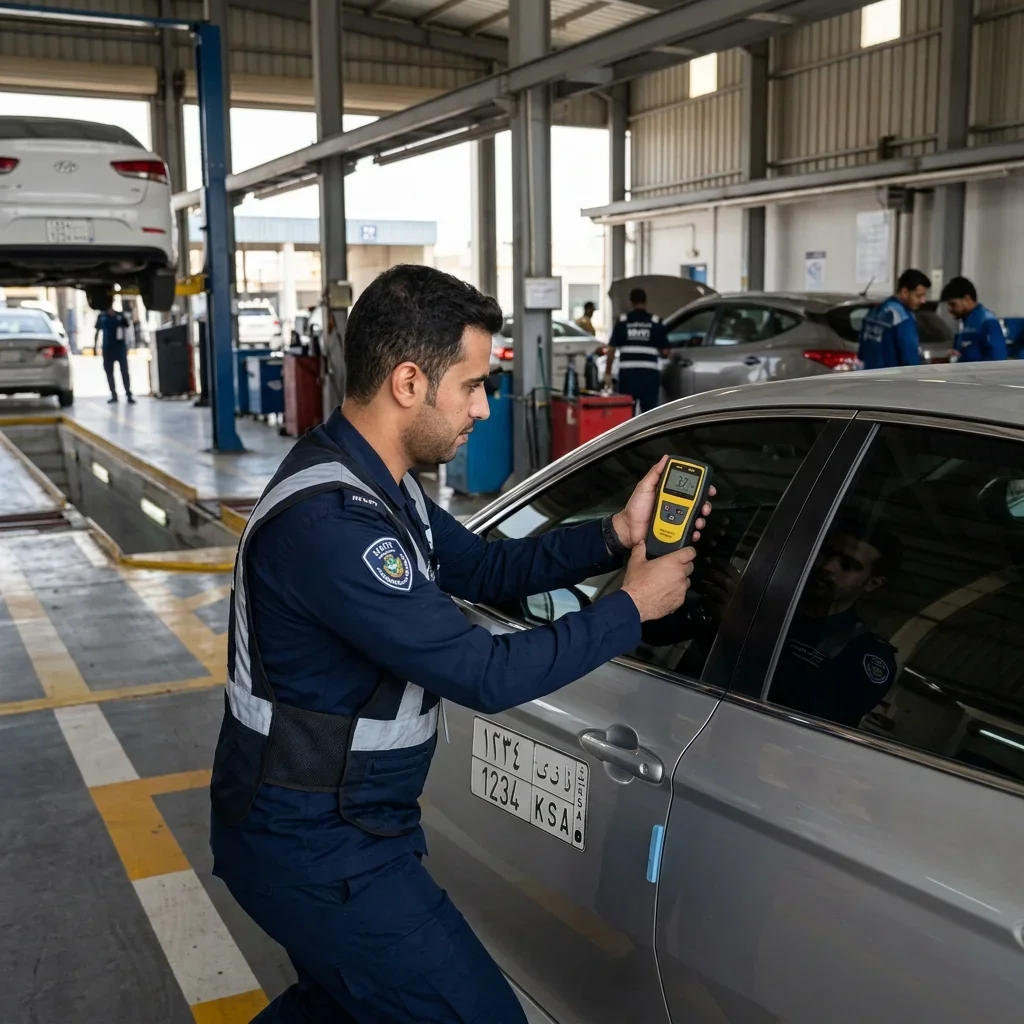
Illegal tint fines in Saudi Arabia range from 500 to 900 SAR under "modification to the vehicle body." Periodic inspection (Fahas) measures light transmission with a Tint Meter, and the common failure is because factory glass is already 5–10% dimmed, so the total exceeds the limit once a 30% film is added.
Many car owners in Jeddah and Riyadh fear three things at once when considering tint: the traffic fine of 500 to 900 SAR, the embarrassment at a checkpoint when asked to peel the film off in the street, and the sudden failure of the annual periodic inspection despite — in their minds — installing an "allowed shade." The problem is that most of these fears are built on incomplete information about how Traffic enforces the rule and how inspection centers (Fahas) actually measure. In this 2026-updated guide, we explain in technical detail how an illegal tint is assessed, what a Tint Meter is and how it measures Visible Light Transmission (VLT), and why so many people fail despite intending to comply. We expose the hidden reason behind failures — that original factory glass is not 100% clear but carries a built-in 5% to 10% dimming — and how a certified installer avoids these traps by measuring the glass before installation. All legal figures here are grounded in the General Directorate of Traffic, Ministry of Interior regulations, and Saudi Standards (SASO) specifications, with no exaggeration, so you can make a cool, 100%-legal tint decision that passes inspection on the first attempt.
Table of Contents:
- What the illegal-tint fine is and the article it falls under
- Legally allowed shades per window (00, 01, 02)
- What a Tint Meter is and how it measures light transmission
- The hidden failure cause: factory glass is already 5–10% dimmed
- Step by step: how periodic inspection tests the glass
- Fines and penalties table linked to tint
- Vehicles strictly prohibited from tinting that auto-fail
- How to pass on the first try: the certified installer's role
- The warranty certificate and tax invoice as a legal shield
| Case | Penalty / Impact | Approx. Amount | Note |
|---|---|---|---|
| Dimming the windshield or driver side window | Violation + immediate removal | 500–900 SAR | Under vehicle-body modification |
| Rear windows exceed allowed transmission | Inspection failure + possible violation | 500–900 SAR | Correction and re-inspection required |
| Refusing to remove tint at a checkpoint | Fine + possible impound | Up to 900 SAR + impound | If tint poses imminent vision danger |
| Tinting a prohibited vehicle (taxi/2-seat coupe) | Automatic failure + violation | 500–900 SAR | Prohibited at any shade |
| Reflective (mirror) or colored tint | Explicit violation + removal | 500–900 SAR | Impairs night vision |
What the Illegal-Tint Fine Is and the Article It Falls Under
In the Saudi traffic system, a tint violation is not logged under its own dedicated heading; it is filed under the offense of "making a modification or addition to the vehicle's structure or body" per the Traffic Law Executive Regulations. This classification matters because it explains Traffic's strictness: the system treats any dimming that obstructs a security officer's or the driver's view as a modification affecting the vehicle's general safety.
The fine ranges from a minimum of 500 SAR to a maximum of 900 SAR, with the exact figure within that band left to the officer's or monitoring system's assessment. More serious than the money is what accompanies it: if the tint obstructs vision in a way that poses an imminent danger, or the driver refuses to remove it immediately at the checkpoint, the matter can escalate to impounding the vehicle.
And because monitoring devices and officers' tools can now measure dimness accurately, betting on "not being noticed" is no longer rational. Complying with allowed shades is not merely fine-avoidance; it is insurance against having your trip disrupted and your car impounded at the worst possible time.
Legally Allowed Shades per Window (00, 01, 02)
The Saudi system uses a local shade classification: 00 means completely transparent, 01 means light dimming, and 02 means medium dimming. The golden rule is simple: anything in the driver's field of view must stay clear.
The large front windshield permits only a transparent shade-00 film with 70% VLT or higher, provided it is not light-reflective (mirror finish) and does not alter the glass color. The driver and front-passenger side windows follow exactly the same rule: clear 00.
The rear side windows, however, may be tinted up to shade 02 (roughly 30–40% transmission) in deference to family privacy and protecting children from glare. The large rear windshield must not be dimmed so as not to block the central mirror's view; only a transparent 00 film for heat rejection is allowed.
The core idea every driver must grasp: effective heat insulation is no longer tied to a dark color at all. Modern shade-00 nano-ceramic films block up to 96–97% of infrared and 99% of ultraviolet while remaining fully transparent, combining strong cooling with full legal compliance.
What a Tint Meter Is and How It Measures Light Transmission
A Tint Meter is a precise instrument that measures the percentage of visible light passing through the glass — the value known as VLT (Visible Light Transmission). Its principle is simple but strict: a calibrated light source on one side of the glass and a sensor on the other reads how much of that light actually passes through.
If the device emits 100 units of light and 35 reach the sensor, the transmission reading is 35%. The device does not distinguish whether the dimming comes from the film or from the glass itself; it reads only the final combined result.
This exact point is the source of most failures, which we explain in the next section. At accredited periodic-inspection centers, the measurement is taken on the regulated windows and the reading is compared against the legal limit allowed for each glass position.
Modern devices give an instant digital reading with no room for visual guesswork, meaning the "eyeball estimate" some unprofessional tint shops rely on is worthless against the device's number. A professional installer owns their own Tint Meter and uses it before installation — not too late at the inspection center.
The Hidden Failure Cause: Factory Glass Is Already 5–10% Dimmed
Here lies the secret most well-intentioned people who fail inspection do not know. Glass that comes from the factory (the dealership) is not 100% transparent; it carries a very light factory dimming usually between 5% and 10%, especially on rear side windows, which arrive slightly tinted from the factory on many models.
Now picture the equation: Traffic allows roughly no less than 30% transmission for the rear side window. You go to an unprofessional shop and ask for a "30% film." The shop applies a 30% film over glass already dimmed by 8%.
The mathematical result is not 30% but far lower, because the two dimmings stack — actual transmission can drop below 25%. The Tint Meter at inspection reads this low combined number and fails the car instantly.
This is precisely the difference between a shop that calculates only the "film grade" and one that calculates the "final result." A certified AzelCore installer begins by measuring the original glass transparency with their own device, then selects a film grade that ensures the final total stays within the legal limit — so the car passes on the first try with no surprises.
Step by Step: How Periodic Inspection Tests the Glass
When a car enters a periodic-inspection (Fahas) center, the glass test proceeds through clear stages. First, the inspector visually checks the glass for cracks, decals or stickers that obstruct vision, or reflective metallic finishes.
Second, they verify the windshield and front side windows carry no dimming that violates the transparency requirement, using a Tint Meter to measure when in doubt. Third, they measure light transmission on the regulated windows and compare the reading to the allowed limit.
Fourth, they cross-check the vehicle type on the registration card against tinting requirements; a car registered as a taxi or as a two-seater follows different rules. If any window exceeds the limit, a "non-compliant" note is recorded and the owner is asked to remedy it and re-inspect.
The key point is that inspection accepts neither verbal justifications nor "the grade printed on the roll"; it relies on the device's reading of the glass as actually installed. That is why bringing a certificate from an accredited tint center showing the real VLT for each window speeds the process, proves you installed an original product at a calculated percentage, and reduces any ambiguity during measurement.
Fines and Penalties Table Linked to Tint
To complete the picture, it helps to summarize the likely penalties tied to tint violations in one table. Remember the base fine ranges from 500 to 900 SAR, but the real impact may exceed the money to include wasting your time and forcing you to peel the film.
The table below outlines the most common cases and their consequences as applied by Traffic and periodic inspection, recalling that the final assessment is subject to the competent authority's evaluation case by case. The key message from the table: the cost of compliance (choosing an original film at a legal grade) is far lower than the cost of repeated violations, peeling, and reinstallation.
Many drivers pay for tinting twice: once for the cheap illegal film, and once to remove it and install a legal film after failing inspection. The economically correct decision is to invest in the right grade from the start.
Vehicles Strictly Prohibited from Tinting That Auto-Fail
Not all vehicles are equal before the tint system. Some categories are prohibited from tinting at any shade on any window, and any tint on them means automatic failure at periodic inspection and an immediate violation at a checkpoint.
These categories include taxis of all kinds (limousines and ride-hailing app cars), daily rental cars, and two-seater sports cars (coupes) unless fitted with rear seats officially registered on the vehicle registration card, in addition to cargo transport vehicles and public buses. The logic is clear: vehicles carrying unfamiliar passengers or serving the public must be visible from outside for public-security reasons, and a two-seater needs no rear tint as there are no rear passengers to begin with.
The important practical point: before you spend a single riyal on tint, confirm your car's classification on the registration card. The same model may be allowed rear tint as a private family car yet completely prohibited if registered as a taxi.
A certified installer always begins by reviewing the registration card before suggesting any grade, and that step alone spares you a full violation and a guaranteed failure.
How to Pass on the First Try: The Certified Installer's Role
Passing inspection on the first try is not luck but the result of a method a certified installer follows. Step one is reviewing the registration card to determine the vehicle type and the shades allowed for it.
Step two is measuring the original glass transparency of each window with a Tint Meter before installation, to learn the factory dimming already present. Step three is selecting the film grade based on the correct equation: film grade + original glass dimming = a final result within the legal limit.
Step four is using an original nano-ceramic film that blocks heat without needing visual dimming, so you get strong cooling with high, legal light transmission. I am Mohammed Al-Hadi, a certified insulation and tinting technician and a Johnson and 3M dealer at AzelCore in Jeddah, and I say frankly: most people who come to me after failing inspection installed an "allowed grade on paper" at a shop that never measured the glass.
The solution is not necessarily a pricier film, but correct measurement and a calculated choice. When these four steps are followed, your car passes inspection and stays cool and legal throughout the warranty period.
The Warranty Certificate and Tax Invoice as a Legal Shield
Proving your tint is legal matters no less than it actually being legal. When installed at an accredited center, you should receive an electronic tax invoice and a written warranty certificate clearly stating the VLT for each window, the film type and brand (Johnson or 3M), and the warranty duration.
These documents become a practical shield in two situations: first at a checkpoint, where you can present the certificate to prove the film is original and at a compliant percentage instead of arguing verbally; and second at the periodic-inspection center, where the certificate speeds the inspector's understanding of what is installed and supports the device reading. Most importantly, these documents are evidence you used an original product with untampered percentages, unlike cheap counterfeit films that come with no documentation at all.
We always advise keeping a copy of the certificate in the car with its papers. The practical conclusion of this entire guide: choose an original film at an accurately measured legal grade, keep its documents, and you will avoid the fine, the failure, and the embarrassment all at once — enjoying instead a moderate Jeddah coolness inside your car rather than its summer oven.
Frequently Asked Questions
How much is the illegal-tint fine in Saudi Arabia 2026?
It ranges from 500 to 900 SAR, filed under "making a modification or addition to the vehicle's structure or body" in the Traffic Law Executive Regulations, with the amount set within that band according to the assessment of the case.
How does periodic inspection detect illegal tint?
The inspection center uses a Tint Meter that measures the Visible Light Transmission (VLT) through the glass as actually installed, and compares the reading to the legal limit for each window. The device reads the combined result (film + original glass) and accepts no visual guesswork.
Why did my car fail inspection even though the shade is allowed?
Usually because factory glass is already dimmed 5–10%, so adding a 30% film stacks the two dimmings and the final transmission drops below the legal limit. The fix is to measure the original glass before installation and pick a film grade that keeps the total legal.
Can I tint the windshield for heat insulation without a violation?
Yes, but only with a completely transparent shade-00 film at 70% VLT or higher, non-reflective and not altering the glass color. Transparent nano-ceramic films block 96–97% of heat (IR) and 99% of UV while staying traffic-compliant.
Is the film grade printed on the roll enough to pass inspection?
No. Inspection reads the final result on the installed glass with a Tint Meter, not the number printed on the roll. What matters is the film's dimming combined with the original glass dimming, which is why measurement must happen before installation.
Which vehicles automatically fail inspection if tinted?
Taxis and ride-hailing cars, daily rental cars, two-seater coupes (unless registered with rear seats), cargo transport vehicles, and public buses. Always verify the car's classification on the registration card before any tinting.
Does a tint certificate protect me from a violation at a checkpoint?
The certificate and tax invoice prove you installed an original product at a measured, compliant VLT, and ease the situation before an officer and an inspector. But real protection comes first from the tint itself being within legal limits.
How much does legal nano-ceramic tint cost in Jeddah?
Nano-ceramic tint starts at 1,500–2,200 SAR for a sedan, 2,200–3,000 SAR for an SUV, and 2,500–3,500 SAR for luxury cars, including installation and warranty up to 10 years. Contact us to determine the legal grade for your car.
⚠️ Warning: Warning: Do not rely on the \"grade printed on the roll\" as proof of compliance. Inspection reads the final result on the glass with a Tint Meter, and factory glass is already dimmed 5–10%. Reflective (mirror), colored, or decorated tint on the glass is strictly prohibited — all are explicit violations requiring immediate removal and dangerously impairing night vision, leading to accidents.
Sources & References
Related Services
- Nano-Ceramic Tint Compliant with Traffic & Inspection ←
- Original Johnson Tint — VLT Certificate per Window ←
- 3M Crystalline CR70 — Transparent and 100% Legal ←
- Full Guide to Saudi Tint Laws 2026 ←
- Allowed VLT Percentages per Window 2026 ←
- How to Spot Fake Tint Before It Gets You Fined ←
- Tint Test with the FLIR Thermal Camera ←
- Calculate Your Legal Tint Cost ←