
How Much Fuel Does Tint Save? Cutting AC Load & Fuel Use in Jeddah Heat (With Numbers)
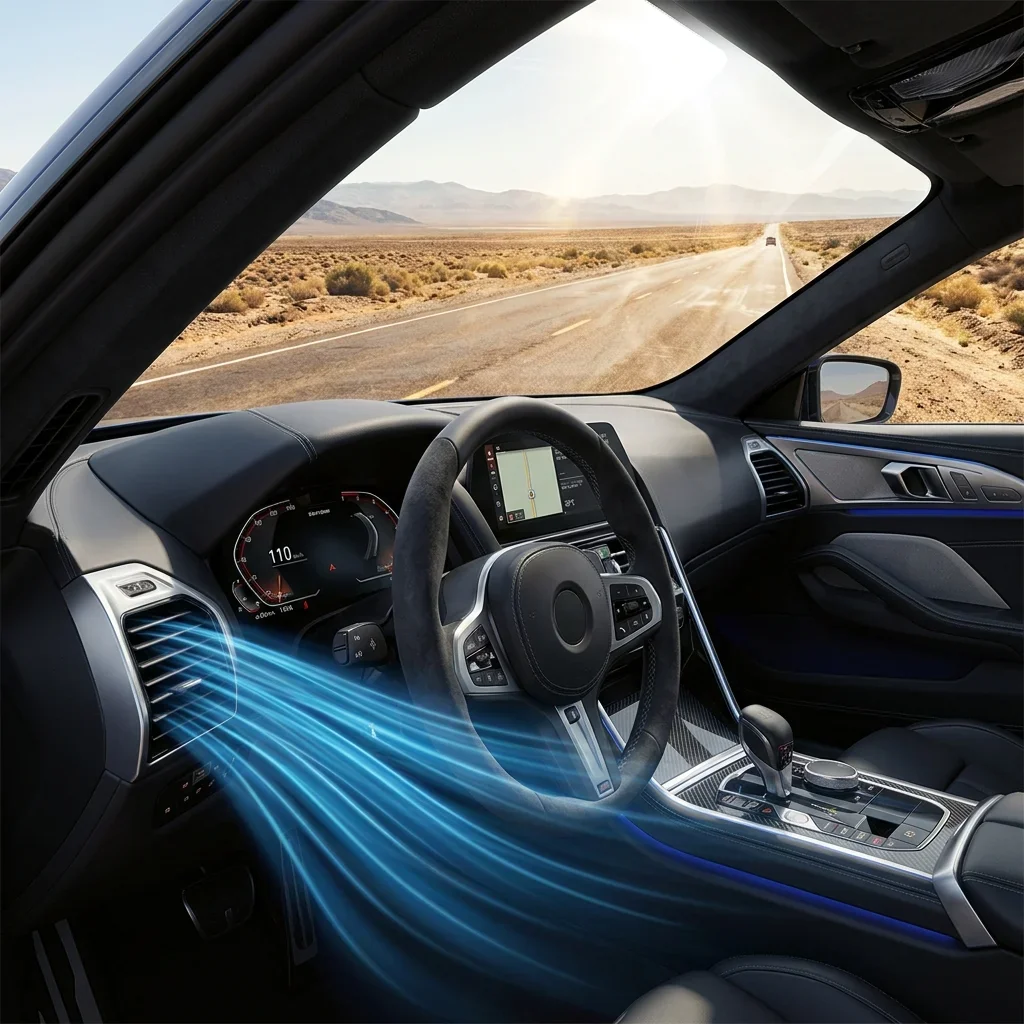
Tint does not "create" fuel, but it cuts AC load by lowering cabin temperature. In AzelCore's Jeddah thermal study, interior dropped from ~77° to ~40°C with nano-ceramic (96-97% IR rejection). With the compressor no longer running flat-out, AC-related fuel use falls measurably — the exact amount depends on your car and driving pattern.
"How many liters of gas will tint save me?" — this is the most common question we get on AzelCore Jeddah's WhatsApp, especially as fuel-station receipts climb every summer. And the honest answer matters more than the flashy one: window tint is not a fuel-saving device, and it does not directly burn less gasoline the way an engine does. What it actually does is relieve the load on your air-conditioning system (the compressor), which consumes a real share of your engine's power. In Jeddah, where asphalt exceeds 50°C and a closed cabin turns into an oven reaching 77°C (per FLIR thermal-camera measurements in AzelCore's study), the AC runs flat-out for hours. This is where nano-ceramic comes in: by blocking 96-97% of the heat-carrying infrared rays, it drops cabin temperature to ~40°C, so the AC no longer has to run at full power and less fuel is wasted on cooling. In this article we walk through the physics step by step, give you realistic numbers instead of inflated promises, and explain when savings are meaningful and when they are modest — so you decide on facts, not hype.
Table of Contents:
- How AC Actually Burns Your Car's Fuel
- Where the Saving Comes From: The Physics of Heat Load
- AzelCore Study Numbers: From 77° to 40°C
- Nano-Ceramic vs Cheap Dark Tint
- A Realistic Fuel-Saving Estimate for Jeddah (No Hype)
- The Factors That Decide Your Real Saving
- The Invisible Saving: Faster Cooling & Longer AC Life
- Benefits Beyond Gas: Protection, Comfort & Legality
- How to Choose the Right Tint for Maximum Saving
| Metric | Car Without Tint (Jeddah Heat) | With Genuine Nano-Ceramic (96-97% IR Rejection) |
|---|---|---|
| Average Cabin Temperature (AzelCore study) | ~77°C | ~40°C |
| Infrared (Heat) Rejection | Negligible | 96-97% |
| Ultraviolet (UV) Rejection | Very poor | 99% |
| AC Full-Power Run Time on Entry | Long (several minutes) | Very short (rapid cooling) |
| Compressor Load on Engine | High and continuous | Low with shorter cycles |
| Fuel-Saving Impact | Almost none | Tangible and cumulative (varies by usage) |
| AC Component Lifespan | Accelerated strain | Longer thanks to lighter load |
| Approx. Price (sedan, 10-yr warranty) | — | SAR 1,500 - 2,200 |
How AC Actually Burns Your Car's Fuel
Before we talk about savings, we must understand where the consumption comes from. In gasoline engines, the car's AC is not electric as some assume — it relies on a compressor connected directly to the engine via a belt.
When you switch on the AC, the engine spins this compressor, and that extra mechanical load forces the engine to burn more fuel to maintain the same speed. Simply put: the harder the AC works, the more gasoline it consumes.
In Jeddah's heat, when you leave your car in the sun and return to a 77°C cabin, you are asking the AC to drop the temperature by tens of degrees at once. This means the compressor runs at full cycle for an extended period, and the cooling fan and blower run at top speed.
Vehicle engineering studies indicate that the AC system can raise fuel consumption noticeably under severe heat and city driving compared to driving without AC. So the logic is clear: anything that reduces the load on this compressor directly reduces the gasoline your engine burns to run it.
Thermal tint does not act on the engine — it acts on the heat source itself before it enters the cabin.
Where the Saving Comes From: The Physics of Heat Load
The heat entering your car in Jeddah comes from three sources: conduction through the body, convection via hot air, and most importantly — direct solar radiation through the glass. Glass is the major weak point; it lets in short-wave infrared (IR) rays that carry most of the sun's thermal energy.
When these rays strike the seats and dashboard, they convert into heat trapped inside the cabin (the greenhouse effect). Here lies the genius of nano-ceramic: microscopic ceramic particles are engineered to reflect and scatter 96-97% of this infrared before it penetrates the glass.
The direct result is that the amount of thermal energy entering the cabin drops dramatically. And because a car's AC only works to expel excess heat, reducing the heat entering at the source means the AC has far less load to handle.
This is not marketing — it is simple physics: less cooling load = less energy demanded from the compressor = less fuel burned by the engine. The higher the film's IR-rejection efficiency (which distinguishes genuine films like Johnson and 3M), the clearer its effect on AC load.
So the saving is real, but indirect: it starts at the glass and ends at the fuel pump.
AzelCore Study Numbers: From 77° to 40°C
Instead of relying on loose promises, AzelCore conducted a documented field thermal study using a FLIR T530 thermal camera, per ISO 13837:2021, on a sample of 530 measurements across 10 Jeddah districts between 2024-2026. The results were revealing: the average interior cabin temperature in a non-tinted car reached ~77°C under Jeddah's sun — hot enough to strain the AC and damage interior trim.
After installing genuine nano-ceramic film, the average cabin temperature dropped to ~40°C — a difference of roughly 37°C. This enormous gap is the heart of the story.
Measurements also confirmed 96-97% infrared rejection and 99% ultraviolet rejection. What does this mean for the AC? When you start driving, the AC needs to drop the temperature from 40°C (with tint) instead of 77°C (without), reaching comfort (~22-24°C) far faster and with much less effort.
The compressor spends less time in 'maximum power' mode and shifts sooner into low-consumption maintenance mode. For full transparency: these are documented temperature figures, not a direct liter-by-liter fuel measurement, because fuel consumption depends on many variables.
But the causal link between a 37°C drop and reduced AC load is indisputable physics. The study is published under CC BY-NC 4.0 for review.
Nano-Ceramic vs Cheap Dark Tint
This is where the biggest mistake costs the driver both money and fuel. Many believe 'dark color' means 'thermal insulation' — scientifically false.
Cheap dyed tint blocks visible light so the car looks dark, but fails to block the heat-carrying infrared. The result: a car dark inside yet still oven-hot, the AC running at full power, and gasoline burned with no real thermal benefit.
By contrast, nano-ceramic blocks heat (IR) with high efficiency regardless of darkness level — even its clear films (like 3M Crystalline with a TSER near 90%) insulate heat strongly. The practical difference is shocking: a dyed film may cost SAR 300-600 and last just one year before turning purple and peeling, while nano-ceramic for a sedan (SAR 1,500-2,200 with a 10-year warranty) genuinely blocks heat and lasts years.
From a savings standpoint: cheap tint saves almost no fuel because it does not reduce AC load, whereas genuine film reduces the load tangibly. So the real 'saving' comes from film quality, not its color.
Buying a cheap film to 'save money' means a double loss: no fuel saving, and a reinstall after a year.
A Realistic Fuel-Saving Estimate for Jeddah (No Hype)
Let's be completely honest: any center promising you a fixed number like 'save 20% of your fuel' is exaggerating and selling an illusion. No one can guarantee a precise percentage because AC-related fuel use depends on your car type, driving pattern, how long it sits in the sun, and the day's temperature.
But we can set a logical framework. The AC system in hot city driving forms a meaningful share of fuel consumption, and genuine tint reduces both the duration and intensity of the AC running flat-out — especially in the first 10-15 minutes after entering a heat-soaked car.
This means part of the fuel once burned on 'shock cooling' is saved. In practice, a driver who enters their car many times a day in Jeddah's heat after it has sat in the sun will notice the difference far more than someone parking in a shaded garage.
The cumulative effect across a full summer (4-5 months of severe heat) can become tangible on the fuel bill. Our honest conclusion: the saving is real but variable — from slight with a shaded garage, to tangible with frequent direct-sun parking.
Most importantly, fuel saving is a 'bonus' benefit that stacks on top of the core benefit: comfort, cabin protection, and passenger health.
The Factors That Decide Your Real Saving
To estimate your expected saving realistically, look at your personal usage profile. The first factor is parking location: someone who parks in the open under Jeddah's sun all workday reaps far greater savings than someone using a covered garage.
The second is the frequency of short trips; every time you enter a heat-soaked car and run the AC flat-out you consume an extra fuel burst, so a person making 6-8 short trips daily benefits more than one making a single long trip. The third is car size and glass area; SUVs and 4x4s with large glass surfaces (like the Land Cruiser and Tahoe) let in more heat, making the tint's effect clearer.
The fourth is the film quality itself; a film with 96-97% IR rejection reduces load far more than a cheap one. The fifth includes the car's exterior color, cabin cleanliness, and original AC condition.
In short: the ideal driver for maximum benefit drives a large SUV, parks in direct sun, and makes frequent trips at peak summer. Someone who parks in a garage and drives a small car will find thermal comfort and protection the main gain, with less visible fuel saving.
The Invisible Saving: Faster Cooling & Longer AC Life
Saving is not limited to the fuel gauge — there is a 'hidden' saving that may be more valuable long term. When the AC compressor runs flat-out daily to fight 77°C heat in Jeddah, it endures severe mechanical strain.
This repeated strain shortens the life of expensive AC components: the compressor itself, the condenser, and the evaporator. When tint lowers cabin temperature to 40°C, the AC works under a lighter load with shorter cycles, reducing wear and extending the entire system's life.
And everyone knows that repairing or replacing an AC compressor in Saudi Arabia can cost thousands of riyals — so delaying that failure by years is a real saving that does not show on the fuel bill but shows in your pocket. There is another saving: instant comfort.
Faster cooling means you don't have to run the AC at maximum for long before feeling comfortable, improving the driving experience and reducing stress in Jeddah's traffic. Additionally, protecting leather seats and the dashboard from cracking caused by direct 77°C heat saves you future interior maintenance costs.
Tint is a multi-faceted investment: it saves fuel, protects the AC, preserves the trim, and buys you priceless comfort.
Benefits Beyond Gas: Protection, Comfort & Legality
If fuel saving is what drew you in, know that the most important benefits of tint may be entirely non-financial. Blocking 99% of ultraviolet (UV) rays is not a cosmetic number; chronic UV-A exposure through car glass is scientifically linked to skin aging and increased skin-cancer risk — especially on the driver's left arm and face in a sunny environment like Jeddah.
The World Health Organization classifies ultraviolet radiation as a known carcinogen, and reducing exposure is a genuine health benefit for you and your children in the back seats. Tint also protects the cabin from the fading and cracking caused by 77°C heat, and reduces eye-straining glare while driving.
But mind the legal side: Saudi traffic law sets the allowed Visible Light Transmission (VLT) for each window, and the windshield and driver side glass must be transparent (shade 00). The excellent news is that clear nano-ceramic blocks heat efficiently with no dimming, so you get all the saving and protection benefits with 100% compliance with 2026 laws and a guaranteed pass at periodic inspection.
This way you never have to choose between coolness and the law. For full legal details, see our dedicated guide on Saudi tint laws.
How to Choose the Right Tint for Maximum Saving
To genuinely get the thermal and fuel saving you deserve, choosing the right film and installer is no less important than the decision to tint itself. First, request a genuine nano-ceramic film from a trusted brand like Johnson (since 1961) or 3M (since 1902) — both are most capable of rejecting infrared at 96-97% efficiency, which is exactly what reduces AC load.
Second, verify the film's serial number and warranty certificate (10-15 years for nano-ceramic) to ensure you are not paying a genuine price for a counterfeit. Third, ask the installer for the written TSER (Total Solar Energy Rejected) and IR-rejection figures, since these numbers are the true measure of saving — not the darkness level.
Fourth, ensure the quality of the installation itself; an excellent film fitted by an unskilled technician leaves bubbles and loose edges that ruin both insulation and appearance. At AzelCore in Jeddah, as an authorized dealer for Johnson and 3M, we provide a pre-installation consultation, measure the original glass transparency to guarantee traffic compliance, and issue a documented invoice and warranty certificate.
For pricing, nano-ceramic starts from SAR 1,500 for a sedan and SAR 2,200 for an SUV, while 3M Crystalline (lifetime warranty) ranges from SAR 2,000 to 4,000. An investment recovered over years through comfort, protection, and real saving.
For an instant estimate, try the cost calculator on our site or contact us directly.
Frequently Asked Questions
Does thermal tint really save fuel, or is it just marketing?
The saving is real but indirect. Tint doesn't cut engine consumption directly; it cuts AC load by lowering cabin temperature from ~77° to ~40°C (AzelCore study). Since the AC consumes a real share of engine fuel, easing its burden reduces cooling-related gasoline. The amount varies by your car, driving pattern, and parking location.
What exact percentage of fuel will I save?
Honestly, no one can give you a guaranteed fixed number, and any center that does is exaggerating. AC consumption depends on car type, the day's heat, sun-parking duration, and number of trips. The saving ranges from slight (shaded garage) to tangible (frequent direct-sun parking), becoming clearer cumulatively across Jeddah's long summer.
Does cheap dark tint save fuel like nano-ceramic?
No. Cheap dyed tint only blocks light and darkens the car but fails to block the heat-carrying infrared, so the AC keeps running flat-out. Nano-ceramic actually blocks heat (96-97% IR) regardless of darkness, and only it reduces AC load and saves fuel. The saving comes from quality, not color.
Does clear windshield tint help save fuel while staying legal?
Yes, and this is one of the biggest advantages of modern technology. Clear films like 3M Crystalline block heat (TSER near 90%) with no dimming, complying with the legally required shade 00 for the windshield and driver side glass, while providing insulation that reduces AC load. You get saving and legality together and pass periodic inspection.
Is the saving worth the cost of genuine tint?
Looking at fuel alone, payback is gradual and variable. But the real value is broader: protecting your AC from strain (repairs cost thousands of riyals), preserving seats and dashboard from cracking, blocking 99% of skin-damaging UV, and instant comfort. The sum of these benefits makes nano-ceramic (from SAR 1,500 with a 10-year warranty) a worthwhile investment in Jeddah's heat.
My car is a large SUV — do I benefit more than a small sedan?
Generally yes. SUVs and 4x4s like the Land Cruiser and Tahoe have larger glass areas, so they let in more heat and their AC works harder. The tint's load-reduction effect is therefore clearer. This, combined with a driving pattern of frequent sun-parking and many short trips, makes the thermal and fuel saving more noticeable than a small car parked in a shaded garage.
How much does my car's temperature actually drop after tinting?
Per AzelCore's field study with a FLIR T530 camera (ISO 13837:2021, 530 measurements across 10 Jeddah districts), the average cabin temperature dropped from ~77°C without tint to ~40°C with genuine nano-ceramic — a difference of roughly 37°C. This gap is what eases the AC's burden, speeds cooling, and saves the associated fuel.
Sources & References
Related Services
- Nano-Ceramic Car Tinting That Cuts AC Load in Jeddah ←
- Clear 3M Crystalline — Heat Rejection Without Dimming ←
- Genuine Johnson Tint — 96-97% Infrared Rejection ←
- Calculate Your Car Tinting Cost Instantly ←
- AzelCore Thermal Study: 77° to 40°C With Numbers ←
- Tint and Electric Vehicle Battery Range ←
- How Jeddah Heat Destroys Your Car's Interior ←
- Compared: Nano-Ceramic vs Carbon vs 3M ←