
Tinting vs Nano-Ceramic Coating vs PPF — The Complete Car Protection Decision Guide for Jeddah 2026
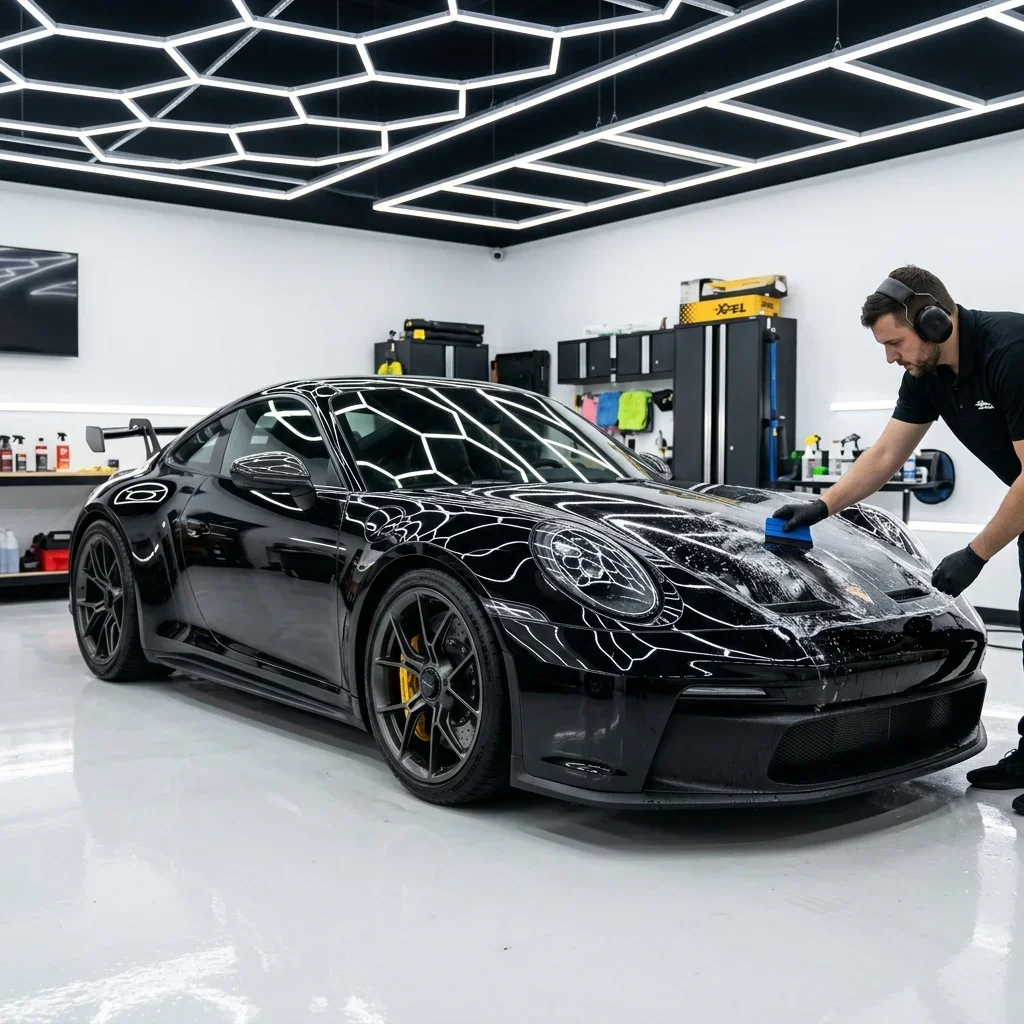
These are three different services solving different problems: car tinting is a film applied to glass to insulate heat and block 99% of UV; nano-ceramic is a thin chemical coating (2-5 microns) added to the paint for gloss and water repellency but does not stop scratches; and PPF is a thick polyurethane film (about 200 microns (8 mil)) that physically protects paint from gravel and scratches. The three are often combined.
One of the biggest sources of confusion among car owners in Jeddah is mixing up three terms that many believe are one thing, when in reality they are three entirely different services solving three separate problems. When you ask, "Which is better for my car: tinting, nano-ceramic, or PPF?" you are actually comparing things that are not comparable — like asking, "Which is better: the air conditioner, the tires, or the seatbelt?" Each is essential for its own purpose. Window Tinting is a film placed on glass to block heat and ultraviolet rays. Nano-Ceramic (Ceramic Coating) is a chemical coating added over the car's paint to give it a glass-like gloss and repel water and dirt. PPF (Paint Protection Film) is a thick plastic film that bonds to the paint to physically protect it from road gravel and deep scratches. In this comprehensive reference guide, we permanently dismantle this confusion and clarify exactly what each product does, where it is applied, what it protects against, how much it costs in Jeddah, how to choose based on your goal and budget, and when — most importantly, in what order — to combine them. The goal is for you to leave this page with a clear decision that protects your investment in your car under Jeddah's sun and heat, which we measured in the field with a thermal camera on 530 vehicles.
Table of Contents:
- Why the three are confused: defining the problem
- What each product actually does: tint, ceramic, PPF
- The complete comparison table: purpose, material, cost, lifespan
- How to choose by goal and budget
- Can they be combined? The correct installation order
- Real-world costs in Jeddah 2026
- Common myths that cost you money
- The decision flow: what do you install first?
- The legal dimension and architectural insulation
| Comparison Point | Window Tinting | Nano-Ceramic Coating | PPF (Paint Protection Film) |
|---|---|---|---|
| Primary Purpose | Heat insulation & UV blocking | Gloss, water repellency, chemical protection | Physical protection from gravel & scratches |
| Material | Polyester/ceramic film on glass | Silicon Dioxide (SiO2) liquid | Thermoplastic Polyurethane (TPU) film |
| Where Applied | On the car's glass (interior) | On the body paint | On the body paint (front or full) |
| Thickness | A few microns | 2-5 microns | about 200 microns (8 mil) |
| Protects Against | Heat, 99% UV, glare | Dirt, stains, acid rain, salt spray | Flying gravel, deep scratches, keys |
| Does NOT Protect Against | Scratches & paint damage | Deep scratches & gravel | Cabin heat (it's not on glass) |
| Self-Healing | No | No | Yes (surface scratches vanish with heat) |
| Cost in Jeddah (from) | 1,500-3,500 SAR per car | Hundreds to thousands SAR by package | Hood 1,500-3,000 / Full 12,000-18,000 |
| Lifespan | 5-10 years (original) | 2-5 years (with maintenance) | 5-10 years (original) |
Why the Three Are Confused: The Core Problem
The first source of confusion is the word "protection." Tinting, ceramic, and PPF are all marketed under the umbrella of "car protection," so the buyer thinks they are choosing between three alternatives for the same function, when each protects something entirely different. Tinting protects what is inside the car (passengers, interior, skin) through the glass. Ceramic and PPF protect the car's exterior surface (paint and metal), but in two completely different ways: ceramic is chemical protection and gloss, while PPF is physical protection and impact absorption.
The second source of confusion is colloquial translation. Many in Jeddah call ceramic "polishing" or "polish," which is a common error: traditional polishing is an abrasive process that removes a fine layer of paint to repair scratches, whereas ceramic is a layer added on top of the paint to protect it. Polishing is often a preparatory step before ceramic, not a substitute for it.
The third source of confusion is the shared word "nano." People say "nano-ceramic tint" and "nano-ceramic coating," so some assume they are the same product. The truth is that "nano-ceramic" describes the technology of microscopic ceramic particles, used in two separate products: a film for glass (for heat) and a coating for paint (for gloss). Same technology, two different applications, two different surfaces.
The bottom line: don't ask "which is better," ask "what problem do I want to solve?" Suffering from cabin heat? Tinting. Want gloss and easy washing? Ceramic. Worried about Al-Haramain Road gravel and scratches? PPF. The right answer for most of Jeddah's luxury cars is: all three together, each for its role.
What Each Product Actually Does
Window Tinting: a thin film applied to the inner surface of the car's glass. Its sole function is controlling what passes through the glass: heat (infrared), visible light, and ultraviolet rays. The best types — original nano-ceramic like Johnson and 3M Crystalline — block 96-97% of infrared and 99% of UV. In our field study with a FLIR T530 thermal camera on 530 vehicles in Jeddah, cabin temperature dropped from an average of 77°C without tint to around 40°C with nano-ceramic. Tinting has nothing to do with the paint whatsoever.
Nano-Ceramic / Ceramic Coating: a chemical liquid based on Silicon Dioxide (SiO2), wiped onto the car's paint where it penetrates the pores and hardens into a very thin glass layer (2-5 microns). Its functions: deep 3D gloss, water and dirt repellency (Hydrophobic property), and chemical protection against bird droppings, acid rain, and salt spray. But it does not prevent deep scratches or flying gravel — its thickness is thinner than a human hair.
PPF / Paint Protection Film: a thick thermoplastic polyurethane (TPU) film (about 200 microns (8 mil)) bonded to the paint as a physical shield. It absorbs the impact of gravel flying at 120 km/h, prevents deep scratches, and features self-healing (surface scratches disappear with heat). It is the only product among the three that repels real mechanical damage. Think of it as a "clear protective case" for the car.
In short: tinting for glass, ceramic for gloss and chemistry, PPF for physical protection. Three surfaces, three problems, three solutions.
How to Choose by Goal and Budget
Since the three do not compete, the choice begins with identifying your top priority, then ordering your spending accordingly. Here is realistic guidance for Jeddah cars:
If your priority is cabin heat and protecting skin and interior: always start with nano-ceramic tint. This is the highest health and practical priority in Jeddah's climate, where cabin temperatures reach 77°C. Tinting blocks 99% of the UV rays that cause skin cancer and interior fading. A budget starting from 1,500 SAR for a sedan gives you a huge leap in comfort.
If your priority is the car's gloss, easy washing, and appearance: nano-ceramic is your choice. Ideal for brand-new agency cars and for those who wash their cars often and want water to slide off and gloss that lasts. But it does not protect against gravel — don't expect that of it.
If your priority is protecting the paint from gravel and scratches and preserving resale value: PPF is the smartest investment, especially for those who drive on Al-Haramain Road or Al-Madinah Road where gravel flies off trucks. Front-end PPF (hood and bumper) protects the most expensive and most damage-prone parts.
On a limited budget: order it like this — nano-ceramic tint first (health and comfort), then front-end PPF (asset protection), then ceramic for the body (gloss and chemistry). Don't spend on cheap ceramic before protecting your glass and front end. To help calculate your package cost by car type, use the cost calculator on our site.
Can They Be Combined? The Correct Installation Order
Yes — combining is the rule, not the exception, in luxury car protection. Because each product works on a different surface, there is no conflict between them at all, and the ideal car in Jeddah carries all three: tint on the glass, PPF on the body's front end, and ceramic on the rest of the paint and over the PPF itself.
But the chronological order of installation is critical, and getting it wrong costs you rework:
First — Paint Correction: before any paint protection layer, the paint must be corrected to remove micro-scratches and brake dust. Any scratch trapped under ceramic or PPF stays trapped for years.
Second — PPF: applied directly to the original paint (after polishing), because it is a physical shield that must bond to the paint. This is a strict rule: no ceramic under PPF, otherwise the film won't adhere and will peel within weeks.
Third — Nano-Ceramic (for paint): always applied over the PPF and over the rest of the exposed paint. Ceramic over PPF adds water-repellency, makes the film easier to clean, and extends its life.
Fourth — Tinting: entirely independent of the paint, applied to the glass at any time (before or after). The only one whose order is unaffected by the others.
The golden rule for paint: polish → PPF → ceramic. The glass is independent. At AzelCore we execute this engineering sequence precisely to ensure the maximum lifespan of each layer.
Real-World Costs in Jeddah 2026
The following prices are realistic ranges including installation and warranty in Jeddah, varying by car size (sedan/SUV/luxury) and product type. Treat them as "starting from," since the luxury class and larger areas raise the cost.
Tinting (original nano-ceramic): sedan 1,500-2,200 SAR, SUV 2,200-3,000 SAR, luxury 2,500-3,500 SAR — with warranties up to 10 years. 3M Crystalline is higher (2,000-4,000 SAR) with a lifetime warranty, and LLumar CTX is more economical (1,200-3,000 SAR) with a 7-year warranty. Carbon is a cheaper option (600-1,500 SAR, 5 years) but weaker at blocking heat. Add-ons: top sun strip 100-200 SAR, old-tint removal 200-400 SAR, mobile home service +100-200 SAR.
Nano-Ceramic (paint coating): depends on the number of layers (9H) and car size, typically starting from a few hundred to a few thousand SAR depending on the package, product quality, and warranty length. Request a detailed quote for your specific car.
PPF: full-car protection can cost 12,000-18,000 SAR, so most clients prefer protecting only the front end (hood 1,500-3,000 SAR). The smartest hybrid package (front PPF + body ceramic) typically ranges between 4,000-8,000 SAR and gives the best return.
Budget tip: don't chase the cheapest. Counterfeit tint yellows and cracks, and cheap PPF (PVC/TPH) yellows within months and rips the paint off on removal. A very low price means rework and paying twice.
Common Myths That Cost You Money
Myth 1: "Ceramic spares me from tinting." Fundamentally wrong. Ceramic on the paint does nothing for cabin heat or the glass. Heat enters through the glass, and ceramic is not on the glass. You need both, each for its surface.
Myth 2: "Nano-ceramic protects against scratches and gravel." Half-true. It resists micro-scratches from wash towels, but is completely helpless against a key or a flying stone. Its thickness is only 2-5 microns. For real physical protection you need PPF.
Myth 3: "Darker tint is cooler." A common and dangerous error. Thermal insulation depends on the film's technology (blocking infrared), not the darkness level. A transparent nano-ceramic film (shade 00) blocks more heat than a cheap black film. And darker is often legally non-compliant.
Myth 4: "Ceramic means my car doesn't need washing." Wrong. Ceramic makes washing easier and faster, but does not eliminate it. Dirt still sticks, it's just easier to remove.
Myth 5: "Polishing and ceramic are the same thing." Wrong. Polishing is an abrasive process that repairs paint, while ceramic is a layer added over it for protection. Polishing is a preparatory step before ceramic.
Myth 6: "PPF makes the car glossy, so it spares me from ceramic." PPF is clear and looks good, but ceramic over it adds water repellency, extends the film's life, and makes it easier to clean. Combining them is best.
Frequently Asked Questions
Simply put, what is the difference between tinting, nano-ceramic, and PPF?
Tinting is a film on the glass that blocks heat and UV. Nano-ceramic is a thin chemical coating on the paint that gives gloss and repels water but doesn't stop scratches. PPF is a thick film on the paint that physically protects it from gravel and deep scratches. Three surfaces and three different functions.
If my budget only covers one service, which should I choose?
In Jeddah's climate, start with nano-ceramic tint. It is the top health and practical priority: it lowers cabin temperature from around 77°C to 40°C, blocks 99% of the UV that causes skin cancer, and protects the interior. Comfort and health before gloss.
Does nano-ceramic coating spare me from tinting the glass?
Not at all. Nano-ceramic (paint coating) is applied to the car's body, not the glass, and has no effect on cabin heat. Heat enters through the glass, so tinting remains absolutely necessary. They are two different products for two different surfaces.
What is the correct order if I want to install all three?
For the paint: preparatory polishing first, then PPF on the original paint, then nano-ceramic over the PPF and the rest of the paint. Never put ceramic under PPF or it won't adhere. Tinting is completely independent and is applied to the glass at any time.
Can nano-ceramic be applied over PPF?
Yes, and it's recommended. A ceramic layer over PPF adds water repellency, makes the film easier to clean, protects it from staining, and extends its lifespan. The correct order is always: PPF first against the paint, then ceramic over it.
Does darker tint insulate more heat?
No. Thermal insulation depends on the film's infrared-blocking technology, not the darkness level. A transparent nano-ceramic film (shade 00) blocks far more heat than a cheap black film. Darker tint also often violates Saudi traffic regulations.
How much does a complete protection package cost for my car in Jeddah?
It depends on car size and chosen products. Nano-ceramic tint starts from 1,500 SAR for a sedan, and the smartest hybrid package (front PPF + body ceramic) typically ranges between 4,000 and 8,000 SAR. For an accurate estimate for your car, use the cost calculator or request a detailed quote.
Is tinting legal in Saudi Arabia, and what transparency is allowed?
Yes, tinting is legal within General Directorate of Traffic regulations. The windshield and driver's side glass must remain completely transparent (a clear shade-00 nano-ceramic film is allowed), while limited dimming is permitted for the rear side windows. Non-compliant tint exposes you to a fine. Read our complete guide to Saudi tint laws 2026 before choosing.
⚠️ Warning: Beware of centers that sell you \"ceramic\" as a substitute for tinting, or \"tint\" as paint protection — this is marketing deception. Each product serves its own surface and function. Counterfeit tint and cheap PPF (PVC/TPH) also yellow and crack under Jeddah's sun, and the latter rips the paint off on removal. Always demand original products with a tax invoice and a written warranty certificate.
Sources & References
Related Services
- Nano-Ceramic Car Tinting Service in Jeddah — Heat Insulation & 99% UV Block ←
- PPF Paint Protection Film Installation in Jeddah — Shield Against Gravel & Scratches ←
- Building & Villa Glass Insulation — Same Thermal Film Technology for Windows ←
- Protection Cost Calculator — Estimate Your Package by Car Type ←
- Detailed Comparison: PPF vs Nano-Ceramic Coating ←
- PPF vs Polishing: Which Really Fixes Paint Damage? ←
- The Real Longevity of Nano-Ceramic Coating in KSA ←
- Guide to Saudi Car Tint Laws 2026 ←