
Best Tint for Land Cruiser, Patrol & Tahoe in Jeddah 2026 — The Large SUV Guide
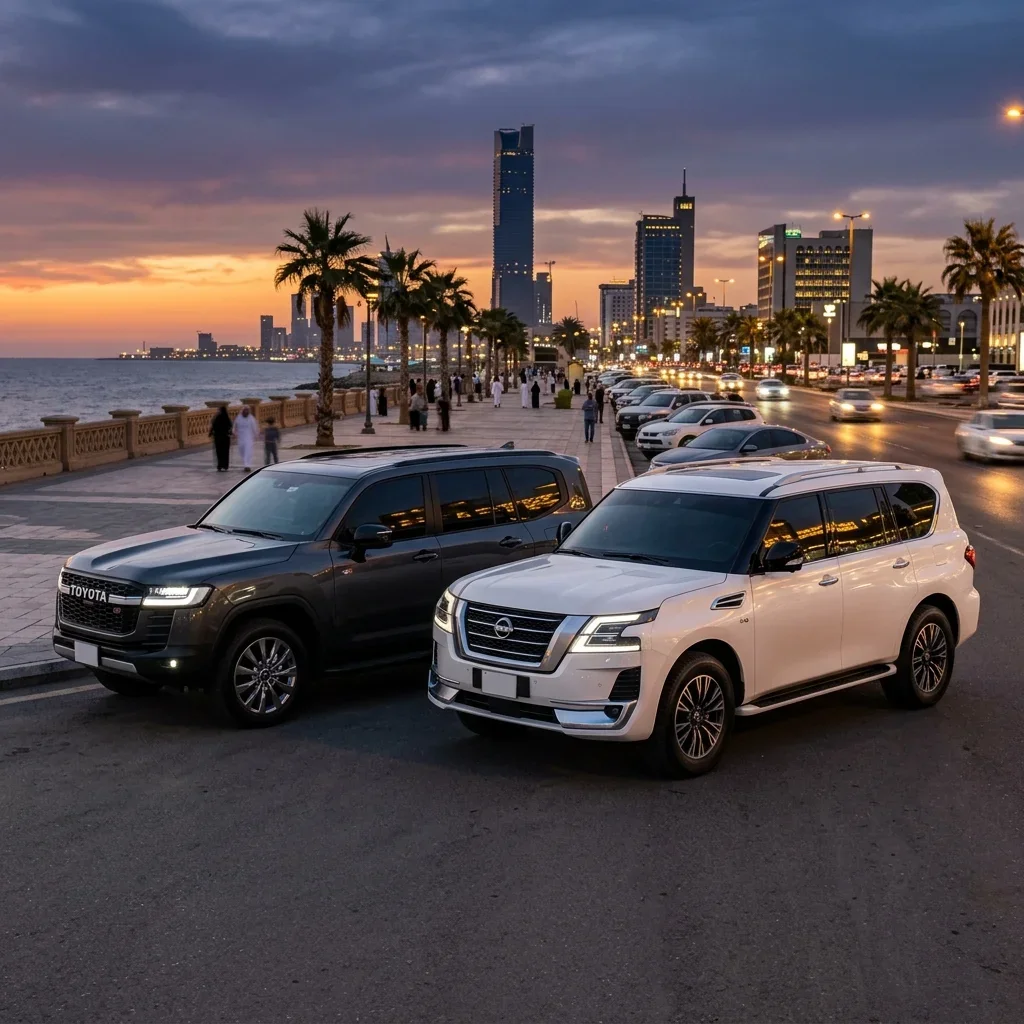
The best tint for a Land Cruiser, Patrol, or Tahoe in Jeddah is original nano-ceramic film (Johnson Supreme IR or 3M Crystalline) in transparent shade 00 for the windshield and front side windows, with up to shade 02 on the rear windows. Expect roughly SAR 2,200–3,500 for an SUV, install and warranty included.
Large SUVs like the Toyota Land Cruiser, Nissan Patrol, Chevrolet Tahoe, and GMC Yukon are the backbone of the road in Jeddah and across the Kingdom. But the very things that make them comfortable and spacious — the wide glass area, tall roof, and large cabin — also make them more exposed to solar heat than any sedan. Every extra square meter of glass is another window letting infrared (IR) radiation in to raise cabin temperature, strain the AC, and fade the interior leather and plastics. In AzelCore's field thermal study (FLIR T530 camera, ISO 13837:2021 standard, 530 measurements across 10 Jeddah districts) we recorded interior temperatures near 77°C in an untinted car, dropping to around 40°C after nano-ceramic installation. In this dedicated large-SUV guide we explain why an SUV needs different selection criteria than a sedan, which tint shades are legal, realistic prices in SAR, and how to choose between Johnson and 3M for your specific Land Cruiser, Patrol, or Tahoe.
Table of Contents:
- Why large SUVs differ from sedans for tinting
- Jeddah heat and large-SUV glass: the numbers
- Legal shades for Land Cruiser, Patrol & Tahoe
- SUV tint price table in SAR
- Johnson Supreme IR vs 3M Crystalline for your car
- Panoramic glass and sunroof: a critical zone
- Protecting the paint with front-end PPF
- Choosing a certified Jeddah center and avoiding fakes
Why Large SUVs Differ From Sedans for Tinting
Tinting a Land Cruiser or Patrol is not just "a bigger sedan tint job." The difference is fundamental and starts with glass area: a large SUV can carry roughly double the glass of a sedan, including third-row windows, the huge rear glass, and sometimes panoramic glass. That large area means any weakness in film performance is magnified; a poor film on a sedan may go largely unnoticed, but on a Tahoe it leaves the cabin hot despite a dark color.
Second, the large cabin holds a bigger air volume that the AC must cool, so every degree of heat blocked at the glass translates directly into rear-passenger comfort and fuel use. Third, large vehicles are usually family cars where children sit in the rear rows for long hours on road trips, making UV blocking and thermal comfort a health priority, not a luxury.
For these reasons we always recommend tinting large SUVs only with high-performance nano-ceramic films, because the performance gap between a cheap film and an original one is far more obvious across these wide surfaces.
Jeddah Heat and Large-SUV Glass: The Numbers
Jeddah combines high heat, suffocating humidity, and near-vertical sun most of the year — a harsh environment for any vehicle. In AzelCore's thermal study (FLIR T530 camera, ISO 13837:2021 standard, 530 measurements across 10 Jeddah districts during 2024–2026) we measured the interior cabin of an untinted car at around 77°C at midday peak, dropping to roughly 40°C in a car tinted with original nano-ceramic film.
High-quality nano-ceramic films block 96–97% of the infrared (IR) responsible for the burning sensation, and 99% of the ultraviolet (UV) that fades leather, cracks the dashboard, and harms passengers' skin. In a large SUV with double the glass area, that difference means the seat surfaces and dashboard stay cooler to the touch, the AC reaches the target temperature faster, and the third row does not turn into a separate "oven" as so often happens in poorly tinted SUVs.
These numbers are not marketing but published field measurements under a Creative Commons licence (CC BY-NC 4.0), and you can review the full methodology in the thermal report.
Legal Shades for Land Cruiser, Patrol & Tahoe
The Land Cruiser, Patrol, Tahoe, and Yukon are private family vehicles with rear seats registered in the vehicle card, so the standard private-car tint rules apply to them — not the no-tint rules imposed on taxis and commercial vehicles. Per the General Directorate of Traffic and the Saudi Standards organization (SASO): the large windshield and the driver/front-passenger side windows must stay completely transparent (shade 00, 70%+ light transmission), and only a clear nano-ceramic film for heat rejection is allowed, with no dimming or mirror effect.
The rear side windows — the most important on large family SUVs — may be tinted up to shade 02 (about 30% light transmission), which is excellent for second- and third-row privacy and shielding children from glare. The large rear windshield should not be tinted with a dark color so it does not block the central-mirror view; only a clear insulating film is allowed there.
A tint violation falls under "making a modification to the vehicle structure" and carries a fine of 500 to 900 SAR. That is why we measure the original glass transparency first, then choose the film so the combined percentage stays within the legal limit and passes the periodic inspection with confidence.
SUV Tint Price Table in SAR
Tint prices for large SUVs are higher than sedans for a logical reason: more glass area means more film, longer installation hours, and greater precision when cutting the curved and huge rear glass. At AzelCore we use transparent pricing based on car class, film type, and warranty length.
For the large SUV class (Land Cruiser, Patrol, Tahoe, Yukon), original nano-ceramic starts around 2,200 SAR and reaches 3,000 SAR with a ten-year warranty, while 3M Crystalline — one of the finest clear films in the world — ranges from 2,800 to 3,500 SAR with a lifetime warranty. More economical options exist such as LLumar CTX (1,800–2,500 SAR, 7-year warranty) and Carbon (900–1,200 SAR, 5-year warranty) for those seeking a balance of price and performance.
We strongly advise avoiding cheap dyed films on large vehicles because they fade and turn purple within months under the Jeddah sun. Prices include installation and warranty; old-tint removal (200–400 SAR) is added if needed, as is mobile installation (100–200 SAR).
The table below summarizes the options.
Johnson Supreme IR vs 3M Crystalline for Your Car
Both are among the finest films you can install on a large SUV, and the choice between them depends on your priorities. Johnson (est.
1961) is a veteran in insulation-film manufacturing, and its Supreme IR and InsulatIR lines deliver excellent infrared blocking with high thermal performance at a more competitive price — a smart choice for anyone wanting the most heat rejection per riyal across a large glass area. 3M (est.
1902) offers Crystalline, built from over 200 nano-layers and achieving a Total Solar Energy Rejected (TSER) of around 90%; it is a clear, non-metallic film that does not interfere with GPS or phone signals and carries a lifetime warranty. For a large luxury vehicle like a top-trim Land Cruiser or a Tahoe High Country, many customers lean toward 3M Crystalline for its prestige and high clarity combined with strong rejection.
For someone driving a Patrol or Land Cruiser for daily use and long road trips who wants maximum thermal comfort at a more economical investment, Johnson Supreme IR is an excellent choice. What matters in both cases is installation by an authorized dealer who guarantees the genuine product, barcode, and warranty certificate, because even a genuine film loses part of its value if installed incorrectly.
Panoramic Glass and Sunroof: A Critical Zone
Many modern SUV editions — and some top trims of the Tahoe, Yukon, and Patrol — come with a large sunroof or panoramic glass extending over the cabin. This overhead glass receives the sun almost vertically in Jeddah and is one of the biggest sources of heat ingress that people overlook when focusing only on the side windows.
Tinting the panoramic glass with a high-performance clear nano-ceramic film makes a tangible difference to the heat on passengers' heads and shoulders, and protects the headliner and leather from heat and UV. The advantage is that the clear film blocks IR and UV without blocking daylight, so you keep the airy, bright feeling you bought the panoramic roof for — but without the suffocating heat.
Installing this piece requires special skill because the glass is large, curved, and can be hard to reach, so make sure the center has the technical ability to cut the film with a precise pattern and no bubbles. At AzelCore we treat the panoramic glass as a separate item in the quote because it deserves special care, and we strongly recommend it for anyone with a large glass-roof SUV in Jeddah's climate.
Protecting the Paint With Front-End PPF
Large SUVs are expensive and their paint is costly to repair, and the tall front end on a Land Cruiser, Patrol, or Tahoe takes the first and hardest hits from road gravel, sand, and insects on Jeddah's highways and desert trips. This is where paint protection film (PPF) comes in — a clear thermoplastic polyurethane (TPU) layer about 8 mil (roughly 200 microns) thick installed over the paint to absorb fine scratches and stone chips and preserve the original gloss.
Common packages for large vehicles start with hood-only protection (1,500–3,000 SAR), a full front-end package covering the hood, bumper, and fenders (2,500–4,500 SAR), up to full-body coverage (12,000–18,000 SAR) for those wanting comprehensive protection of their investment. PPF is fundamentally different from tint; the former protects the exterior paint and the latter protects the cabin from heat, and many large-SUV owners combine both.
XPEL and SunTek are among the leading films we install. To understand the difference between PPF and ceramic coating and which suits you, see our dedicated article.
Choosing a Certified Jeddah Center and Avoiding Fakes
On a large glass area like a Land Cruiser's or Tahoe's, the difference between a genuine and a fake film becomes obvious quickly; the fake fades, turns purple, and bubbles under the Jeddah sun within months, and blocks no real heat no matter how dark it looks. To avoid that, choose a certified center that is an official dealer for the brand (Johnson or 3M) and gives you three non-negotiables: an electronic tax invoice, a written warranty certificate naming the product and its term, and a verifiable serial number or barcode you can check with the dealer.
Ask that the Visible Light Transmission (VLT) percentage be stated for each window on the certificate, because it is your legal shield before periodic inspection and checkpoints. Beware of very cheap offers that "cover all glass" at a sedan price — they are usually a cheap dyed film that will not last.
Ask specifically about the technician's experience with the large curved rear glass and the panoramic glass, as these pieces expose an unprofessional center. AzelCore in Jeddah is an authorized dealer for Johnson and 3M, offering a pre-installation consultation to set the legal shades for your specific car, with full documentation.
To verify film authenticity before and after installation, see our guide to spotting fake tint.
Frequently Asked Questions
What is the best tint for a Land Cruiser in Jeddah?
The best option is a clear, original nano-ceramic film from Johnson Supreme IR or 3M Crystalline in shade 00 on the windshield and front side windows, and up to shade 02 on the rear windows. This gives heat rejection that blocks 96–97% of infrared and 99% of UV, while staying fully compliant with traffic law.
How much does tinting a large SUV like a Patrol or Tahoe cost?
For the large-SUV class, original nano-ceramic starts around 2,200 SAR and reaches 3,000 SAR with a 10-year warranty, and 3M Crystalline runs 2,800 to 3,500 SAR with a lifetime warranty. Prices include installation and warranty; old-tint removal (200–400 SAR) is added if present.
Can the panoramic glass on a large SUV be tinted?
Yes, and it is strongly recommended in Jeddah. A high-performance clear nano-ceramic film blocks heat and UV without blocking daylight, so you keep the airy brightness while noticeably reducing heat on the head and shoulders and protecting the headliner. It needs specialized installation because the glass is large and curved.
What is the difference between Johnson and 3M for large SUVs?
Johnson Supreme IR delivers excellent heat rejection at a more competitive price — a smart choice for maximum comfort per riyal over a large glass area. 3M Crystalline is built from over 200 nano-layers with a Total Solar Energy Rejected (TSER) near 90% and a lifetime warranty, and is favored by owners of large luxury vehicles.
Is dark tint allowed on the front windows of large SUVs?
No. The windshield and the driver/front-passenger side windows must stay completely transparent (shade 00, 70%+ transmission), and only a clear nano-ceramic insulating film is allowed. Front dimming is a violation fined 500 to 900 SAR. Dimming up to shade 02 is allowed only on the rear side windows.
Do I need PPF along with tint for my large SUV?
They are two different services: tint protects the cabin from heat and rays, while PPF protects the exterior paint from gravel and scratches. Many Land Cruiser and Patrol owners combine both because the tall front end takes strong stone hits. Hood protection starts at 1,500 SAR and the full front-end package at 2,500 SAR.
Sources & References
Related Services
- Nano-Ceramic Tinting for Large SUVs in Jeddah ←
- 3M Crystalline — Authorized Dealer in Jeddah ←
- Johnson Supreme IR — Authorized Dealer ←
- Paint Protection Film (PPF) for the Front End ←
- Calculate Your Large-SUV Tint Cost ←
- Field Thermal Report (FLIR T530) ←
- Jeddah Tint Prices by Car Size ←
- Compared: Johnson Supreme IR vs 3M Crystalline ←
- Saudi Car Tint Laws 2026 ←