
Full-Body vs Partial PPF: Front-End, Track Pack & Full Wrap Compared (Jeddah)
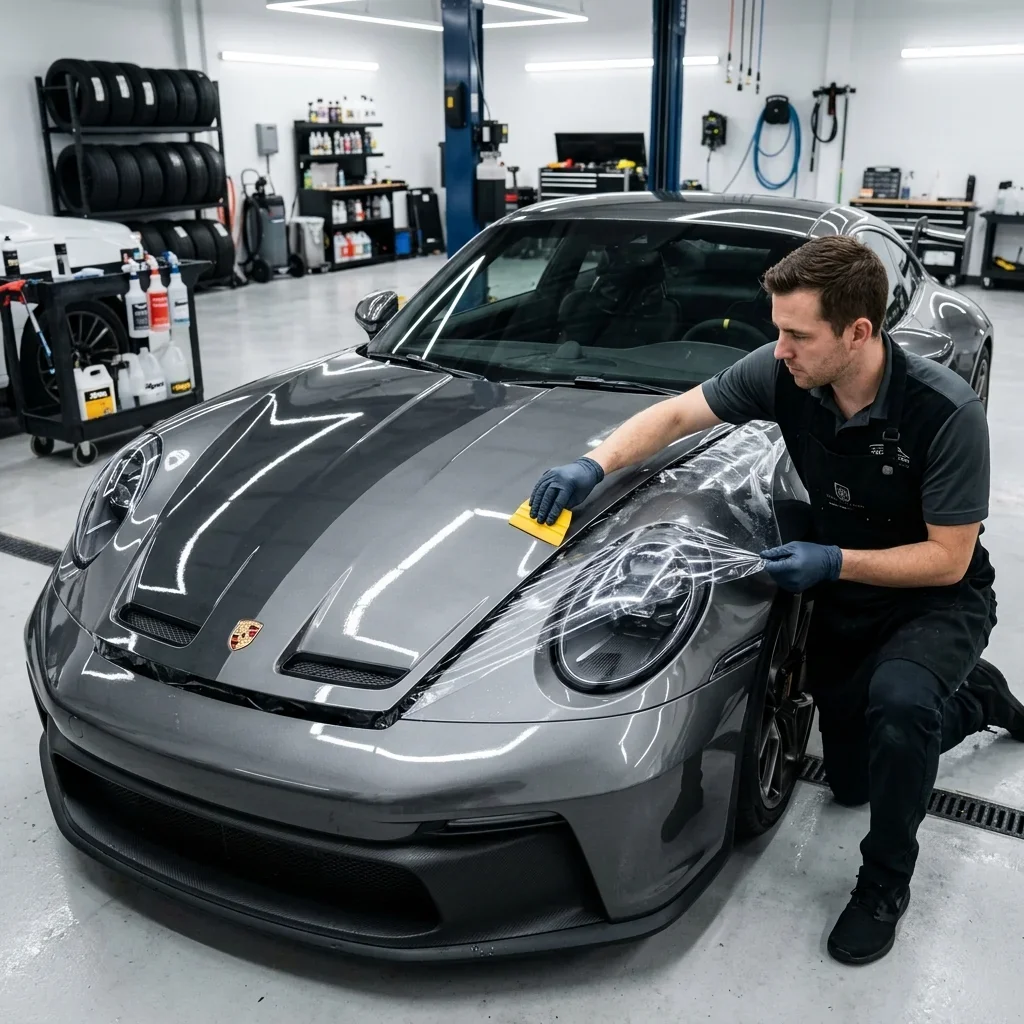
A front-end package (hood + bumper + fenders) protects the highest stone-chip zones for 2,500–4,500 SAR and suits 80% of Jeddah drivers. A full-body wrap (12,000–18,000 SAR) covers every painted panel and suits luxury or limited cars. Choose by car value and driving pattern, not by advertising hype.
When installing paint protection film (PPF) on a new car in Jeddah, most owners face one dilemma: should I wrap the whole car, or just the front-facing panels that take the most abuse? There is no single answer — it depends on the car's value, your daily routes on Jeddah roads like King Abdulaziz Road, the Corniche, and the highways toward Makkah, your budget, and how long you plan to keep the car. The price gap is huge: from 2,500 SAR for a front-end package to 18,000 SAR for a full wrap — up to a fivefold difference. Many centers push you toward the full wrap because it is the most profitable, without telling you that 90% of stone-chip damage concentrates in the front third of the car. In this guide, a certified insulation and tint technician — a Johnson and 3M dealer at AzelCore Jeddah — breaks down every package with real numbers, the panels each covers, and when each one is the smartest choice for Jeddah's climate and roads.
Table of Contents:
- What PPF Is and Why Coverage Type Matters More Than Film Brand
- The Front-End Package: Jeddah's Most Requested and Why
- The Track Pack: What It Covers and Who It Suits
- The Full Wrap: Maximum Protection and Its Real Cost
- Comparison Table: Price, Panels and Lifespan of All Three
- Why the Front Third Deserves Priority on Jeddah Roads
- PPF vs Vinyl Wrap vs Cosmetic Paint — Clearing the Confusion
- How to Choose by Car Value and Driving Pattern
- Common Mistakes When Buying a PPF Package in Jeddah
| Package | Panels Covered | Approx. Price (SAR) | Install Time | Best For |
|---|---|---|---|---|
| Hood Only | Hood | 1,500–3,000 | 1 day | Tight budget / basic protection |
| Front-End Package | Hood + front bumper + fenders | 2,500–4,500 | 1–2 days | Most Jeddah drivers (best ROI) |
| Track Pack | Front-end + door edges + rocker panels | Between front-end and full | 2–3 days | Highway driving / sandy roads / sports cars |
| Full Wrap | Every exterior painted panel | 12,000–18,000 | 3–5 days | Luxury / limited / matte-finish cars |
What PPF Is and Why Coverage Type Matters More Than Film Brand
Paint protection film (PPF) is a clear thermoplastic polyurethane (TPU) layer, 8 mil thick (about 200 microns), bonded over the car's original paint. Its job is to absorb stone-chip impacts, resist wash-induced micro-scratches, block chemical staining, and — in some grades — self-heal surface marks under the sun's heat.
In Jeddah, where surface temperatures soar and flying gravel is common on highways, PPF becomes a logical investment to protect resale value. But the question most owners overlook is not "which film do I buy?" but "which panels do I cover?".
The gap between a front-end package and a full wrap can be fivefold in price, while the difference between one film brand and another (XPEL vs SunTek, for example) matters far less to your actual day-to-day damage protection. The golden rule: coverage type decides how much you protect, and film grade decides how long that protection lasts.
So start your decision from the coverage map that fits how you drive, then pick film quality within your budget.
The Front-End Package: Jeddah's Most Requested and Why
The front-end package is AzelCore's best-seller for one simple engineering reason: it covers exactly the panels that take 90% of stone-chip hits. The package includes the full hood (or half, depending on the option), the front bumper, the front fenders, and often the side mirrors, A-pillars, and the leading edge of the windshield if you wish.
In Jeddah it runs 2,500 to 4,500 SAR for the complete package (hood + bumper + fenders), while hood-only coverage starts at 1,500 SAR. Why is it the smartest for most people? Because a moving car acts like a vacuum that funnels gravel toward the front third; the front bumper and the hood's leading edge are the first to meet debris on the Makkah highway or Al Haramain road.
Installing this package with computer cutting ensures no blade ever touches your car's body. For a daily-driven family or commercial car of moderate value in Jeddah, the front-end package delivers the highest protection per riyal spent, and leaves budget to add nano-ceramic heat insulation that completes the protection.
The Track Pack: What It Covers and Who It Suits
The Track Pack is a middle ground between the front-end and the full wrap, targeting the "track" of airflow and debris along the car's sides. It typically includes everything in the front-end package, plus the leading edges of the front doors, the area behind the front tires (rocker panels / lower sills), and sometimes the rear fender arches.
It earns its name by following the path of gravel thrown by the front tires toward the doors and sills while driving — zones many people neglect despite constant scuffing on sandy roads and Jeddah's outskirts. Who is it for? Drivers who spend a lot of time on highways or roads with blowing sand and gravel, and owners of lowered sports cars whose sills sit close to the ground and catch more spray.
Its price sits logically between the front-end and the full wrap, depending on how many extra panels you choose and the car's size. Important note: the "Track Pack" label varies between centers — always ask for a written list of exactly which panels are covered before paying, because some centers sell a front-end package under the Track Pack name.
The Full Wrap: Maximum Protection and Its Real Cost
A full wrap (full-body PPF) means covering every exterior painted panel with film: hood, roof, all doors, fenders, bumpers, pillars, and trunk lid. In Jeddah it runs 12,000 to 18,000 SAR, depending on the car's size, the complexity of its curves, and the chosen film grade.
What justifies this price? First, the sheer quantity of film is far greater. Second, time: a professional full wrap takes 3–5 working days because each panel is computer-cut and hand-installed precisely around the curves.
Third, wrapping the roof, pillars, and wheel arches demands high skill to avoid bubbles and visible edges. Who is it worth it for? Luxury, sports, and limited-edition cars worth several hundred thousand, where any scratch in the original paint is very costly to fix and hurts resale value.
Also cars with special finishes (matte) that are extremely hard to match when repainting. But be realistic: for an ordinary family car, the difference between protecting the front third and protecting a roof that rarely meets gravel does not justify paying triple the cost.
Why the Front Third Deserves Priority on Jeddah Roads
Simple physics explains why damage concentrates at the front. At speed, the airstream drives gravel and sand kicked up by cars ahead straight into the bumper, the hood's leading edge, and the windshield.
The faster you go, the greater the impact energy and the deeper the potential damage. On Jeddah's highways toward Makkah and Taif, or on roads under construction at the city's edges, flying gravel is especially dense.
Add Jeddah's heat: hot paint is softer and more prone to taking on scratches. That is why covering the front bumper, hood, and fenders addresses the primary source of damage.
The roof, rear doors, and trunk lid rarely take direct stone hits because they are shielded by the airflow angle and by the front panels themselves. This does not mean a full wrap has no value; it means the priority order always starts from the front.
The correct engineering decision: protect the front as your foundation, then expand to the Track Pack or full wrap only if your car's value or driving pattern justifies it.
PPF vs Vinyl Wrap vs Cosmetic Paint — Clearing the Confusion
A very common confusion in the Saudi market mixes three entirely different products. First: PPF, a clear 8-mil polyurethane film whose job is mechanical protection from gravel and scratches; the original paint stays visible beneath it at full gloss.
Second: vinyl wrap, a thin colored film that changes the car's color (gloss, matte, or chrome); its purpose is cosmetic, not protective, and it does not resist gravel the way PPF does. Third: ceramic coating, a liquid chemical layer that hardens onto the paint to add gloss, water repellency, and stain resistance — but it does not stop stone chips because it is only a few microns thick.
The practical takeaway: PPF for mechanical protection, ceramic for looks and easy cleaning, vinyl for color change. Many owners combine PPF on the front panels with a ceramic coating over the whole car for double protection: PPF deflects gravel while ceramic eases washing and boosts shine.
Do not let a center sell you ceramic as a substitute for PPF — they complement each other, neither replaces the other.
How to Choose by Car Value and Driving Pattern
Instead of asking "which is best?", ask "which fits my situation?". Here is a practical framework our AzelCore technicians use in consultations.
First, car value: if it is worth under 120,000 SAR, a front-end package usually gives the best return on investment. Between 120,000 and 300,000 SAR, the Track Pack is a balanced choice.
Above 300,000 SAR or a limited edition, a full wrap is justified to preserve value. Second, driving pattern: short city driving inside Jeddah? Front-end is enough.
Daily highway driving or frequent trips to Makkah and Taif? Consider the Track Pack. Third, holding period: if you will sell within two years, the front-end protects the area that most shapes a buyer's first impression.
If you will keep it 7–10 years, broader coverage preserves the paint long term. Fourth, color: dark and matte finishes show scratches clearly and are hard to repaint, so they benefit more from wider coverage.
The best decision starts with honest advice, not an ad. Reach our technician on WhatsApp to assess your car and your routes and suggest the most suitable package for your budget without sales pressure.
Common Mistakes When Buying a PPF Package in Jeddah
Mistake one: being dazzled by the full wrap without a real need. Many pay 15,000 SAR to protect panels that rarely see damage, when a 3,500 SAR front-end package would have covered the critical zones and left budget for heat insulation.
Mistake two: not requesting a written list of covered panels. The labels "full package" and "Track Pack" vary between centers; some silently exclude mirrors, A-pillars, or inner arches.
Mistake three: focusing on the film's name and ignoring the cutting method. An excellent XPEL film installed with manual blade cutting on the body can scratch your paint under the film — computer cutting matters more than the film brand.
Mistake four: ignoring the written warranty. Ask for a warranty certificate stating the film's coverage period (usually against yellowing and peeling) and a tax invoice.
Mistake five: confusing PPF with ceramic and buying one thinking it replaces the other. Mistake six: applying PPF over paint with scratches or oxidation without paint correction first — the film is clear and will permanently lock in every flaw beneath it.
Avoiding these six mistakes saves you thousands of riyals and ensures real protection for your car's paint.
Frequently Asked Questions
How much does a front-end PPF package cost in Jeddah?
A complete front-end package (hood + front bumper + front fenders) in Jeddah costs between 2,500 and 4,500 SAR, while hood-only coverage starts at 1,500 SAR. The final price depends on the car's size, film grade, and cutting method. Always ask for a written quote stating exactly which panels are covered.
What is the price of full-body PPF in Jeddah?
A full-body PPF wrap in Jeddah runs between 12,000 and 18,000 SAR, depending on the car's size, curve complexity, and film grade. Professional installation takes 3–5 working days because each panel is computer-cut and hand-installed precisely. This package is usually justified for luxury, limited-edition, or matte-finish cars.
Is a full wrap always better than a partial package?
No. About 90% of stone-chip damage concentrates in the front third of the car, so a front-end package protects the most exposed zones for a fraction of a full wrap's cost. A full wrap makes sense only for high-value, limited, or long-hold cars. The decision should rest on your car's value and driving pattern, not on advertising.
What is the difference between a Track Pack and a front-end package?
A front-end package covers the hood, front bumper, and fenders. A Track Pack adds the leading edges of the doors, the lower rocker panels, and sometimes the rear arches, following the path of gravel thrown by the front tires along the car's sides. Labels vary between centers, so always ask for a written list of exactly which panels are covered before paying.
Does PPF replace ceramic coating?
No — they complement each other, neither replaces the other. PPF is a thick film (8 mil) that protects mechanically from gravel and scratches, while ceramic is a thin chemical layer (microns) that adds gloss, water repellency, and stain resistance but does not stop stone chips. Many owners combine PPF on the front panels with ceramic over the whole car for double protection.
How thick is PPF film and what is it made of?
Standard protective PPF is 8 mil thick (about 200 microns) and made of thermoplastic polyurethane (TPU), a flexible, tough material that absorbs stone impacts, resists scratches, and in some grades self-heals surface marks under the sun's heat — a particularly useful trait in Jeddah's hot climate. This thickness is what sets PPF apart from ceramic coating, which is only a few microns.
Do I need paint correction before installing PPF?
Yes, if your paint has swirl marks or oxidation. PPF is completely clear and will permanently lock in any flaw beneath it, so paint correction before installation ensures your car is preserved in its best state. Brand-new dealership cars usually need only thorough cleaning and surface prep before bonding, without full correction.
Does installing PPF affect Saudi traffic laws or periodic inspection?
Clear PPF placed on painted panels (hood, bumper, doors) is unrelated to window-tint laws and does not affect visibility. Any film placed on glass, however, is subject to the General Directorate of Traffic's visible light transmission (VLT) limits, where tint violations carry fines between 500 and 900 SAR. For painted panels, just ensure the film is clear and does not change the car's registered color. When in doubt about glass, refer to MOI traffic requirements and SASO specifications.
⚠️ Warning: Note: package labels (front-end / Track Pack / full) and their panel contents vary between centers in Jeddah. Before paying, always request a written list of exactly which panels are covered, a tax invoice, and a film warranty certificate. The prices shown are 2026 estimates and depend on car size, film grade, and cutting method — get an exact quote for your specific car before deciding.
Sources & References
Related Services
- Computer-Cut PPF Installation — Front-End, Track Pack & Full Wrap Packages ←
- Calculate PPF Cost for Your Car by Package and Size ←
- Nano-Ceramic Heat Insulation to Complement PPF ←
- PPF Work Gallery — Before & After in Jeddah ←
- PPF Cost Guide in Jeddah by Coverage Packages ←
- Computer-Cut vs Manual PPF Cutting ←
- PPF vs Ceramic Coating — Which to Choose? ←
- PPF Films Compared: XPEL vs 3M vs SunTek ←
- Self-healing: what Jeddah's heat repairs and what it does not ←