
Dealership Tint vs. Specialized Centers: Why You Shouldn't Tint at the Car Agency
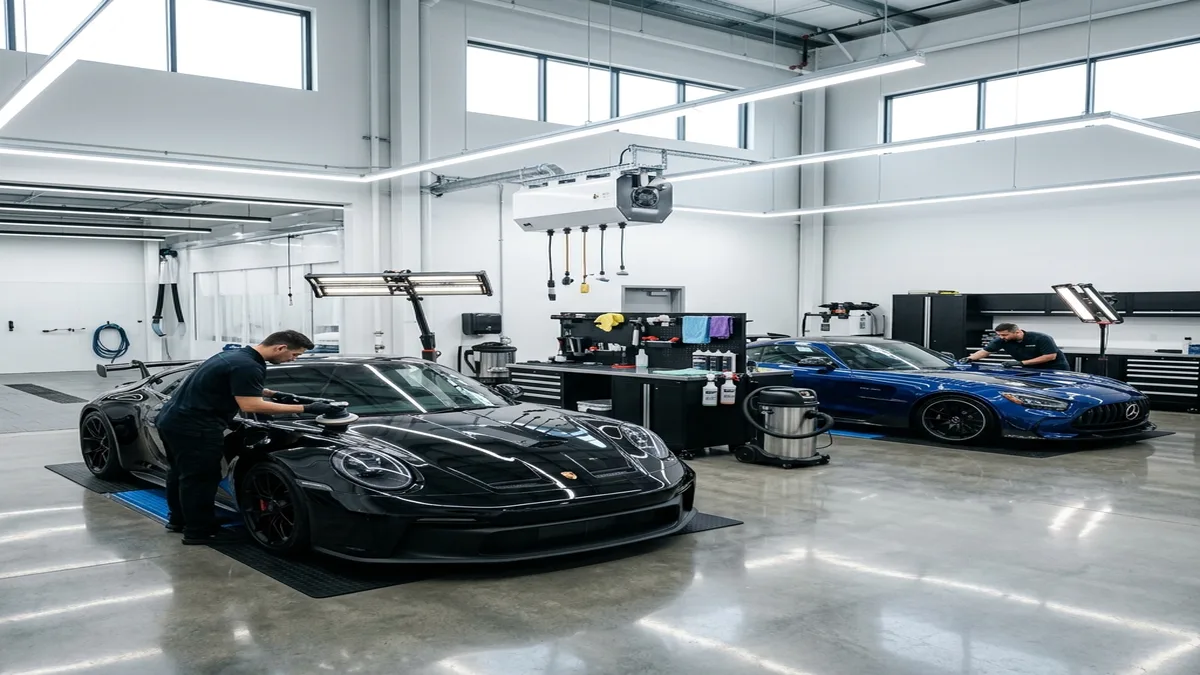
Car dealerships do not manufacture tint — they hire subcontractors who install cheap commercial films with a markup exceeding 200-400%. In certified specialized centers, you get original Nano Ceramic films with a factory electronic warranty and installation in air-conditioned clean rooms — at half the cost or less.
When buying a new car from the dealership, the sales rep enthusiastically offers a "protection and tinting package" as an add-on before delivery. They might say it's "free" with the purchase deal, or charge up to 3,000 SAR. In the Saudi car market alone, dealerships generate annual profits exceeding 200 million SAR from "protection packages" — not car manufacturer profits, but local dealership margins. The fundamental question: Is this package really worth it? Or is it just a hidden profit margin exploiting your excitement for the new car? In this detailed technical investigation, we reveal with numbers the complete truth behind "dealership tinting" and compare it with specialized centers.
Table of Contents:
- Inflated Numbers at Dealerships vs Real Value
- Quality of Films Used in Dealerships as Subcontractors
- Limited Insulation Options at the Dealership
- Professionalism of Technicians in Specialized Centers
| Criterion | Dealership Tinting | Specialized Center (AzelCore) |
|---|---|---|
| Film Type | Cheap commercial carbon or dyed | Original Nano Ceramic (3M / Johnson / XPEL) |
| Markup | 200-400% above actual cost | Fair margin — real market price |
| Installation Environment | Open yards / parking lots | HEPA air-conditioned clean rooms |
| Warranty | Plain paper, no verification | Factory electronic + serial number |
| Actual Heat Rejection | Only 15-30% | 80-97% IR Rejection |
| Quality Testing | Not available | FLIR + UV Meter before delivery |
| After-Sales Service | None | Free annual inspection + replacement |
The Real Numbers: Dealership Markup vs. Actual Value
What you pay 2,500 SAR for at the dealership is actually a dyed or carbon film costing no more than 300-500 SAR (including installation). The dealership achieves up to a 400% profit margin on this service.
The reason is simple: the dealership doesn't own a specialized tinting department — it contracts a "Subcontractor" who buys the cheapest available films to maximize their own profit too. The exploitation chain: Manufacturer sells cheap film at 50-100 SAR per roll → Subcontractor installs it for 300-500 SAR → Dealership sells it to you for 2,000-3,000 SAR.
In contrast, specialized centers like AzelCore offer original Nano Ceramic films (3M Crystalline, Johnson Quantum, XPEL) — films whose raw material cost alone is 400-800 SAR — at a total price of 1,200-2,500 SAR including professional installation and electronic warranty. Additionally, certified centers provide FLIR measurement devices so you can verify insulation efficiency yourself before paying.
Installation Environment: Open Yards vs. Air-Conditioned Clean Rooms
Tint quality doesn't depend only on the film type — but critically on the installation environment. At the dealership: installation is often done in open yards, delivery parking lots, or the "backyard." Dust in Jeddah and Riyadh's atmosphere settles on the adhesive during installation, causing white dots (Dust Contamination) under the film within weeks.
High temperatures affect adhesive curing and cause future air bubbles. Time pressure to finish dozens of cars daily reduces cutting and installation precision.
In certified centers like AzelCore: installation occurs in closed, air-conditioned clean rooms (Controlled Environment) at a constant 22-25°C. HEPA Filtration air purification systems ensure 99.97% dust-free air.
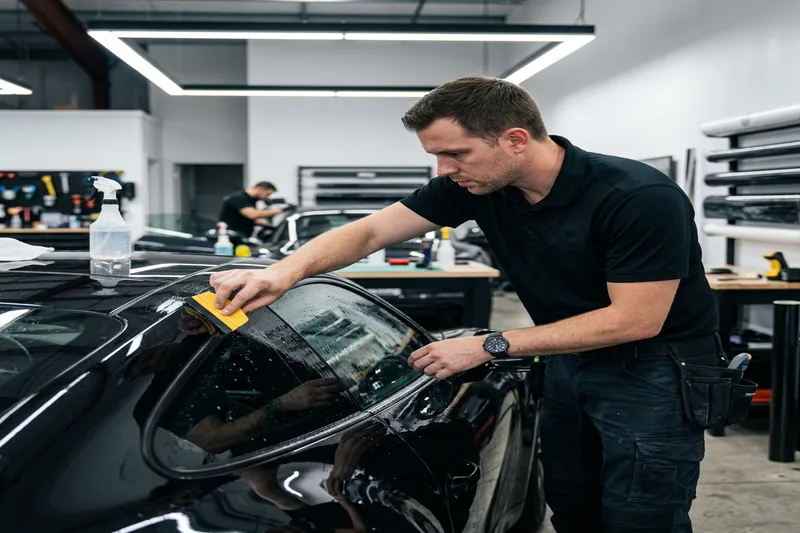
LED lighting distributed at 45° angle to detect the finest defects during installation. One technician works on one car for 3-5 hours without rushing.
Result: perfectly clear glass without bubbles, dots, or scratches.
Warranties: Worthless Paper vs. Factory Electronic Warranty
The dealership gives you a "warranty" printed on plain paper — no serial number, no verification link, and no connection to the film's original manufacturer. If the tint fails after a year, you'll discover the dealership "no longer works" with that subcontractor.
The warranty is lost. In certified centers: the warranty is electronic, registered on the manufacturer's website (3M, Johnson, XPEL) with a unique serial number you can verify online anytime.
Warranty up to the car's lifetime against peeling, discoloration, and bubbling. After-sales service: free annual inspection to measure tint performance (VLT + heat).
In case of any defect: full replacement at no charge. This warranty difference alone justifies choosing a specialized center — even at the same price.
The "Original Dealership Tint" Myth — The Technical Truth
Do not be fooled by "Original Dealership Tint." The truth: major car manufacturers (Toyota, Hyundai, Ford, BMW) do not own tint film factories and do not manufacture tint themselves. The tint the dealership sells is a third-party product purchased from the cheapest local supplier.
"Original" here only means the dealership installed it — not that the car manufacturer made or warrants it. In reality, the car manufacturer's warranty covers mechanical and electrical parts — not tinting.
If the tint peels after a year, Toyota or Hyundai won't take responsibility. Worse: some dealerships deliberately use films without a known brand name (White Label) to prevent you from comparing market prices.
If you ask the sales rep "What is the film brand used?" — and they can't answer — that's a clear warning sign.
Frequently Asked Questions
Should I completely refuse the dealership tinting package?
Yes. Receive your car from the dealership with factory shine without any add-ons. Then go to a certified specialized tinting center. You'll get a better film with a stronger warranty at a lower price. Your investment in a specialized center provides real warranties and proven thermal performance.
What if the tinting package is "free" with the car purchase?
If the package is "free," rest assured its actual cost is under 150 SAR. You'll get a commercial film that impairs night vision and traps heat. Not to mention glass scratching risks from rushed installation. If you accept it for free, plan to replace it later with original Nano Ceramic film.
Does installing tinting outside the dealership void the car warranty?
No. The car manufacturer's warranty covers mechanical and electrical parts. Installing a tint film (without dismantling car parts) does not void any warranty. Specialized centers install the film without dismantling handles, lights, or trim — unlike some dealership subcontractors.
How do I verify the specialized center uses original films?
Three decisive signs: First, ask to see the original film box (bearing 3M, Johnson, or XPEL logo). Second, request the electronic warranty with a serial number verifiable on the manufacturer's website. Third, request a FLIR test or thermal measurement before delivery — the original film will show a clear difference.
⚠️ Warning: Do not be fooled by "Original Dealership Tint" — major car manufacturers (Toyota, Hyundai, Ford, Nissan) do not own tint film factories. The "original" tint is a cheap third-party product sold at a huge markup. Always ask: "What is the film brand name?" — if the employee can't answer, the tint is of unknown origin.