
Kids & Pets in a Hot Car: How Jeddah Cabins Hit 70°C in Minutes — and the Role of Tint in Saving Lives
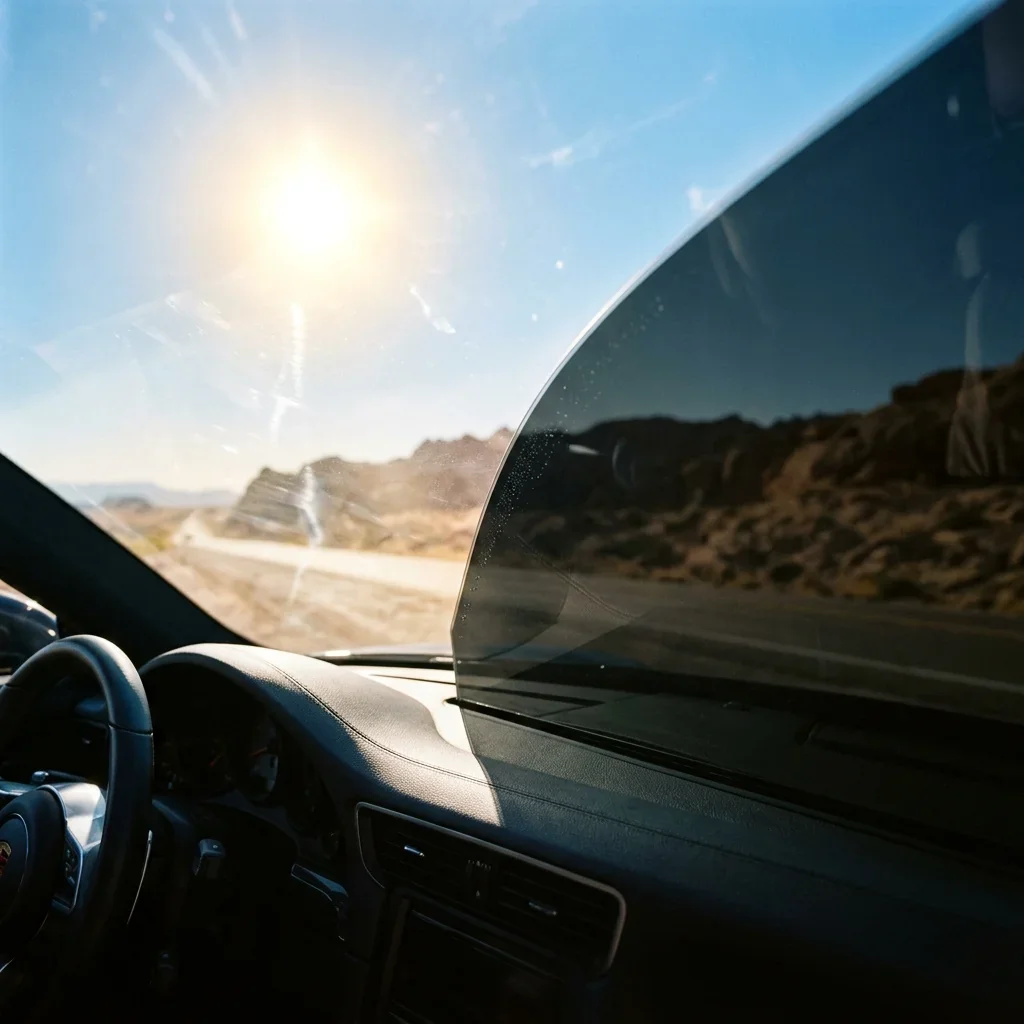
In a Jeddah summer, a closed car cabin can exceed 70°C within minutes — even on a "mild" day — creating a deadly environment for children and pets. Nano-ceramic thermal film blocks up to 96-97% of infrared rays and lowers cabin heat, but it never makes leaving a child or pet in a car safe. The golden rule: never leave a living being alone in a vehicle, not even for one minute.
In Jeddah, the outdoor temperature does not need to be record-breaking for your car to turn into an oven. Even on a day when the sun feels "bearable," closing the doors and parking for a few minutes is enough to push cabin temperatures to life-threatening levels. The dashboard can touch 80°C or more, and leather seats get hot enough to burn a child's skin. This is not an exaggeration; it is simple physics: car glass acts as a greenhouse, trapping solar radiation inside far faster than a small body or a pet can shed heat. Infants and animals lack an adult's ability to regulate body temperature, so their core temperature climbs at double the rate, and heatstroke and organ failure can occur within minutes. In this guide, we explain with real numbers how the heat builds, why "cracking a window" is a dangerous myth, and exactly where thermal film honestly stands: it helps significantly in lowering heat and protecting skin from rays, but it is no substitute for one non-negotiable rule — no one stays alone in the car.
Table of Contents:
- Why a car becomes an oven: the greenhouse physics
- The real numbers: how fast the cabin climbs
- Why children and pets are far more vulnerable
- The myth of the cracked window and shade
- What thermal film does — and honestly does not do
- Field thermal measurement across 10 Jeddah districts
- A practical safety checklist for families and pet owners
- What to do if you see a child or pet trapped in a car
Why a Car Becomes an Oven: The Greenhouse Physics
A closed car behaves exactly like a greenhouse. Short-wave sunlight passes easily through the window glass and strikes the seats, dashboard, and floor, heating these surfaces, which then re-radiate that heat as long-wave infrared that cannot escape back out through the glass nearly as easily.
The result: trapped heat that accumulates rapidly. Because a car cabin is small and air-sealed, a modest amount of solar radiation raises the temperature far faster than it would in a large room.
Most critically, the bulk of the rise happens in the first 10 to 20 minutes — that is, before you have "quickly returned" from a short errand. A dark exterior color, leather seats, and uninsulated glass all accelerate the heating.
In Jeddah's hot, humid coastal climate, high humidity makes the body's natural cooling (sweating) less effective, doubling the danger: high heat plus humidity that blocks the body from cooling itself. Understanding this physics is the starting point for grasping why "one minute" can be enough.
The Real Numbers: How Fast the Cabin Climbs
Let us replace vague scare-talk with real numbers. In our field thermal study in Jeddah (using a FLIR T530 camera under the ISO 13837:2021 methodology), cars with no thermal film recorded interiors touching about 77°C at midday peak, while nano-ceramic film lowered that to about 40°C under the same conditions.
That is a gap of roughly 37 degrees — the difference between a lethal environment and a survivable one. But note: even 40°C remains dangerous for an infant or pet left alone.
Global pediatric research indicates a car cabin can rise about 20 degrees above outdoor temperature within just 10 minutes, and roughly 30-40 degrees within an hour, with most of that rise happening very early. This means a "mild" 35°C day outside — extremely common in Jeddah — is enough to push the interior past 55°C quickly.
Human skin begins to be damaged on contact with surfaces hotter than 50°C, and a child's vital organs fail once core temperature exceeds about 40°C. These are not rare scenarios; they are a plausible daily reality in Jeddah parking lots under direct sun.
Why Children and Pets Are Far More Vulnerable
An infant's body is not a miniature adult's; it is far more fragile against heat. A child's body temperature rises three to five times faster than an adult's, because the skin surface area is large relative to body weight, and the heat-regulating nervous system is not yet fully developed.
A child may also be unable to express distress or unbuckle the seat to escape. Pets like dogs and cats do not sweat through the skin as humans do; they rely on panting to cool down, a method that fails completely in the hot, humid, trapped air inside a car.
The World Health Organization classifies heat stress and heatstroke as potentially fatal emergencies, with children and the elderly the most affected groups. A child's heatstroke may begin with irritability, redness, and dryness, then escalate terrifyingly fast to seizures, loss of consciousness, and organ failure.
Time is not an ally here; the minutes you think are "quick" can be enough to cause permanent harm. That is why safety is never built on luck or on "I'll be right back," but on one strict, unbreakable rule: never leave a child or pet alone in the car, no matter how short the errand seems.
The Myth of the Cracked Window and Shade
One of the most dangerous common beliefs is that "cracking a window" or "parking in the shade" solves the problem. Medical and field research has proven that opening a small gap in the window has a very minor effect on the heat curve; the cabin still rises to nearly lethal levels at almost the same speed, because the issue is not simple ventilation but trapped solar radiation.
As for shade, it helps delay the rise but does not prevent it; the sun moves, the shade disappears, and Jeddah's ambient heat is high to begin with. Likewise, running the AC then switching off the engine and leaving the child is not a solution; the moment cooling stops, the heat climbs fast — not to mention the risks of leaving an engine running unattended.
Even dark or reflective tint alone does not turn a closed car into a safe place for a living being left alone. The scientific conclusion is clear: there is no "trick" that makes leaving a child or pet in a parked car safe.
All these half-measures give a false sense of security and can be fatal. The only guaranteed solution is for the living being to not remain in the car at all.
What Thermal Film Does — and Honestly Does Not Do
Good thermal film is not a marketing myth, but it is also not a magic wand. Let us be completely honest.
What original nano-ceramic film (such as Johnson and 3M Crystalline) does: it blocks a very high share of the infrared rays (96-97% in our measurements) responsible for the sensation of heat, blocks about 99% of ultraviolet (UV) rays responsible for skin damage and interior fading, and lowers cabin temperature by a large margin that can reach tens of degrees versus bare glass. This reduces AC load, protects children's skin from UV while driving, and makes the cabin far cooler on entry.
What it honestly does not do: film does not stop the temperature rise in a closed car parked under the sun for a long period; it slows and reduces, but does not turn it into a refrigerator. Even with the best film, a parked car remains an unsafe environment for a child or pet left alone.
So we state the message plainly: use thermal film because it genuinely improves safety, comfort, and skin protection while driving — but never use it as an excuse to leave a living being in the car. Film is a daily preventive tool, not a substitute for attention and vigilance.
Field Thermal Measurement Across 10 Jeddah Districts
Because we believe in numbers, not vague talk, at AzelCore we conducted a field thermal study in Jeddah running between 2024 and 2026, covering 530 measurements across 10 different districts, using a FLIR T530 thermal camera under the ISO 13837:2021 methodology accredited for in-vehicle heat testing. Its data was published under a Creative Commons license (CC BY-NC 4.0).
The results were striking and consistent: cars with no film recorded interiors touching 77°C at peak, while cars insulated with nano-ceramic stayed around 40°C. The measurements also confirmed infrared blocking of 96-97% and ultraviolet blocking of 99% with original film.
What matters to families here: the difference is not a number on paper, but a tangible difference between a cabin that can burn and a survivable one on entry. Even so, we honestly repeat that even 40°C remains dangerous for an infant left alone.
The aim of publishing this data is not promotion but awareness: so you know exactly what your car faces every Jeddah midday, and so you protect your family on a scientific basis, not a guess. You can review the full report on our research page.
A Practical Safety Checklist for Families and Pet Owners
Prevention begins with simple daily habits that save lives. First, make "look before you lock" a fixed habit: check the rear seats every single time you leave the car, without exception.
Second, place something you need (your phone, bag, or work shoe) next to the child's seat, so you are forced to turn around when leaving. Third, arrange with the nursery or school to call you immediately if your child does not arrive without prior notice.
Fourth, never leave the car unlocked or keys within children's reach; many tragedies happened to children who climbed into a parked car while playing and could not get out. Fifth, for pet owners: plan your errands so your pet never stays in the car, and only bring it to places that allow it inside.
Sixth, invest in original nano-ceramic thermal film to reduce heat and protect your children's skin from UV while driving, and in light-colored seat covers and a front-windshield sunshade while parked. Remember that these tools help, but none of them cancels the master rule: no living being stays alone in the car.
Print this checklist, keep it in the glovebox, and share it with everyone who drives the family car.
What to Do If You See a Child or Pet Trapped in a Car
You may be the one who makes the difference between life and death. If you see a child or pet trapped alone in a closed car under the Jeddah sun, do not hesitate and do not assume "the owner will be right back." First, quickly assess the child's or animal's condition: are they sweating heavily, appearing lethargic, unconscious, or panting severely? These are serious warning signs.
Second, immediately call emergency services on 911 in the Kingdom, reporting the exact location, the car's description and plate, and the condition of whoever is inside. Third, try to find the car owner in nearby shops only if it will take seconds, but do not waste precious time if the situation looks critical.
Fourth, stay by the car until specialists arrive. Do not break the glass except in a case of confirmed danger to life and after notifying the authorities, as these decisions belong to security and ambulance personnel.
Most importantly, remember that minutes of hesitation can cost a life. Community awareness and swift action are the last line of defense, and each of us is responsible for protecting the most vulnerable in our society.
Save a life — this is not something that can wait.
Frequently Asked Questions
How long does the cabin take to reach dangerous heat in Jeddah?
Most of the heat rise happens in the first 10 to 20 minutes. On a 35°C outdoor day — common in Jeddah — the interior can exceed 55°C within minutes and may touch 70-77°C at peak. This window is enough to cause fatal heatstroke for a child or pet.
Does thermal film make it safe to leave a child in the car?
No, absolutely not. Nano-ceramic film lowers heat by a large margin (from about 77°C to about 40°C in our measurements) and blocks 96-97% of infrared, but a closed parked car remains unsafe for any living being left alone. Film is a daily preventive tool, not a substitute for the rule of never leaving anyone in the car.
Does cracking a window protect against the heat?
No. Research proves a small gap has a very minor effect on heat rise; the cabin still climbs to lethal levels at nearly the same speed, because the problem is trapped solar radiation, not lack of ventilation. Never rely on this trick.
Why are children and pets more affected than adults?
Because a child's body temperature rises three to five times faster than an adult's, and their heat-regulating system is immature. Pets do not sweat through the skin and rely on panting, which fails in hot, humid, trapped air. The WHO classifies children and the elderly among the groups most vulnerable to heatstroke.
What is the heat difference between an insulated and a non-insulated car in Jeddah?
In AzelCore's field study (FLIR T530, ISO 13837:2021 methodology, 530 measurements across 10 Jeddah districts), non-insulated cars recorded interiors touching 77°C, while nano-ceramic-insulated cars stayed around 40°C — a gap of roughly 37 degrees. Even so, 40°C remains dangerous for a living being left alone.
What should I do if I see a child or pet trapped in a car?
Quickly assess the condition (lethargy, unconsciousness, severe panting), and immediately call emergency services on 911 with the location, car description, and plate. Stay by the car until specialists arrive. Do not break the glass except in confirmed danger to life and after notifying authorities. Minutes of hesitation can cost a life.
Is dark tint better at blocking heat than clear film?
Not necessarily. What blocks heat is rejecting infrared rays, which is nano-ceramic technology — available even in clear shade-00 traffic-compliant films. Cheap dark tint may block light without blocking real heat, leaving the car dark yet hot. Authenticity and technology matter more than color.
⚠️ Warning: Life-saving warning: No thermal film, tint, or trick (cracked window, shade, temporary AC) makes leaving a child or pet alone in a parked car safe in Jeddah's climate. The heat can become fatal within minutes. The only guaranteed rule: never leave a living being in the car, not even for one minute. This article is for awareness and does not replace emergency medical care; if heatstroke is suspected, call emergency services 911 immediately.
Sources & References
Related Services
- Nano-Ceramic Car Thermal Insulation — Protection and Comfort for Your Family ←
- Original Johnson Film — Authorized Dealer in Jeddah ←
- 3M Crystalline — Superior Heat Rejection, Traffic-Compliant Clarity ←
- AzelCore 2026 Jeddah Field Thermal Report ←
- UV Skin Protection Through Window Tint ←
- How Jeddah's Heat Damages Your Car and How to Protect It ←
- Saudi Car Tint Laws 2026 ←
- Contact AzelCore for a Free Consultation ←