
Full Windshield Tinting in Saudi Arabia — What's Legal vs What Gets You Fined
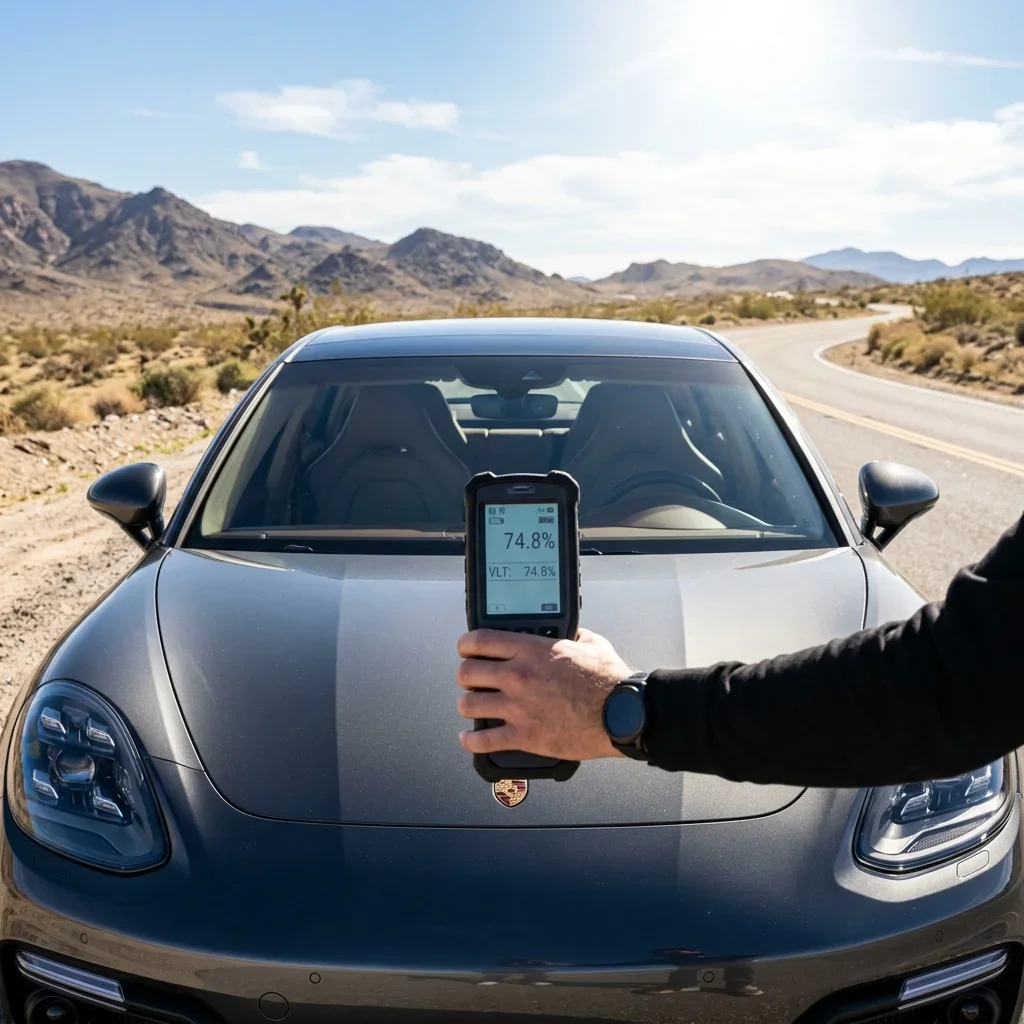
Full windshield tinting is legal in Saudi Arabia only with a completely transparent heat film (shade 00, 70%+ visible light transmission) such as nano-ceramic or 3M Crystalline, provided it is not reflective, colored, or alters the glass color. Any dimming on the front windshield is a violation carrying a 500–900 SAR fine and a periodic-inspection failure.
A question car owners in Jeddah and Riyadh ask daily: "Can I tint my entire windshield?" The short answer is yes — but with one decisive condition many overlook. The windshield is the single most sensitive piece of glass on a vehicle under Saudi traffic law, because it is the driver's primary window onto the road and the security officer's window into the cabin. The regulations therefore draw a sharp line between permitted "transparent heat insulation" and strictly prohibited "dimming." In this commercial-investigation guide from AzelCore Jeddah, we detail exactly what is allowed on a full windshield, why some drivers fail periodic inspection despite using a "clear" film, the difference between shade-00 nano-ceramic and 3M Crystalline, and how to avoid the 500–900 SAR fine. Every legal figure here is grounded in the traffic regulations and the Tint Meter device used in the Fahas-accredited periodic inspection and SASO standards.
Table of Contents:
- The Definitive Answer: When Is Windshield Tinting Legal?
- Table: What's Allowed vs Banned on Each Glass
- Why the Windshield Is the Most Sensitive Piece of Glass
- Transparent Insulation vs Dimming: The Line That Decides the Fine
- Shade-00 Nano-Ceramic vs 3M Crystalline for the Windshield
- The Inspection Trap: Factory Glass and the Tint Meter
- The Fine and How It's Caught: 500–900 SAR and Why
- Reflective, Colored, and Sunshades: Outright Windshield Violations
- How to Choose a Center That Guarantees a Legal, Cool Windshield
| Glass Position | Legally Allowed | Recommended VLT | Note Specific to the Windshield |
|---|---|---|---|
| Full Windshield | Completely clear, shade 00 only | 70% and above | Allowed for clear heat insulation; no dimming/color/reflection |
| Front Side (Driver & Passenger) | Clear, shade 00 | 70% and above | Any dimming obstructing driver/officer vision is banned |
| Rear Side Windows | Up to shade 02 | About 30% and above | Not windshield-related; allowed for family privacy |
| Large Rear Windshield | Clear only (for insulation) | 70% and above | Dark dimming banned to protect center-mirror view |
| Reflective/Colored Film on Windshield | Strictly prohibited | Not applicable | Outright violation even if clear from inside |
The Definitive Answer: When Is Windshield Tinting Legal?
Full windshield tinting is legal in Saudi Arabia under one essential condition: the film must be completely transparent at shade 00, meaning it transmits 70% or more of visible light (VLT). Practically, you can install an advanced heat-rejection film across the entire windshield edge-to-edge, as long as the naked eye perceives no dimming, color, or reflection.
The legal intent is clear: preserve the driver's night vision and the security officer's view into the cabin. But if the film carries any dimming (shade 01 or darker), any color (smoke, blue, bronze), or a mirror-like reflective layer, it is an outright windshield violation with no exception.
The rule every Jeddah driver should memorize: "insulation yes, dimming no." A shade-00 clear film is not merely a legal loophole — it is genuinely the best thermal choice, because it blocks the infrared rays responsible for cabin heat without touching the visible-light level. This is the product we install daily at AzelCore for customers who want a cool windshield that clears periodic inspection and checkpoints without worry.
Table: What's Allowed vs Banned on Each Glass
Before the details, the table below summarizes the legal status of each piece of glass on a private car, with focus on the windshield — the subject of this guide. Note the rule tightens as we approach the driver and relaxes slightly at the rear where children and family sit.
This gradient is the core logic of Saudi traffic law: forward vision is sacred, rear privacy is permitted within limits. As you read, remember that "shade 00" means clear to the eye, and "02" means roughly 30% light transmission.
Any number other than 00 on the windshield equals a violation. Use this table as a quick reference before visiting any tint center, and ask the technician to record the percentages on the warranty certificate and e-invoice so they serve as your evidence at periodic inspection.
Why the Windshield Is the Most Sensitive Piece of Glass
The windshield is not just a window — it is the driver's first line of defense against hazards. Any visual distortion on it becomes a catastrophic danger in night driving, when ambient light drops and the driver must spot pedestrians, cyclists, and unlit vehicles.
This is why Saudi traffic enforces its strictest standard on this glass specifically, permitting only full transparency. A second dimension is security: at checkpoints, an officer must clearly see the driver's hands and the cabin within a fraction of a second to assess the situation.
A dimmed windshield obstructs this view and endangers everyone — which is also why a vehicle may be impounded if the driver refuses to immediately remove an illegal front tint. A third dimension is engineering: modern windshields carry ADAS camera systems, rain sensors, and light sensors, and any imprecisely designed film can confuse them.
A clear nano-ceramic film is engineered to work with these cameras without affecting them, whereas cheap metallic films can interfere with signals. In short, the windshield combines traffic safety, public security, and technology — leaving zero room for gambling.
Transparent Insulation vs Dimming: The Line That Decides the Fine
The biggest misunderstanding among car owners is conflating "heat insulation" with "dark color." Technically these are two entirely separate concepts. Dimming (low VLT) is how much visible light the film blocks — that is what a traffic officer sees and the inspection device measures.
Heat insulation, by contrast, is measured by the rejection of infrared (IR) and ultraviolet (UV) rays, which are invisible to the eye to begin with. Old films linked the two: want more insulation? Go darker.
But nano-ceramic technology severed that link for good. Today a clear shade-00 film (70–80% visible transmission) can block 96–97% of infrared and 99% of UV.
In AzelCore's thermal study (FLIR T530 camera, ISO 13837:2021 standard, 530 measurements across 10 Jeddah districts from 2024–2026), cabin interior temperature dropped from about 77°C with no film to roughly 40°C with nano-ceramic — all with a film that is completely clear to the eye and windshield-legal. That is the crux: you can get maximum cooling on your windshield without breaking a single number in the traffic code, because heat comes not from visible light but from the infrared the clear film blocks.
Shade-00 Nano-Ceramic vs 3M Crystalline for the Windshield
For a full windshield, two trusted original options compete at AzelCore, both clear and traffic-compliant. The first is nano-ceramic (Johnson — the heritage brand since 1961, and the Johnson Supreme IR edition), blocking 96–97% of infrared and 99% of UV, with warranty up to 10 years and sedan installation priced between 1,500 and 2,200 SAR.
The second is 3M Crystalline (from 3M, established 1902), a multilayer film (hundreds of nano-layers) with a total solar energy rejection (TSER) of roughly 90%, carrying a lifetime warranty and priced between 2,000 and 4,000 SAR depending on the vehicle. Both are metal-free, meaning no interference with phone signal, GPS, or speed-radar systems.
The choice depends on your priorities: nano-ceramic offers the highest IR rejection at a lower price, while Crystalline offers premium crystal-clear optics and a lifetime warranty for those who keep their car for years. Either way, request shade 00 for the windshield and front side glass to stay 100% legal.
We always recommend viewing a film sample on real glass before deciding, because the difference in optical clarity between these brands and cheap counterfeits is tangible.
The Inspection Trap: Factory Glass and the Tint Meter
Here is a secret most people miss that causes a surprise periodic-inspection failure even with a "clear" film. Factory glass from the dealer is not 100% transparent; it already carries a very light dimming of 5% to 10% due to safety layers and factory tint.
The Tint Meter used in inspection measures total transmission = original glass + film combined. If your factory glass is, say, 88% transparent and you add a film that subtracts an additional percentage, the final sum must remain above the legal threshold.
On the windshield that threshold is 70%, and the error margin is tight. An unprofessional center applies the film without measuring the original glass first, so total transmission drops below 70% and the windshield fails the Fahas-accredited inspection.
The correct method we follow at AzelCore: we measure the original glass transparency with the device before any installation, then select a high-transmission clear film that guarantees the final sum stays above the legal limit with a safety margin. We then document the final figure on the warranty certificate so you can present it to the inspector as conclusive proof.
This single step is the difference between a windshield that clears inspection smoothly and one that sends you back to square one.
The Fine and How It's Caught: 500–900 SAR and Why
A windshield tint violation is not recorded as "tinting" but under a broader clause: "making a modification or addition to the vehicle's structure or body." The fine ranges from a minimum of 500 SAR to a maximum of 900 SAR, with the figure set according to case assessment and how severely the dimming impairs vision. More serious than the fine is the possibility of impounding the vehicle if the driver refuses to immediately remove the illegal tint at the checkpoint, or if the dimming obstructs vision in a way that poses an imminent danger to public safety.
Detection has advanced considerably: an officer at a checkpoint can easily spot windshield dimming by eye and uses handheld meters when in doubt. Smart systems also link a vehicle's plate to its type and the tint conditions allowed for it (a taxi, for example, is banned from tinting entirely).
The practical point: the 500–900 SAR fine recurs each time you are caught, plus the cost of removing the illegal film and re-installing a legal one — a doubled expense avoidable by fitting a correct clear film from the start. Compliance is always cheaper than the violation.
Reflective, Colored, and Sunshades: Outright Windshield Violations
Even if you respect the transparency level, three types of "additions" on the windshield are indisputable violations. First: reflective/chrome (mirror) film, even if clear from inside, because it casts a disruptive reflection onto vehicles behind by day and counts as a prohibited modification to the vehicle's frontage.
Second: colored films (smoke, blue, bronze, bright red) or any film that alters the original glass color — banned because they distort night vision and make traffic signals harder to distinguish. Third: removable sunshades and barriers some place on the windshield while driving — strictly prohibited in motion and permitted only when the car is fully parked.
Add to these the colored top strip (visor) that extends further than allowed and covers the driver's field of view. None of these additions relate to genuine heat insulation; they are decorations that invite fines and impair vision.
The golden rule for the windshield: clear, non-reflective, non-colored, no barriers while driving. Follow it and you will pass any checkpoint with confidence.
How to Choose a Center That Guarantees a Legal, Cool Windshield
Choosing the right center for your windshield is the difference between years of comfort and a recurring fine. A professional center, like AzelCore in Jeddah, starts with a step it never skips: measuring your original glass transparency with a Tint Meter before any installation, then explaining the legal options available specifically for your car based on its type and registration.
Second, it uses documented original films (authorized Johnson and 3M dealer), not cheap counterfeits that crack and emit fumes under the Jeddah sun. Third, it provides a VAT e-invoice and a written warranty certificate detailing the visible light transmission (VLT) for each piece of glass — your legal document before periodic inspection and checkpoints.
Fourth, it installs the windshield film with precision compatible with ADAS camera systems and rain sensors without obstructing them. Fifth, it gives honest advice: if your car is in a tint-banned category (taxi, rental, two-seat coupe), it tells you plainly rather than taking your money and exposing you to a violation.
These five criteria are the difference between an investment that protects and cools your car for years, and a cheap job that ends in an embarrassing roadside removal and a fine on your traffic record.
Frequently Asked Questions
Is full windshield tinting allowed or banned in Saudi Arabia?
Allowed under one condition: the film must be completely clear at shade 00 with 70%+ visible light transmission (like nano-ceramic or 3M Crystalline), non-reflective and non-colored. Any dimming on the windshield is prohibited and counts as a violation.
Do I get real heat insulation with a clear windshield film?
Yes. Heat comes from invisible infrared rays, and a clear shade-00 film blocks 96–97% of it and 99% of UV. In AzelCore's study, cabin temperature dropped from about 77°C to roughly 40°C with a fully clear film.
What is the fine for an illegal windshield tint?
It falls under "modification to the vehicle's structure" and ranges from 500 to 900 SAR depending on case assessment, with possible vehicle impoundment if the driver refuses immediate removal at a checkpoint.
Why might my clear windshield fail inspection?
Because factory glass already has 5–10% dimming, so if a film is added without measuring the original glass, total transmission can drop below 70%. The fix is to measure the original glass first, then pick a high-transmission film that keeps the total above the legal limit.
What's the difference between nano-ceramic and 3M Crystalline for the windshield?
Nano-ceramic (Johnson) blocks 96–97% of infrared with warranty up to 10 years and a sedan price of 1,500–2,200 SAR. 3M Crystalline has a TSER of about 90% with a lifetime warranty and a price of 2,000–4,000 SAR. Both are clear, metal-free, and traffic-compliant.
Is reflective (mirror) film allowed on the windshield if it's clear from inside?
No, reflective film is strictly prohibited on the windshield even if clear from inside, because it counts as a modification to the vehicle's frontage and casts disruptive glare onto vehicles behind. The rule: clear, non-reflective, non-colored.
Is a sunshade on the windshield a violation?
While driving, yes — placing any sunshade or barrier on the windshield that obstructs vision is prohibited. It may be used only when the car is fully parked for sun protection, then removed before moving.
How do I prove to an officer my windshield is legal?
Keep the warranty certificate and e-invoice from a certified center detailing the visible light transmission (VLT) for each glass. This document is conclusive proof the film is original, clear, and traffic-compliant before periodic inspection and checkpoints.
⚠️ Warning: Warning: a clear shade-00 film is allowed on the windshield, but reflective (mirror) film, colored film (smoke/blue/red), or any dimming are all outright violations requiring immediate removal and a 500–900 SAR fine, and may lead to vehicle impoundment if removal is refused at a checkpoint. Never trust a center that promises \"stronger insulation\" by dimming the windshield; genuine insulation is clear.
Sources & References
Related Services
- Clear Nano-Ceramic Car Tint, Traffic-Compliant — Shade 00 ←
- Clear 3M Crystalline for the Windshield — Authorized Dealer ←
- Original Johnson Film Approved by Periodic Inspection ←
- The Complete Guide to Saudi Tint Laws 2026 ←
- Clear Windshield Tint with 3M — Everything You Need ←
- Allowed VLT Percentage by Window 2026 ←
- Tint Fines and Fahas Inspection Pass Guide ←
- Book a Free Consultation and Transparency Check — AzelCore Jeddah ←