
Self-Healing PPF Explained: How Scratches Vanish in Jeddah's Heat
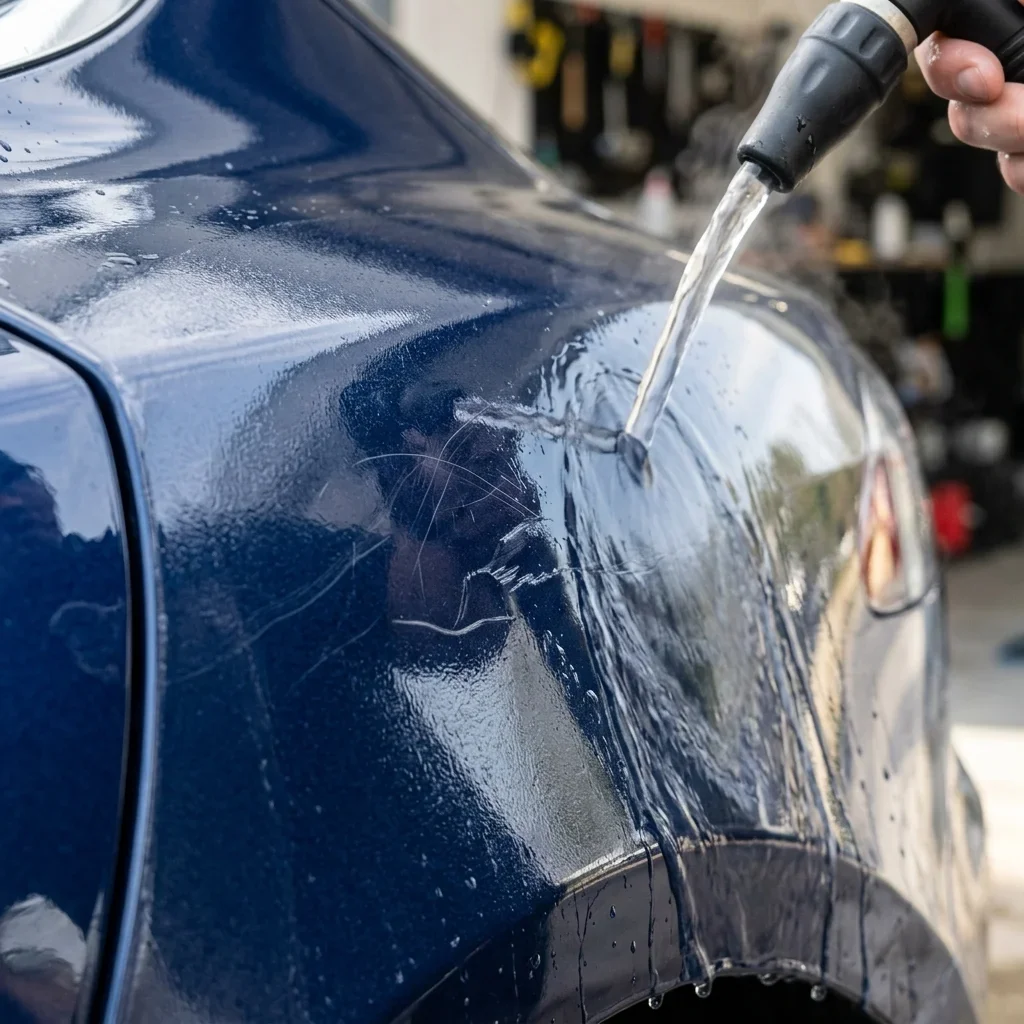
Self-healing PPF has a flexible top layer (a polymer elastomer). When a light surface scratch (swirl mark) occurs, the layer reflows to its original shape with heat — and Jeddah's sun (car surface 70-80 C) is enough to make scratches vanish within minutes without hot water.
Many luxury car owners in Jeddah ask about the most-repeated marketing phrase in paint protection: "the film that heals itself." Is it just hype, or a real technology backed by physics and chemistry? The truth is that self-healing is not magic, but a physical property of a flexible polymer layer known as an elastomer, designed to recover its original shape when activated by heat. The irony is that Jeddah's harsh climate — which destroys ordinary paint — is the ideal environment that makes this property work at peak efficiency year-round. In this engineering guide from AzelCore, we explain in detail how this layer works, which scratches actually vanish (and which never do), the role of car-surface heat in Jeddah, plus the differences between the Johnson and 3M films we offer and their real prices. Our goal is for you to buy based on correct technical understanding, not exaggerated marketing slogans.
Table of Contents:
- What self-healing really is: anatomy of the elastomer layer
- Heat physics: why Jeddah's sun is an ideal activator
- Cold vs hot healing: Johnson and 3M film differences
- Limits of the tech: which scratches vanish and which never return
- A field test in Jeddah: timing scratch disappearance on a hot panel
- Self-healing PPF vs nano ceramic coating: who protects what
- Real prices and coverage packages at AzelCore
- How to verify the film truly heals before you pay
What Self-Healing Really Is: Anatomy of the Elastomer Layer
Paint protection film (PPF) is not a single layer but a multilayer construction. The top layer responsible for self-healing is made of a flexible polymer called an elastomeric topcoat, usually based on thermoplastic polyurethane (TPU).
The physics is simple: when a light abrasive object — a car-wash brush or trapped dust during wiping — passes over the surface, it displaces the polymer molecules superficially without cutting them, forming a fine swirl mark. The flexible polymer has shape memory: when its temperature rises above a certain point, the molecular chains recover their original arrangement and the layer regains its smooth flow, so the scratch disappears visually.
This differs fundamentally from a hard clear coat, where a scratch is permanent because material is actually lost. The core difference: ordinary paint is abraded, while the PPF layer is displaced and returns.
But we must be precise: this property works only on surface scratches within the thickness of the top layer (a few microns) and has nothing to do with deep scratches. This scientific basis is what any realistic purchase decision should rest on.
Heat Physics: Why Jeddah's Sun Is an Ideal Activator
Self-healing needs heat to activate the polymer's memory. In cold regions, owners pour warm water or use a heat gun to raise the surface temperature and erase scratches.
In Jeddah, nature does the job for free. According to our field thermal study at AzelCore (using a FLIR T530 camera, per ISO 13837:2021, on a sample of 530 cars across 10 Jeddah districts between 2024 and 2026), we recorded an interior surface temperature of around 77 C in an untinted vehicle, while the metal body panels under direct sun run even higher at midday.
This elevated heat on the hood and doors is enough to exceed the activation threshold of most modern PPF films. In practice, this means a car parked under Jeddah's noon sun 'heals' its surface scratches automatically within minutes with no intervention from you.
This is a core advantage of the western Kingdom's climate: what is considered a climate flaw (heat that destroys ordinary paint) becomes an operational advantage for self-healing technology. That said, we state honestly that the speed of disappearance depends on scratch depth, film type, and instantaneous surface temperature, and we promise no single fixed number.
Cold vs Hot Healing: Johnson and 3M Film Differences
Not all self-healing films are equal. They are technically classified into two types: 'hot healing,' which needs an actual temperature rise (sun, warm water, heat gun) to activate the layer, and the newer 'cold healing,' which works faster at room temperature.
The films we offer at AzelCore come from two established brands: Johnson, the American company founded in 1961 specializing in window and protection films, and 3M, the long-established American company founded in 1902 with advanced surface technologies (offering, in the tint category, its Crystalline film with a total solar energy rejection TSER of around 90%). In Jeddah's hot environment, the practical difference between the two types largely disappears, because the high year-round surface heat provides the activation any hot-healing film needs effortlessly.
What we recommend is focusing on the written manufacturer warranty (years of coverage against yellowing, cracking, and loss of the healing property), not the marketing term alone. An authentic film with a long-term warranty from an authorized dealer is what guarantees the healing property stays effective for years, not months.
Limits of the Tech: Which Scratches Vanish and Which Never Return
Engineering honesty requires clarifying what self-healing does not do, because exaggerated marketing creates false expectations. The technology effectively hides: swirl marks from washing, light fingernail marks, surface dust scratches, and marks from automatic car-wash brushes.
These are all surface scratches within the flexible top layer that recover with heat. But the technology does nothing about: deep scratches that penetrate the elastomer layer down to the adhesive or paint (a key scratch or sharp stone), cuts from impacts, hardened paint or tar spots, and yellowing from a cheap expired film.
Self-healing also does not protect against permanent chemical staining if bird droppings or insects are left for days under Jeddah's sun. The practical rule: if you can feel the scratch with your fingernail, it is likely deeper than the layer can heal.
These limits are not a product defect but a precise definition of its function: protection against daily surface wear and preserving paint gloss, not a shield against accidents. Understanding this difference protects you from disappointment and from a seller who promises what no film in the world can deliver.
A Field Test in Jeddah: Timing Scratch Disappearance on a Hot Panel
To bring the concept down to reality, here is how any customer can verify it for themselves at our Jeddah showroom. We take an authentic PPF piece mounted on a test panel and create light swirl marks with a coarse sponge.
On a cool panel (inside the air-conditioned showroom, around 22-24 C), the scratches begin to fade gradually over minutes to tens of minutes depending on the film type. Then we take the panel out into direct sun: as the surface temperature rises quickly (documented by our FLIR camera readings), the healing accelerates and the scratches vanish visually within a few minutes.
This live demonstration is more truthful than any slogan printed on a box. We encourage every serious customer to ask for this test before paying — an authentic film with effective healing passes the test in front of you, while a counterfeit is exposed instantly as the scratches remain.
An important safety note: never leave children or pets inside a closed car to demonstrate the heat; the temperature rise that activates healing is itself a lethal health hazard inside a closed cabin, a warning health authorities stress worldwide and one we relay faithfully.
Self-Healing PPF vs Nano Ceramic Coating: Who Protects What
Many customers confuse two entirely different technologies: self-healing PPF and nano ceramic coating. The difference is fundamental in the nature of protection.
PPF is a relatively thick physical layer (tens of microns) that absorbs impacts and stops gravel and scratches from reaching the paint, and it has the self-healing property. Nano ceramic, by contrast, is a very thin chemical layer that bonds to the paint and provides high gloss, hydrophobic water repellency, easy cleaning, and chemical-stain resistance, but it does not absorb impacts or stop mechanical gravel scratches the way PPF does.
The truth is they are complementary, not competing: ideal protection for a luxury car in Jeddah is PPF on impact-prone areas (hood, front fenders, mirrors, bumper) and then a nano ceramic layer over the whole car for gloss and easy washing. This dual setup combines impact absorption and self-healing on one side, with gloss and dirt/water repellency on the other.
Choosing one without the other depends on your budget and priorities, and at AzelCore we help you decide what suits your actual use without upselling what you do not need.
Real Prices and Coverage Packages at AzelCore
At AzelCore we believe in full price transparency. PPF installation is priced by coverage area, not by car type alone.
Our core packages in Saudi Riyals are as follows: hood-only coverage from 1,500 to 3,000 SAR, the best package for those who drive gravel-heavy highways often. Full front-end coverage (hood + fenders + front bumper + mirrors) from 2,500 to 4,500 SAR, the most requested because it protects the highest-exposure impact zones.
Full body coverage from 12,000 to 18,000 SAR for maximum protection and preserving a luxury car's resale value. Final figures vary by car model, curve complexity, and film type (Johnson or 3M) and its warranty length.
We recommend pairing front-end PPF with traffic-law-compliant nano ceramic window tint for comprehensive protection against both heat and gravel. For an accurate quote tailored to your specific model, use the cost calculator on our site or contact us directly for an inspection.
How to Verify the Film Truly Heals Before You Pay
The Saudi market is full of films marketed with a 'self-healing' property that are in reality cheap ordinary films with no effective elastomer layer, or counterfeits that lose the property within months under Jeddah's sun. To verify before paying, follow these practical steps: First, ask for a live test on a sample (scratch it with a sponge, then expose it to sun or warm water and watch it disappear).
Second, ask to see the original product card, its serial number, and the written manufacturer warranty certificate (Johnson or 3M), since a real warranty is registered in your name. Third, confirm the center is an authorized dealer for the brand, not just a reseller, because the warranty is honored only through the authorized dealer network.
Fourth, beware illogical price gaps: an 'original' film at half the usual price is likely counterfeit. Fifth, read the warranty duration carefully and what it covers (yellowing, cracking, loss of healing, delamination).
An authentic film is an investment that preserves your paint for years; a counterfeit is an expense that becomes a problem. A few minutes of verification can save you thousands of riyals and years of regret.
Frequently Asked Questions
Do scratches really vanish from PPF with Jeddah's sun heat alone?
Yes, for surface scratches only (swirl, dust, and light fingernail marks). The car's surface temperature under Jeddah's noon sun rises enough to activate the elastomer layer so it recovers its shape and scratches disappear within minutes. Deep scratches you can feel with a fingernail are not healed, because they penetrate the flexible layer.
What is the difference between cold-healing and hot-healing PPF?
Hot healing needs an actual temperature rise (sun, warm water, heat gun) to activate the layer, while the newer cold healing works faster at room temperature. In Jeddah's hot climate the difference largely disappears in practice, because high year-round surface heat activates any hot-healing film automatically. What matters most is film authenticity and the manufacturer warranty, not the classification alone.
Does self-healing PPF replace nano ceramic coating?
No, they are complementary technologies. PPF is a thick layer that absorbs impacts, stops gravel scratches, and heals itself, while nano ceramic is a thin layer providing high gloss, water repellency, easy cleaning, and chemical-stain resistance. Ideal protection in Jeddah is PPF on impact zones (front end) plus nano ceramic over the whole car, so each completes the other.
How much does self-healing PPF installation cost in Jeddah?
It is priced by coverage area in Saudi Riyals: hood only 1,500-3,000, full front-end 2,500-4,500, and full body 12,000-18,000. Final figures vary by car model, curve complexity, film type (Johnson or 3M), and warranty length. For an accurate price, use our cost calculator or book an inspection.
How long does the self-healing property last before it weakens?
In an authentic film from an authorized dealer, the property typically stays effective for the warrantied life of the film (several years), as long as the film is intact and has not cracked or yellowed. Cheap counterfeit films may lose the property within months under Jeddah's sun due to elastomer-layer degradation. This is why we stress product authenticity and a written warranty registered in your name.
Can I test the healing property before buying?
Yes, and we encourage it. At AzelCore we offer a live demo on a film sample: we make light swirl marks with a sponge, then expose it to sun or warm water so you watch them disappear within minutes. An authentic film passes clearly, and a counterfeit is exposed instantly as the scratches remain. Always ask for this test before paying.
Does self-healing protect against key scratches or accidents?
No. The technology is for surface scratches within the top layer thickness only. Key scratches, sharp stones, and impacts penetrate the flexible layer down to the adhesive or paint, so they are not healed. However, the thickness of the PPF film itself absorbs part of the gravel impact energy and reduces scratches reaching the original paint compared with bare paint.
⚠️ Warning: Important safety warning: Do not use a closed cabin's heat to demonstrate self-healing, and never leave a child or pet inside a closed car under Jeddah's sun, even for minutes. The surface heat that activates the film (70-80 C) rises inside a closed cabin to lethal levels quickly, a health hazard warned against by health authorities worldwide. We also warn against counterfeit films marketed with a 'self-healing' property that have no effective elastomer layer and lose the property within months; always verify product authenticity, serial number, and a manufacturer warranty registered in your name.
Sources & References
Related Services
- Self-Healing PPF Installation — Computer-Cut, No Blade ←
- Dual Protection: PPF + Nano Ceramic Tint for Luxury Cars ←
- AzelCore Authorized 3M Dealer — Authentic Films with Registered Warranty ←
- AzelCore Authorized Johnson Dealer — Authentic PPF with Long Warranty ←
- PPF Cost Calculator — Estimate Your Model's Protection Package ←
- Comparison: PPF vs Nano Ceramic Coating — Which Do You Need? ←
- Computer-Cut vs Manual PPF — Why It Matters for Your Paint ←
- PPF Pricing Guide in Jeddah and Coverage Packages in Detail ←